What Is Organic Chemistry and Why Do Students Struggle With It?
Organic chemistry has one of the highest failure rates among college science courses. National data on U.S. college performance shows that close to 40 percent of students do not pass the course on their first attempt. This is not because the subject is impossible. It is because most students study it the wrong way.
This guide explains what organic chemistry really involves, why so many students get stuck, and the exact study approach that turns confusion into clear, lasting understanding.
What Organic Chemistry Actually Means?
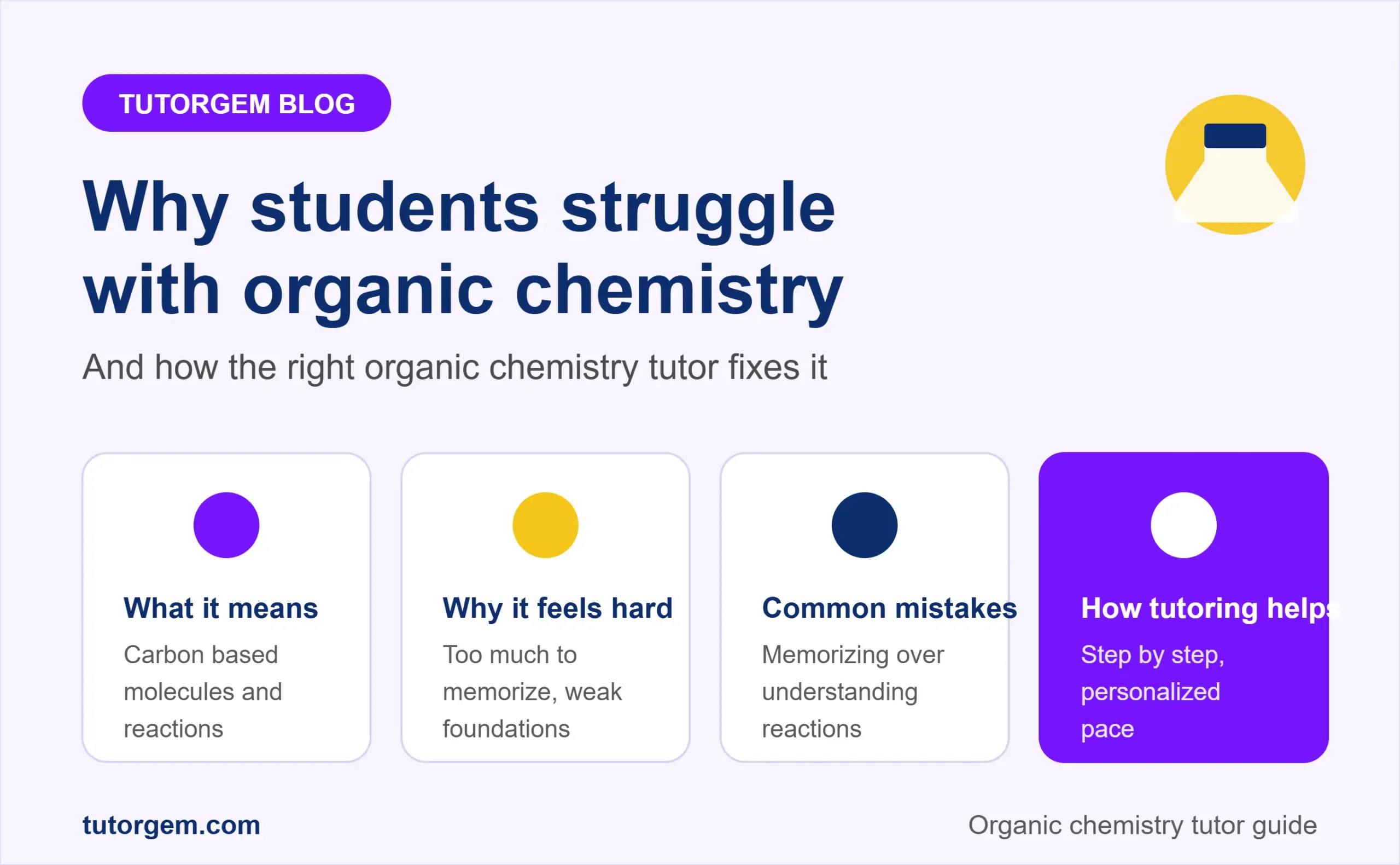
Organic chemistry is the study of carbon based compounds. Carbon forms the backbone of every living thing on Earth, from proteins to DNA to the plastic on your desk.
This branch of chemistry explains how carbon atoms bond, break apart, and rearrange to form new substances. Students learn how molecules react under different conditions and why certain reactions happen faster than others.
The Building Blocks of Organic Chemistry
Every course starts with functional groups, hydrocarbons, and bonding patterns. Functional groups act like molecular fingerprints. They tell you how a compound will behave in a reaction.
| Core Concept | What It Covers | Why It Matters |
| Functional groups | Alcohols, aldehydes, ketones, carboxylic acids | Predicts reactivity |
| Nomenclature | IUPAC naming rules | Universal chemical language |
| Reaction mechanisms | Electron movement, arrow pushing | Explains why reactions happen |
| Stereochemistry | 3D molecular shape | Affects drug design and biology |
| Spectroscopy | NMR, IR, Mass Spec | Identifies unknown compounds |
Learning to spot these patterns early saves hours of confusion later in the semester.
Why So Many Students Find Organic Chemistry Hard?
Students often say organic chemistry feels like learning a new language overnight. This comparison is accurate. The course introduces hundreds of new terms, symbols, and reaction types within a few weeks.
Unlike algebra, organic chemistry rarely gives one fixed answer. A single molecule can react in several different ways depending on conditions. This flexibility confuses students used to strict, formula based subjects.
The Memory Overload Problem
Many students try to memorize every reaction separately. This approach fails quickly because the subject contains too many reactions to memorize one by one.
Organic chemistry actually follows patterns of electron behavior. Once a student understands why a reaction happens, similar reactions become predictable instead of new.
A Weak Foundation in Basic Chemistry
Students who struggled with atomic structure, bonding, or acid base concepts in general chemistry carry that gap into organic chemistry. The subject builds directly on these earlier ideas.
Without a solid base, new topics pile up faster than a student can process them, and the gap widens every week.
A Real Example: How Small Changes Fixed a Big Problem
One tutoring case involved a second year pre-med student who had failed organic chemistry once already. She had memorized over 60 reactions but could not answer a single exam question that changed the wording.
Her tutor rebuilt her study method around electron pushing arrows instead of memorized steps. Within five weeks, she raised her exam average from 58 percent to 84 percent. The shift came from understanding mechanisms, not from studying longer.
This pattern repeats across thousands of students. The problem is rarely intelligence. It is method.
Common Mistakes Students Make While Learning Organic Chemistry
Many learners jump into complex reactions without mastering the basics first. This creates confusion that spreads through the entire course.
Some students also avoid practice problems and rely only on reading notes. Organic chemistry is a skill subject, closer to learning music than memorizing history dates.
Memorizing Instead of Understanding
Students frequently memorize reaction steps without asking why each step happens. When an exam question changes the wording slightly, memorized answers fall apart.
Understanding electron movement and molecular stability solves this problem permanently and makes new topics easier to absorb.
How an Organic Chemistry Tutor Makes the Subject Easier
A skilled organic chemistry tutor breaks down complex reactions into simple, logical steps. Instead of memorizing hundreds of reactions, students learn the underlying rules that connect them.
Working with an organic chemistry tutor also gives students a safe space to ask basic questions without embarrassment, something that rarely happens in a packed lecture hall. TutorGem’s chemistry tutoring programs are built around this exact method, focused on mechanism based learning rather than rote memorization.
Personalized Learning at Your Own Pace
Every student learns differently. Some need extra time on mechanisms, while others struggle more with nomenclature or stereochemistry. A tutor adjusts pace based on individual needs.
This personalized approach builds real understanding instead of rushing through topics just to keep up with a fixed classroom schedule.
Simple Tips to Study Organic Chemistry Better
Draw every reaction by hand instead of just reading it. The physical act of drawing molecules improves memory and recognition during exams.
Group similar reactions by mechanism type, such as substitution or elimination. This method reduces the total number of things a student needs to remember.
Practice With Real Reactions Daily
Consistency matters more than long study sessions. Practicing a few reactions daily builds stronger recall than cramming the night before a test.
Past papers and topic based questions help identify weak areas early, giving enough time to fix them before exams arrive.
Frequently Asked Questions
Is organic chemistry harder than physics?
Both subjects challenge students differently. Organic chemistry demands pattern recognition and spatial reasoning, while physics relies more on mathematical problem solving.
How long does it take to understand organic chemistry?
With consistent practice and proper guidance, most students see noticeable improvement within four to six weeks.
Why do so many students fail organic chemistry?
Most failures come from memorizing reactions instead of understanding electron movement and reaction mechanisms.
Can online tutoring help with organic chemistry?
Yes. Online sessions let students revisit recorded lessons, practice at their own pace, and get instant feedback on mistakes.
What is the best way to memorize organic chemistry reactions?
Understanding the reasoning behind a reaction works better than pure memorization, since it lets students predict similar reactions confidently.
Organic chemistry does not have to feel impossible. Thousands of students have turned a failing grade into an A simply by changing how they study, not how much they study. If you want that same shift without wasting another semester guessing, book a free consultation with a TutorGem organic chemistry tutor and start learning the subject the way it was meant to be taught.