Why Students Struggle With A-Level Economics and How to Fix It?
You revise for hours. You know the definitions. Your essay still comes back with a middle grade.
This is the most common story in Economics. Most students have the knowledge but lose marks on how they use it. TutorGem’s A-level tutoring sees this pattern again and again.
This guide shows why students struggle with A-Level Economics, where the marks actually go, and a simple fix for each problem.
What Makes A-Level Economics Harder Than It Looks
Economics mixes theory, diagrams, data, and essay writing in one paper. Each skill is marked differently.
Students who only memorize definitions often stall at a middle grade.
What the Latest Data Shows
About 41,880 students sat A-Level Economics in 2025, up 5.6 percent on 2024, according to JCQ provisional entry figures. Growing numbers mean more competition for top grades.
In AQA A-Level Economics, 28.0 percent earned A* or A in 2025, rising to 29.5 percent in 2026, based on JCQ data analyzed by tutor2u. Top grades are possible, but they go to students who master technique.
Why Students Struggle With A-Level Economics: The Real Causes
Most lost marks trace back to a small set of skills. Fix these and your grade moves.
Weak Evaluation
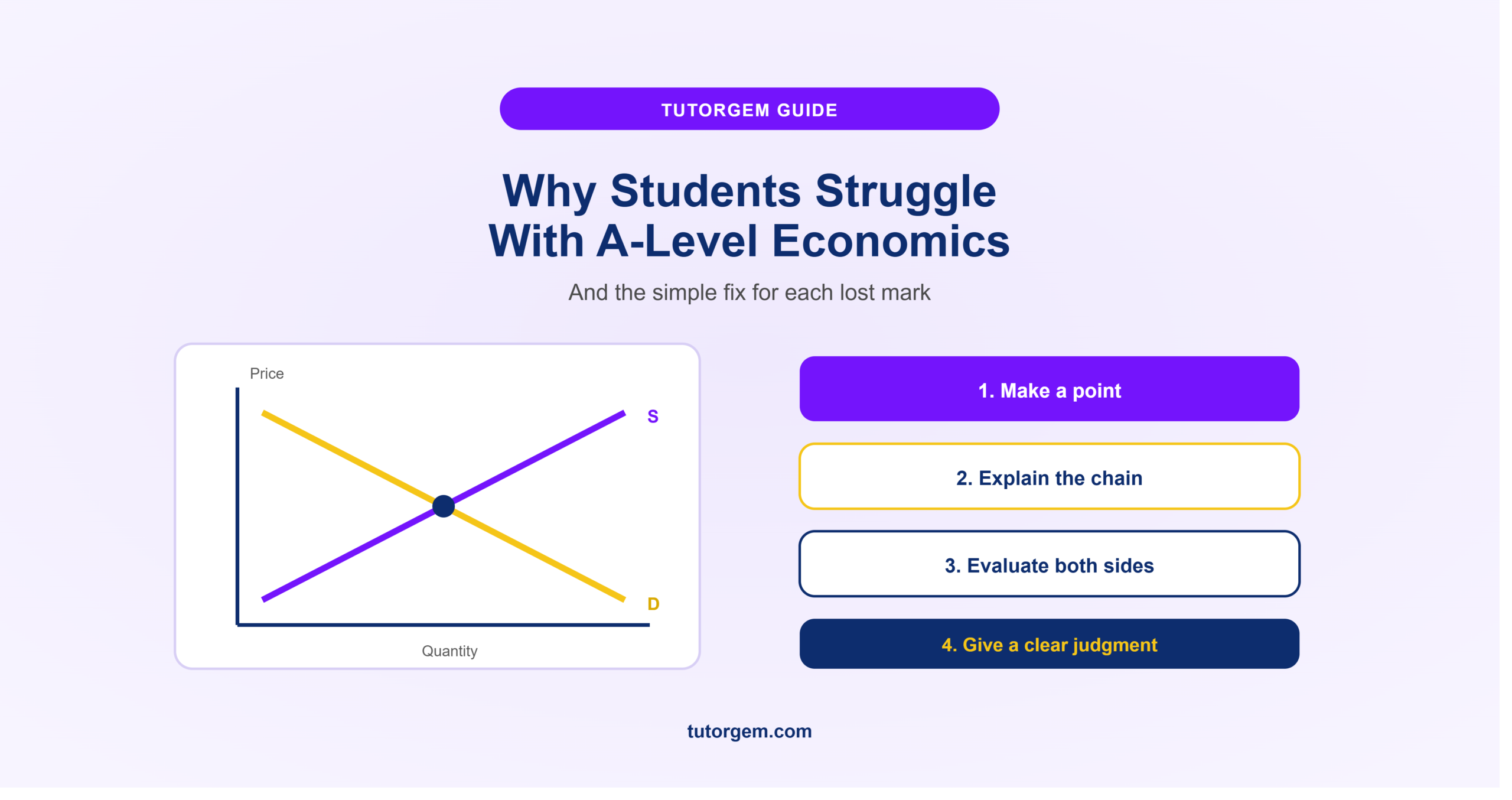
Mark schemes reward knowledge, application, analysis, and evaluation. Evaluation is the top level, and most students skip it.
A strong answer weighs both sides and ends with a clear judgment. A weak answer just lists points.
Diagrams and Data Questions
Many students draw diagrams but do not explain them. Others misread data or make small percentage errors.
| Skill | What Examiners Want | Common Mistake |
|---|---|---|
| Analysis | A clear chain of reasoning | Jumping straight to the conclusion |
| Evaluation | Both sides weighed, then a judgment | Listing points with no verdict |
| Diagrams | Labeled, then explained in words | Drawing without explaining |
| Data questions | Exact figures used in the answer | Describing trends without numbers |
A Real Case: From Knowledge to Judgment
One TutorGem student in Dubai held a strong grasp of theory but kept getting a C on essays. Her answers were full of correct facts.
Her tutor found the gap quickly. She never ended an essay with a judgment, so she missed the top mark levels.
After eight weeks of practicing short judgment paragraphs, her practice essays rose to a B, then an A. Her knowledge stayed the same. Her technique changed.
How to Fix Each Problem
Practice one skill at a time instead of rewriting whole essays. Short, focused drills work faster.
For evaluation, finish every paragraph with a “however” point and a final verdict. For diagrams, write two sentences explaining every curve shift.
Questions to Ask After Every Essay
Did I reach a clear judgment? Did I use numbers from the data? Did I explain every diagram in words?
These three checks catch most lost marks.
How a Tutor Helps
A tutor marks your essays against the real mark scheme and shows exactly which level you reached. This turns vague feedback into a clear plan.
TutorGem’s online tutoring matches you with a specialist for your exam board, whether you study in the UK, UAE, or Pakistan.
Frequently Asked Questions
Is A-Level Economics hard?
It is demanding because it mixes essays, diagrams, and data. Most students struggle with evaluation, not the content.
How do I get an A in A-Level Economics?
Master analysis chains and clear judgments, and practice timed essays against the mark scheme.
Do I need strong maths for Economics?
Basic skills like percentages and elasticity are enough. Accuracy matters more than advanced maths.
Which exam boards offer Economics?
AQA, Edexcel, OCR, and Cambridge International all offer it, with different paper structures.
Can a tutor help with Economics essays?
Yes. A tutor can mark essays against the band descriptors and fix your technique quickly.
Knowing why students struggle with A-Level Economics turns a vague worry into a fixable list. If your essays keep stalling at the same grade, TutorGem’s tutors can review your work this week and show you exactly where the marks are slipping away.