IB Chemistry HL vs SL: What’s the Real Difference?
Trying to decide between Higher Level and Standard Level chemistry and worried one wrong choice could affect your university offer? You are asking the right question at the right time.
The honest answer is that IB chemistry HL vs SL comes down to depth, not difficulty of concepts alone. Both levels share the same core framework, but HL adds significantly more content, longer exam papers, and a faster teaching pace.
This guide breaks down the real 2025 syllabus differences, shares actual grade data, and helps you choose the level that matches your university goals rather than just what feels impressive on paper.
What IB Chemistry Actually Involves
IB chemistry sits within Group 4 of the Diploma Programme, alongside biology and physics, and combines theoretical understanding with practical laboratory work. Every student completes an Internal Assessment, a hands on scientific investigation marked separately from the written exams.
Both HL and SL students study the same foundational topics, then HL students continue into additional material that goes deeper into each theme.
Structure and Reactivity: The New 2025 Framework
The IB redesigned the chemistry syllabus for first assessment in May 2025, replacing the old topic based structure with two unifying strands called Structure and Reactivity. This framework focuses on how matter is organized at the atomic level and how substances interact and transform.
This change reduced overall content volume compared to the older syllabus, allowing more classroom time for building genuine conceptual understanding rather than memorizing isolated facts.
IB Chemistry HL vs SL: The Core Differences
Both levels share identical core concepts and the same Internal Assessment structure. The real distinction between IB chemistry HL vs SL lies in how much additional depth HL students must master within each topic.
Teaching Hours and Content Depth
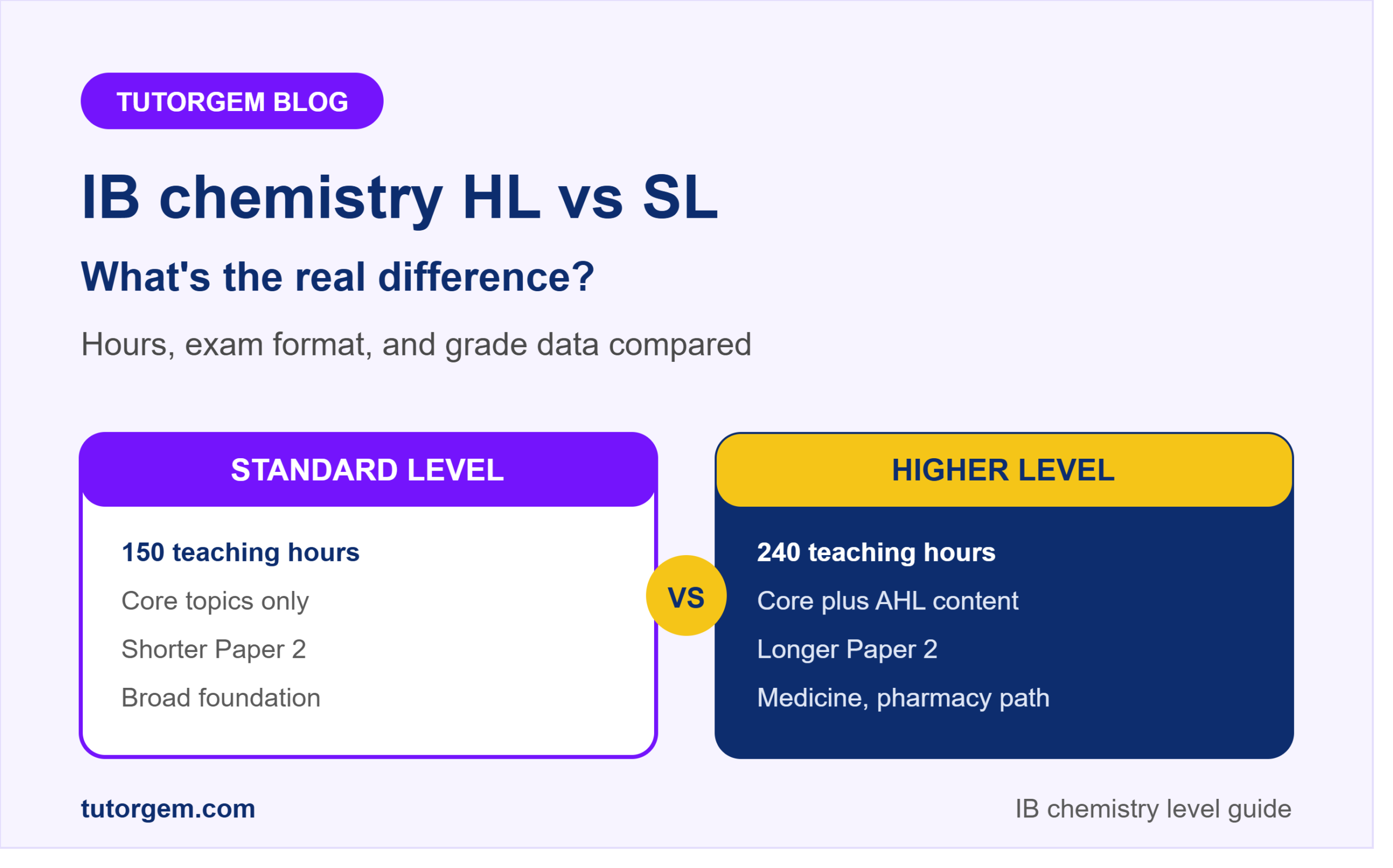
Standard Level chemistry typically covers around 150 hours of teaching, while Higher Level extends to roughly 240 hours once Additional Higher Level content is included. This extra material covers topics like Born-Haber cycles, buffer solution calculations, and multi-technique spectroscopy problems that do not appear at SL.
| Feature | Standard Level (SL) | Higher Level (HL) |
|---|---|---|
| Teaching hours | Approximately 150 | Approximately 240 |
| Exam papers | Paper 1 and Paper 2 | Paper 1, Paper 2, longer format |
| Additional content | Core topics only | Additional Higher Level (AHL) material |
| Internal Assessment | Same requirement as HL | Same requirement as SL |
| Typical suitability | General science foundation | Chemistry, medicine, or engineering bound students |
Exam Papers and Assessment Format
Both levels sit multiple choice and structured question papers, but HL students face a longer Paper 2 that tests the additional depth covered in AHL material. The extra length means HL exams demand stronger time management alongside stronger content knowledge.
This distinction matters most for students considering competitive university courses, since admissions teams often view HL as a meaningfully different academic signal compared to SL.
How Difficult Is IB Chemistry Really?
IB chemistry consistently ranks among the more demanding Diploma Programme science subjects, largely due to its blend of mathematical calculation and abstract conceptual thinking.
What the Grade Data Shows
According to recent IB subject data, the average IB chemistry score across both levels sits between 4.2 and 4.7 out of 7, with only around 4 percent of students achieving the top grade of 7. A score of 5 or above is generally considered strong, while a 4 is viewed as satisfactory.
This data confirms that strong preparation genuinely separates top scoring students from the average, regardless of whether they study HL or SL.
A Real Case: Choosing the Wrong Level and Fixing It
One TutorGem student enrolled in HL chemistry aiming for a competitive pharmacy program, but struggled significantly with the pace during the first term, particularly with AHL organic mechanisms and calculation heavy topics.
His tutor built a structured catch up plan focused specifically on the additional HL content, paired with weekly past paper practice under timed conditions. By the end of the year, his predicted grade rose from a 4 to a 6, allowing him to stay on his intended HL path rather than downgrading to SL.
This case shows that struggling with HL pace does not always mean switching levels is necessary. Often, targeted support closes the gap faster than changing the entire academic plan.
How to Decide Between HL and SL Chemistry
Choosing HL simply because it looks impressive on a university application, without genuine interest or strong foundational skills, often backfires under real exam pressure.
Questions to Ask Before You Choose
Consider whether your intended university course requires HL chemistry specifically, since many science and medical programs list this as an entry requirement rather than a preference. Also honestly assess your comfort with mathematical calculation, since HL leans more heavily on this than SL.
How an IB Chemistry Tutor Helps You Prepare
A dedicated IB chemistry tutor identifies exactly which topics need extra attention, whether that means reinforcing SL fundamentals or catching up on demanding AHL content. This targeted approach works far better than a generic revision plan built for an entire class.
TutorGem’s chemistry tutoring programs support students across IB, IGCSE, and A-level curricula, helping families navigate exactly this kind of level choice with experienced subject specialists. According to the International Baccalaureate Organisation itself, past papers from the updated syllabus remain the closest available match to real exam content, making structured practice essential regardless of chosen level.
Frequently Asked Questions
Is IB chemistry HL harder than A-level chemistry?
Both are demanding, though IB HL chemistry generally covers a broader range of topics within a shorter overall timeframe compared to the two year A-level structure.
Can I switch from HL to SL chemistry partway through the Diploma Programme?
Switching is possible in some schools during the first year, though policies vary, so speaking with your IB coordinator early is essential if you are considering this option.
Do all universities require HL chemistry for science degrees?
Not all universities require HL specifically, though highly competitive courses like medicine and pharmacy often list it as a firm entry requirement rather than a suggestion.
How many teaching hours does HL chemistry add compared to SL?
HL chemistry adds roughly 90 additional teaching hours through Additional Higher Level content, covering topics not included in the SL curriculum.
What score is considered good in IB chemistry?
A score of 5 or above is generally considered strong, while scores of 6 or 7 place a student among the top performers in the subject.
Deciding on IB chemistry HL vs SL should reflect your university goals and genuine comfort with mathematical depth, not just how the choice looks on paper. If you are unsure which level fits your situation, or already feel behind in your current course, TutorGem’s experienced IB chemistry tutors can assess your exact gaps this week and build a plan that keeps your original academic goals within reach.