AS Level and A Level Physics: Curriculum and Content Compared
Physics students often notice the same pattern chemistry students do. AS-Level feels manageable. Then the second half of A-Level arrives, and the maths, the depth, and the exam expectations all jump at once.
AS level and A level physics difference is actually documented precisely in how Cambridge structures its papers and content, not just a vague sense that things got harder. Once you see the actual topic split and mark weighting, the jump makes complete sense.
This guide breaks down exactly what AS-Level Physics covers, what full A-Level adds, and how the five-paper Cambridge structure reflects that growing depth. Read this before you plan your revision schedule.
How Cambridge Structures AS Level and A Level Physics (9702)
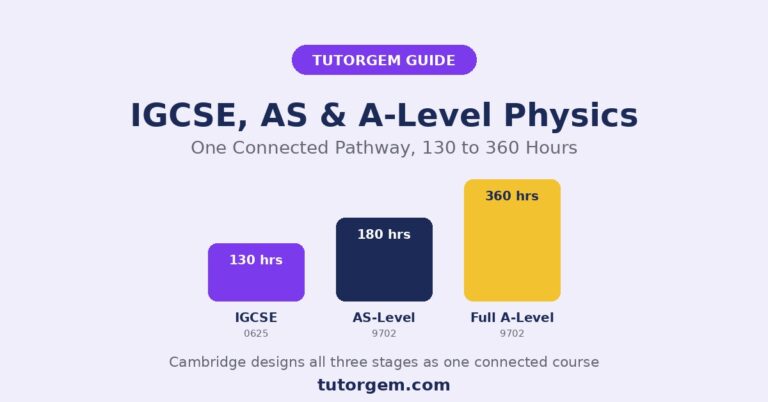
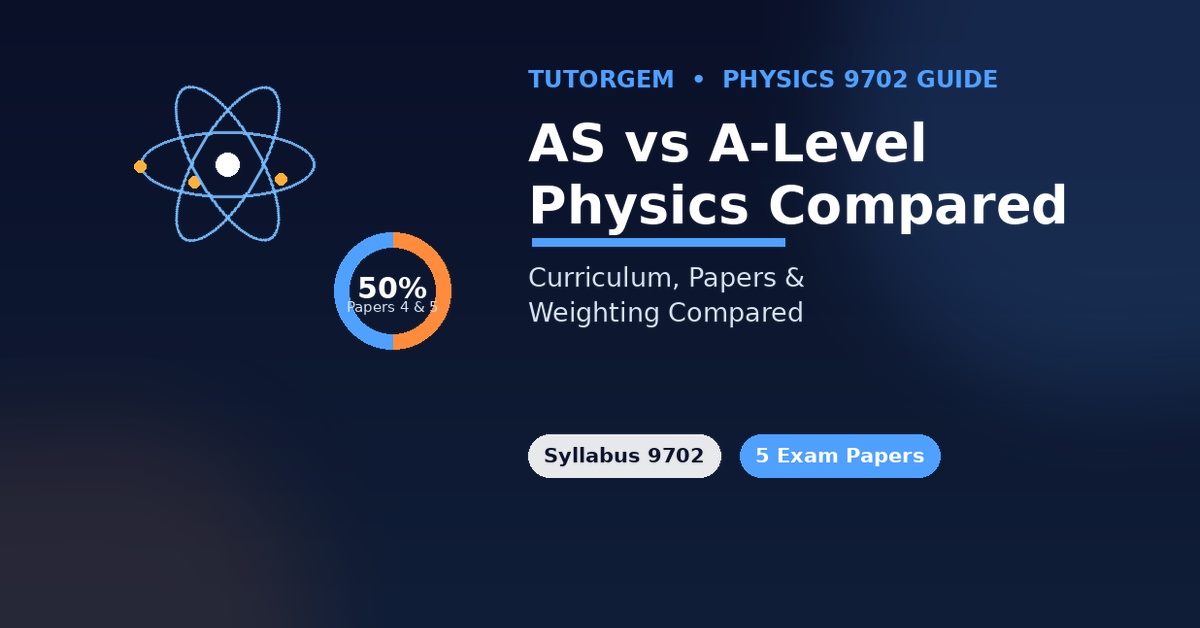
Cambridge International AS Level and A Level Physics, syllabus code 9702, splits its five-paper assessment cleanly between AS content in Papers 1 to 3, and the second half of A-Level content in Papers 4 and 5.
What AS-Level Physics Actually Covers
AS content covers:
- Physical quantities and units
- Measurement techniques, including uncertainty analysis
- Kinematics, dynamics, and forces
- Work, energy, and power
- Deformation of solids
- Waves and superposition
- Electricity and D.C. circuits
- An introduction to particle and nuclear physics
What Full A-Level Adds on Top of the AS Foundation
The second half of A-Level introduces:
- Circular motion
- Gravitational, electric, and magnetic fields
- Capacitance
- Oscillations
- Thermodynamics and ideal gases
- Quantum physics
- More advanced nuclear physics
Some centres also offer medical physics or astrophysics options at this stage.
Topic Comparison Table: AS vs Full A-Level Content
The following is the comparison table of AS level and A level physics on the basis of their content:
| Physics Branch | AS-Level Content | A-Level Additional Content |
|---|---|---|
| Mechanics | Kinematics, dynamics, forces, work, energy, power | Circular motion |
| Fields | Not covered | Gravitational, electric, and magnetic fields, capacitance |
| Waves and Oscillations | Waves and superposition | Oscillations in depth |
| Thermal and Modern Physics | Basic particle and nuclear physics | Thermodynamics, ideal gases, quantum physics, advanced nuclear physics |
| Electricity | D.C. circuits | Extended circuit applications within field topics |
How the Five Exam Papers Reflect the AS Level and A Level Physics Split?
The paper structure itself confirms exactly how the weighting shifts once the second half of A-Level content enters the picture. Paper 1, the multiple-choice paper testing AS content, carries 31% of a standalone AS-Level award but only 15.5% once it’s factored into the full A-Level.
Paper 2, the AS structured questions paper, similarly drops from 46% of AS-Level down to 23% of the full A-Level. Papers 4 and 5, which test the second half of A-Level content exclusively, make up exactly 50% of the full A-Level between them, structured questions carrying 38.5% and the planning, analysis, and evaluation paper carrying 11.5%.
The following table highlights the difference between the over all weightage of AS Level and A-Level physics exams:
| Paper | Content Tested | Weight at AS-Level | Weight at Full A-Level |
|---|---|---|---|
| Paper 1: Multiple Choice | AS content | 31% | 15.5% |
| Paper 2: AS Structured Questions | AS content | 46% | 23% |
| Paper 3: Advanced Practical Skills | AS content | 23% | 11.5% |
| Paper 4: A Level Structured Questions | Second-half content | Not applicable | 38.5% |
| Paper 5: Planning, Analysis and Evaluation | Second-half content | Not applicable | 11.5% |
Why the Second Half of A-Level Physics Feels Like a Genuine Jump?
It is not simply AS physics with harder numbers. It introduces entirely new conceptual territory, particularly fields and quantum physics, where intuition built from mechanics and waves doesn’t transfer directly.
Students frequently describe the jump into field theory specifically as the point where A-Level physics stops feeling like an extension and starts feeling like a new subject.
Practical Skills Run Through Every Stage Differently
AS-Level assesses practical skills through Paper 3, a dedicated Advanced Practical Skills paper worth 23% of the AS award. At full A-Level, that practical weighting effectively continues through Paper 5, which shifts focus toward planning, analysing, and evaluating experimental methods, rather than just executing them.
A Realistic Example From TutorGem Sessions
One TutorGem student scored well across AS-Level Physics, confident with mechanics and waves. Once fields and quantum physics began, the same student struggled initially, not from weak effort, but because these topics genuinely don’t build on prior intuition the way mechanics builds on itself.
Reframing fields as a fresh topic, rather than an extension of AS mechanics, changed how the student approached revision entirely.
Common Mistakes Students Make Across the Two Stages
- Assuming AS mechanics knowledge alone prepares you for fields, when field theory needs its own conceptual foundation
- Underestimating how much Papers 4 and 5 count, since together they decide exactly half of the final grade
- Treating Paper 5 as “just more practical work,” when it specifically rewards planning and evaluation skills, not just carrying out experiments
How TutorGem Supports Students Through the Physics Transition
TutorGem’s physics tutors map revision directly onto the 9702 paper structure, making sure AS mechanics and waves are genuinely solid before the second half of A-Level, fields and quantum physics, builds on top of them. Since Papers 4 and 5 alone make up half of the full A-Level weighting, getting that preparation right matters as much as, if not more than, AS itself.
Frequently Asked Questions
What is the main AS level and A level physics difference in content?
AS-Level Physics covers mechanics, waves, D.C. circuits, and introductory particle physics. The second half of A-Level adds fields, capacitance, oscillations, thermodynamics, and quantum physics, tested through Papers 4 and 5, which together make up half of the full A-Level weighting.
Is the second half of A-Level physics harder than AS physics?
Many students find it genuinely harder, since it introduces new conceptual areas like field theory and quantum physics rather than simply extending AS content at a higher difficulty.
How many exam papers does Cambridge Physics 9702 have?
Cambridge Physics 9702 uses five papers in total, with Papers 1 to 3 assessing AS content and Papers 4 and 5 assessing the second half of A-Level content exclusively.
Does AS Physics content still matter once I reach the second half of A-Level?
Yes, significantly. Topics like circular motion and fields build directly on AS mechanics, so weak AS foundations tend to resurface as difficulty once that stage begins.
What new topics appear only in the second half of A-Level Physics?
The second half introduces gravitational, electric, and magnetic fields, capacitance, oscillations, thermodynamics, ideal gases, and quantum physics, none of which appear in the AS content.
Understanding exactly how AS Level and A-Level physics content and paper weighting connect makes the transition between them far less overwhelming. If you want a revision plan built around the specific AS foundations your later topics depend on, TutorGem’s physics tutors can map that out with you.