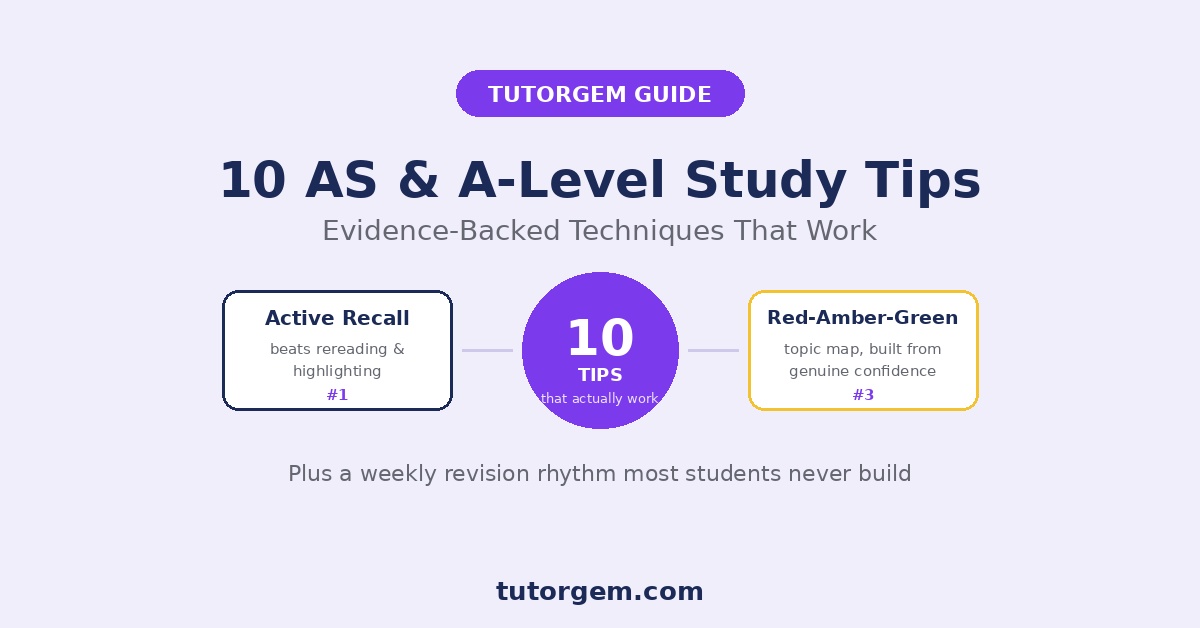
10 AS Level A Level Study Tips for Exam Success
Most revision advice amounts to “work harder,” not “work smarter.” Students spend hours rereading notes and highlighting textbooks, then wonder why the information doesn’t show up in the exam hall.
AS Level A Level study tips that actually work come down to a small number of evidence-backed techniques, not endless hours logged at a desk. A 2013 review published in Psychological Science in the Public Interest found that rereading and highlighting, the two most common study habits, are among the least effective techniques available.
This guide covers ten specific, usable tips, including a weekly study structure most students never build for themselves. Read this before your next revision session, not after another week of rereading notes that don’t stick.
1. Replace Rereading With Active Recall
Active recall means pulling information out of your head, not putting more in. Cover your notes and write down everything you remember, then check what you missed. This single switch, from recognition to retrieval, is the most consistently supported revision technique in the research.
2. Use Spaced Repetition Instead of Cramming
Spacing your revision across weeks beats cramming the night before, every time. Each time you successfully recall something, the next useful review point stretches further out. This matches how the brain’s forgetting curve actually works, reviewing material right before you’d naturally forget it, rather than endlessly rereading it fresh.
3. Map Your Syllabus With a Red, Amber, Green System
Most students revise whatever feels familiar, not what actually needs attention. Go through your exam board’s specification and rate every topic red, amber, or green based on genuine confidence, not how recently you covered it in class.
This single step turns a vague “I should revise everything” into a concrete, prioritised list, red topics first, amber topics maintained, green topics checked only occasionally.
4. Treat Past Papers as Practice, Not Preview
Many students use past papers just to see what the exam looks like. That’s a weaker use of a powerful tool. Past papers work best as full retrieval practice, timed and closed-book, forcing the same recall pressure as the real exam.
Build Up to Full Timed Conditions Gradually
Start with individual questions, untimed, to learn the format. Move to full papers under timed conditions only once you’re comfortable with the content itself, not before.
5. Mark Strictly Against the Real Mark Scheme
Marking your own past paper generously defeats the entire purpose of the exercise. Use your exam board’s actual mark scheme, not your own judgement of whether an answer “sounds right.” This reveals genuine gaps that a lenient self-mark would hide completely.
6. Keep a Running Error Log
Every past paper session should produce a specific list of exactly where marks were lost. That list becomes your next round of targeted retrieval practice. Without it, the same mistakes tend to repeat across multiple papers without ever being directly addressed.
7. Learn Command Words Like Separate Vocabulary
“Evaluate,” “analyse,” “compare,” and “justify” each demand a genuinely different kind of answer, and losing marks for answering the wrong command word is one of the most avoidable mistakes in both essay subjects and the sciences.
Build a simple answer structure for each command word type. In the sciences, this might mean knowing exactly which command words require a named example versus a general explanation. In essay subjects, it means knowing when an answer needs balanced argument rather than straightforward description.
8. Build a Weekly Revision Rhythm, Not a Random Schedule
This is the part most revision guides skip entirely: a concrete weekly structure, not just a list of techniques. A workable weekly pattern per subject looks like:
- Two retrieval sessions: one early in the week with no notes, cold recall, and one mid-week targeting exactly what the first session revealed as weak
- One past paper session: timed, closed-book, marked against the real scheme
- Spaced revisits: older topics get brief, scheduled review, newer topics get deeper focus
Rotating subjects through this same rhythm each week keeps progress visible instead of vague.
9. Study in Short, Focused Blocks
Marathon study days feel productive but rarely are. Shorter blocks, often 25 to 50 minutes with a genuine break between them, maintain focus better than long unbroken sessions. The specific length matters less than the consistency of taking real breaks rather than pushing through fatigue.
10. Protect Sleep and Physical Wellbeing
Burnout undermines every technique on this list. Sleep consolidates memory in ways no amount of extra revision time can replace, and regular physical activity measurably supports concentration during study sessions themselves. Treating wellbeing as optional, rather than part of the revision plan, tends to backfire in the final weeks before exams.
A Realistic Example From TutorGem Sessions
One TutorGend student was spending nearly every evening rereading Chemistry notes, convinced that more hours meant more progress. Switching to the weekly rhythm above, two retrieval sessions plus one past paper session, cut total revision time while actual past paper scores improved within three weeks.
Common Mistakes Students Make With Revision
- Confusing familiarity with learning, since rereading creates recognition, not genuine recall
- Treating all topics equally, rather than prioritising red-rated weak areas first
- Self-marking past papers generously, which hides exactly the gaps that need the most attention
How TutorGem Supports Students With Exam Preparation
TutorGem’s tutors help students build the RAG topic map, structure weekly retrieval sessions, and mark past papers strictly against real mark schemes, turning general revision advice into an actual weekly system.
Frequently Asked Questions
What are the most effective AS Level A Level study tips?
Active recall and spaced repetition are the two most consistently supported techniques, according to a widely cited 2013 review in Psychological Science in the Public Interest, which found both significantly outperform rereading and highlighting.
How often should I do past papers before exams?
One timed, closed-book past paper per subject per week works well as a baseline, increasing closer to exams once core content confidence is in place.
What is a Red, Amber, Green topic map?
It’s a simple system for rating every syllabus topic by genuine confidence level, red for weak, amber for shaky, green for solid, so revision time goes toward what actually needs it rather than what feels familiar.
Why do command words matter so much in A-Level exams?
Words like evaluate, analyse, and compare each require a different type of answer. Misreading the command word is one of the most avoidable ways to lose marks, even with strong subject knowledge.
Is cramming the night before ever effective?
Spaced revision across weeks consistently outperforms cramming, since each successful recall extends how long information stays accessible, something a single late-night session can’t replicate.
Building real AS Level A Level study tips into a weekly system, not just a list of good intentions, is what actually moves exam results. If you want help structuring a revision rhythm around your specific weak topics, TutorGem’s tutors can build that plan with you.