Private Candidate vs School Candidate: Key Differences
Most guides on this topic tell you the qualification is identical either way, then stop there. It is identical on the certificate. It is not identical in the actual process of getting one, and that gap catches families off guard more than any registration deadline.
Private candidate vs school candidate comparisons usually focus on registration logistics. The parts that genuinely affect a student’s experience, predicted grades, university applications, and day-to-day support, get far less attention than they deserve.
This guide covers the real differences that matter beyond “same exam, different entry route,” including one university application friction point almost nobody mentions. Read this before deciding which route fits your situation.
The Basic Difference, Covered Quickly
A school candidate is registered by their school, which acts as the exam centre, handles payment, and submits results. A private candidate, also called an external candidate, registers independently through an approved centre that accepts candidates not enrolled there.
The qualification itself is identical. Private candidates sit the same papers, follow the same syllabus, and receive the same certificate as school-based students. This part, at least, every guide gets right.
Who Actually Chooses the Private Candidate Route
Private candidature suits a specific range of situations, not just students who performed poorly the first time:
- Homeschooled students with no local school offering the syllabus
- Students whose school doesn’t offer a specific subject or exam board they want
- Adults returning to education years after leaving school
- Students resitting a subject without wanting to re-enrol in a full course
- Families facing financial or logistical constraints that make traditional schooling difficult
Predicted Grades: The Difference Most Guides Skip Entirely
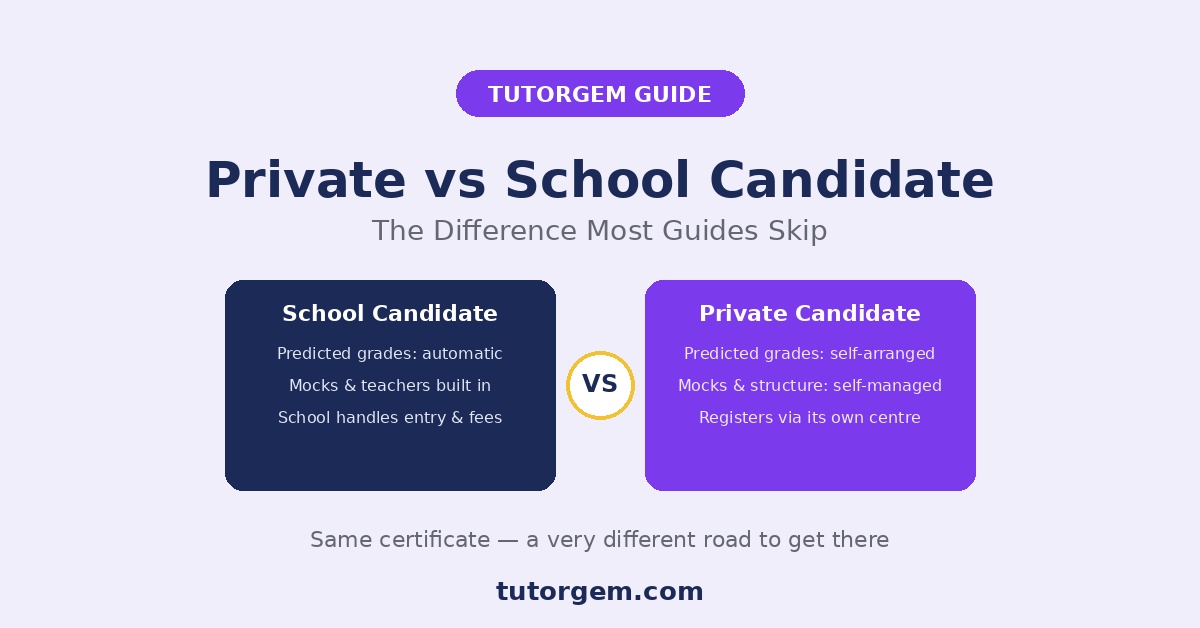
This is the single biggest practical gap between the two routes, and it rarely gets mentioned. School candidates receive predicted grades automatically, generated by teachers who’ve taught them for months or years, as a standard part of the university application process.
Private candidates have no equivalent built-in source. Predicted grades typically need to come from a tutor, the exam centre, or be arranged separately, which adds a genuine extra step school candidates never think about.
University Applications: What Actually Happens in Practice
Universities state clearly that private and school qualifications carry equal academic weight. In practice, students who’ve gone through the private route describe a different experience.
One former private candidate, now studying at university, described being asked by admissions staff for “clarification about my status as a private candidate, which meant providing additional explanation and documents.” This doesn’t mean private candidates face discrimination. It means the application process can involve extra administrative steps that school candidates simply never encounter, since schools handle references and context automatically.
Support Structure: What You Gain and What You Lose
What School Candidates Get Automatically
- Daily access to subject teachers
- Internal mock exams that track progress
- A structured timetable set by the school
- Peer study groups built into the school day
What Private Candidates Must Arrange Themselves
- No default access to teachers, tutoring must be sought out independently
- No internal mocks, progress tracking becomes self-managed or tutor-managed
- Full control over pacing and timetable, which suits some students and overwhelms others
Subject Access and Practical Restrictions
Private candidates face real restrictions that school candidates don’t. Subjects with coursework or centre-supervised practical components are often unavailable or significantly harder to arrange privately, since that assessment needs ongoing supervision an external candidate typically can’t access.
Core subjects with fully written exams, Mathematics, many Sciences with an alternative-to-practical option, and most humanities, tend to remain fully accessible either way.
Cost Comparison
Fees work differently, not necessarily cheaper, for private candidates. School candidates typically pay bundled fees covering tuition and exam entry together. Private candidates pay the exam board fee plus the centre’s own administration fee separately, and if they want tutoring support, that’s an additional cost on top.
For families specifically avoiding full-time school fees, private candidature can still work out more affordable overall, but it isn’t automatically cheaper once tutoring and admin fees are accounted for.
A Realistic Example From TutorGem Sessions
One TutorGem student moved from a school-based IGCSE track to private A-Level candidature for financial reasons. The biggest adjustment wasn’t the exam content itself, it was building a structure that replaced daily school routine: a fixed weekly tutoring schedule, self-set mock exam dates, and a plan for securing predicted grades through the tutor rather than a school.
Common Mistakes Students Make When Choosing a Route
- Assuming “equal qualification” means “equal process,” when predicted grades and application support genuinely differ
- Underestimating the self-management private candidature demands, without lectures, mocks, or built-in structure
- Choosing subjects with coursework components without checking private candidate availability first
How TutorGem Supports Both Routes
TutorGem works with school candidates needing extra subject support and private candidates needing full structure built from scratch, including predicted grade support and a realistic mock exam schedule that replaces what a school would normally provide.
Frequently Asked Questions
Is a private candidate qualification worth less than a school candidate one?
No. The qualification itself is identical, same syllabus, same papers, same certificate. The differences lie in the process of getting there, not the value of the result.
How do private candidates get predicted grades for university applications?
Predicted grades typically come from a tutor or the exam centre, since there’s no school-based teacher automatically providing them. This needs to be arranged separately, unlike for school candidates.
Do universities treat private candidates differently during applications?
Officially, no. In practice, some private candidates report being asked for additional clarification or documentation about their candidature status during the application process.
Can private candidates take every subject?
No. Subjects with coursework or centre-supervised practical components are often unavailable or harder to arrange privately, since that assessment needs ongoing centre supervision.
Is private candidature cheaper than being a school candidate?
Not automatically. Private candidates pay exam fees and centre administration fees separately, and often need to add tutoring costs, which can offset the savings from avoiding full school fees.
Choosing between private candidate vs school candidate routes comes down to real practical differences, predicted grades, support structure, and application logistics, not just where you sit the exam. If you want help building the structure and predicted grade support a private candidature needs, TutorGem’s tutors can put that together with you.