How to Revise for A Level Chemistry in the Last Month?
With four weeks left, rereading the whole syllabus from the start feels productive and wastes most of the time you have. The last month needs a different approach entirely, one built around where marks are actually won and lost.
A Level Chemistry last month revision works best when it’s weighted toward the papers that carry the most marks and the specific error patterns examiners flag year after year, not an even sweep across every topic regardless of importance.
This guide gives you a week-by-week plan for the final month, plus the exact mistakes that cost strong students marks every single series. Read this before you open your notes for another full reread.
Why an Even Sweep Across All Topics Wastes Your Final Month
With limited time left, not every topic deserves equal attention. Cambridge’s own paper structure for A-Level Chemistry 9701 weights content unevenly, and your revision time should match that weighting rather than ignore it.
| Paper | Content | Weight at Full A-Level |
|---|---|---|
| Paper 1 | AS multiple choice | 15.5% |
| Paper 2 | AS structured questions | 23% |
| Paper 3 | AS practical skills | 11.5% |
| Paper 4 | A-Level structured questions | 38.5% |
| Paper 5 | Planning, analysis, evaluation | 11.5% |
Paper 4 alone is worth more than Papers 1 and 3 combined. If your last month is split evenly across all five papers, you’re under-preparing for the single largest chunk of your final grade.
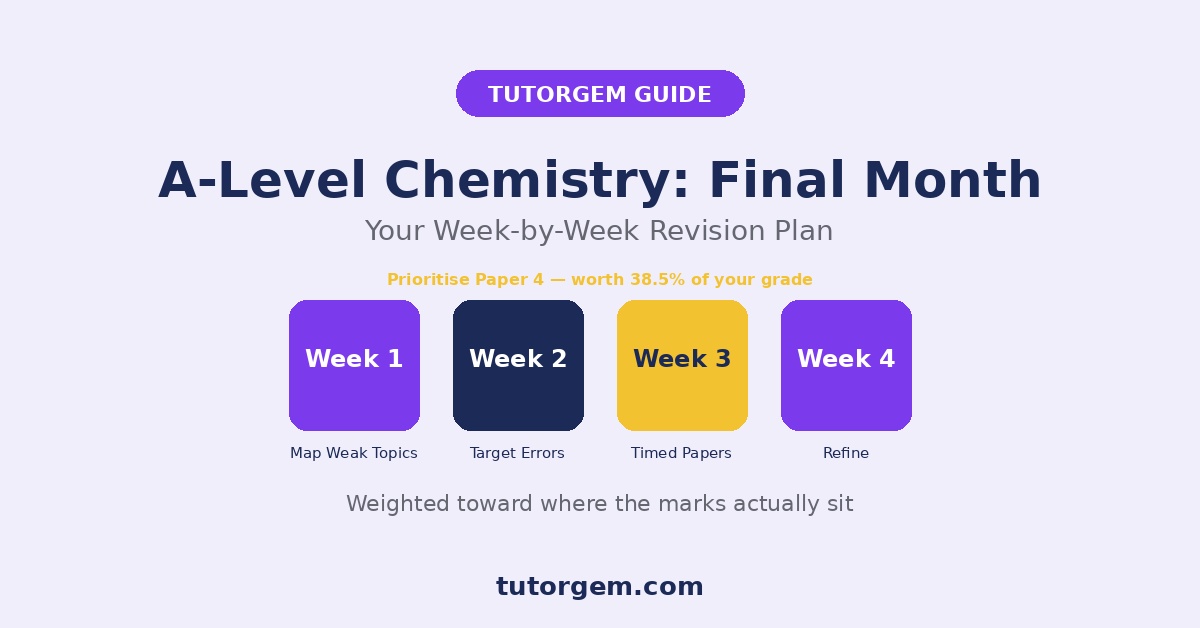
Week 1: Map Your Weak Topics Honestly
Start by rating every topic, not by how recently you covered it, but by genuine confidence. Work through your specification and mark each topic red, amber, or green. This first week is diagnostic, not content-heavy, and skipping it means guessing at priorities for the rest of the month.
Prioritise Paper 4 Topics First
Since Paper 4 carries the most weight, red-rated topics that fall under A-Level structured questions should come before anything else, even if they feel less urgent than topics you covered more recently.
Week 2: Target the Mistakes Examiners Report Every Year
This is where most last-minute revision falls short. Generic content review misses the specific, recurring errors that examiner reports flag repeatedly across series.
Organic Mechanism Precision
Organic mechanisms consistently rank among the lowest-scoring areas in examiner reports. The two most common, avoidable slips are:
- Getting the direction of the curly arrow wrong, which changes the entire meaning of the mechanism
- Forgetting to show lone pairs on the nucleophile, a small omission that costs real marks
Practising mechanism diagrams specifically, rather than just reading through them, closes this gap faster than any other single action in Week 2.
Thermodynamics and the Born-Haber Cycle
Lattice enthalpy, entropy, and free energy calculations trip up even strong students, particularly when the Born-Haber cycle ties multiple energy terms together. Practice problems with genuinely messy, non-round data, since clean textbook numbers rarely reflect what shows up in the real paper.
Electrochemistry Sign Errors
Getting the sign of the cell EMF wrong is one of the most common, entirely avoidable mistakes in electrochemistry questions. A few focused practice questions specifically checking sign conventions pays off disproportionately for the time invested.
Week 3: Full Timed Past Papers
By Week 3, shift almost entirely from content review to full, timed past papers. Treat each one as a real exam: closed book, strict time limits, no pausing to check notes mid-question.
Mark Against the Real Scheme, Not Your Own Judgement
Use the official mark scheme every time, even when an answer “feels right.” This is the only way to catch the gap between what you think you know and what you can actually demonstrate under exam conditions.
Week 4: Refine, Don’t Relearn
The final week is for sharpening technique, not absorbing new content. Revisit your error log from Weeks 2 and 3, drill the specific mistakes that kept recurring, and do one or two final timed papers under conditions as close to the real exam as possible.
Avoid introducing genuinely new topics this late. A shaky grasp of something new in the final week causes more damage than reinforcing what you already mostly know.
A Realistic Example From TutorGem Sessions
One TutorGem student, four weeks out from A-Level Chemistry, was still rereading organic chemistry notes from the beginning of the course. Switching to the weighted approach above, prioritising Paper 4 topics and drilling curly-arrow precision specifically, turned the final month into focused, measurable progress instead of unfocused repetition.
Common Mistakes Students Make in the Final Month
- Spending equal time across all five papers, when Paper 4 alone decides more of the final grade than three other papers combined
- Treating organic mechanisms as memorisation, when examiners consistently reward logical, step-by-step reasoning instead
- Introducing brand new topics in the final week, rather than refining what’s already mostly solid
How TutorGem Supports Students in the Final Month
TutorGem’s chemistry tutors build a weighted final-month plan around Paper 4’s larger share of the grade, target the specific mechanism and calculation errors examiners flag repeatedly, and run timed past paper sessions marked strictly against the real scheme.
Frequently Asked Questions
How should I prioritise topics in the last month before A-Level Chemistry?
Weight your time toward Paper 4, which carries 38.5% of the full A-Level grade, more than any other single paper, rather than spreading revision evenly across all five papers.
What are the most common mistakes in A-Level Chemistry organic mechanisms?
Getting the direction of the curly arrow wrong and forgetting to show lone pairs on the nucleophile are two of the most frequently flagged, entirely avoidable errors in mechanism questions.
Should I still do past papers in the final week?
Yes, but shift focus toward refining known weak areas from your error log rather than attempting full new content. One or two final timed papers under realistic conditions is enough.
Is it too late to improve in the last month before A-Level Chemistry?
No. A focused, weighted approach targeting high-mark papers and specific recurring errors can meaningfully improve results, even with limited time left.
Should I learn new topics in the final week before the exam?
Generally no. The final week works best for refining and drilling what you already mostly understand, since a shaky grasp of brand new content late on tends to cause more harm than good.
Getting through A Level Chemistry last month revision effectively means weighting your time toward where the marks actually sit, not spreading effort evenly across content that doesn’t carry equal weight. If you want a focused final-month plan built around your specific weak topics, TutorGem’s chemistry tutors can put that together with you.