
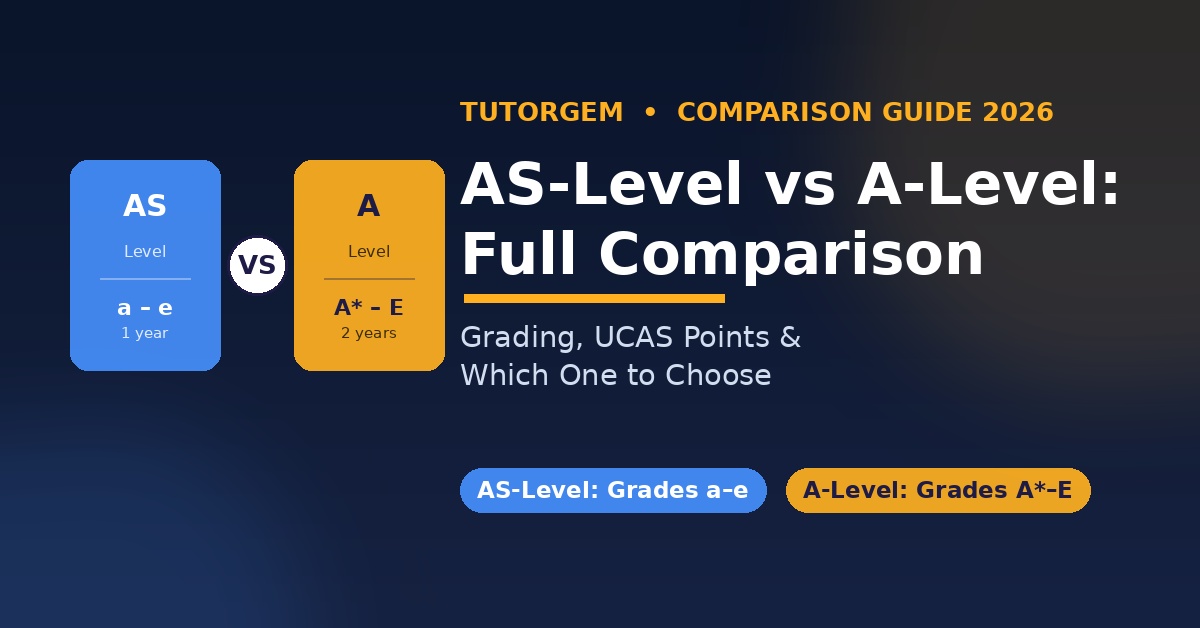
AS Level vs A Level: Full Comparison Guide (Differences, Similarities and Which One to Choose)
Most of the students assume AS Level is simply the first year of A Level. However, that assumption is only half true, and the missing half depends entirely on which exam system you’re actually following.
AS level vs A level comparisons found online frequently mix up two different systems, the UK’s domestic reform and the international Cambridge pathway. That mix-up is exactly what causes most of the confusion students run into.
This guide separates the two systems clearly, compares grading, content, and university weight, and explains which one applies to you. Read this before you make a subject decision that’s hard to reverse.
Quick Answer: The Core AS Level vs A Level Difference
Here is the short version first:
- Two different systems exist. UK domestic reform (England, since 2015) and Cambridge International work differently.
- In the UK domestic system, AS results no longer count toward a final A-Level grade at all.
- Under Cambridge International, an AS grade can still carry forward into a full A-Level within 13 months.
- There is no A at AS-Level, under any exam board, anywhere.
- Universities primarily assess full A-Level grades, though a strong AS result still adds value.
The One Confusion That Trips Up Most Students
Most generic comparison guides online describe the UK’s domestic system, which changed significantly in 2015. If you’re studying Cambridge International A-Levels outside the UK, that description doesn’t fully apply to you.
UK Domestic Reform: AS Level and A Level Are Now Separate
Since reforms introduced in England from 2015 onward, AS-Level results no longer count toward a final A-Level grade at all. A-Level became fully linear. Every topic across both years gets examined together at the end of Year 13, with no banked marks from an earlier AS sitting.
Cambridge International: AS Can Still Carry Forward
Students following Cambridge International A-Levels, common across Pakistan, the UAE, and many international schools, still have access to staged assessment. This route lets an AS grade count toward a full A-Level award if the second half is completed within 13 months. That gives international students a genuine option that domestic UK students no longer have.
AS-Level vs A-Level at a Glance
Once you know which system applies to you, the comparison becomes far easier to follow.
| Feature | AS-Level | A-Level |
|---|---|---|
| Duration | Typically one year | Typically two years |
| Content depth | Roughly half the full syllabus | Complete syllabus, greater depth |
| Guided learning hours (Cambridge) | Around 180 hours | Around 360 hours |
| Grading scale | a to e (lowercase) | A* to E |
| Standing | Standalone qualification | Main university entry qualification |
How the Grading System Actually Differs
The grading difference surprises more families than any other part of this comparison. It’s worth understanding before results day arrives.
The Missing A at AS-Level
AS-Level grades run from a to e, written in lowercase specifically to distinguish them from A-Level grades. There is no A* available at AS-Level under any exam board. A student aiming for a starred grade in a subject needs the full A-Level route to reach it.
UCAS Points Comparison
AS-Level results still convert to UCAS points in the UK system, though at a lower value than the equivalent A-Level grade. An AS grade A typically carries 20 points, compared to considerably more for an A-Level A grade. This reflects the smaller content load, not lower quality of achievement.
What Stays the Same Between AS-Level and A-Level
Despite the differences, several things stay consistent across both qualifications:
- Both sit at the same Level 3 standard
- Both are externally set and marked by the same exam boards
- Both are recognised internationally by universities and employers
- A grade in either qualification means the same thing, regardless of which country the student sat the paper in
Which One Do Universities Actually Prefer
Universities primarily build their offers around full A-Level grades, since these represent the complete, deeper level of subject knowledge admissions teams expect. That said, a strong AS-Level result still adds real value to an application, particularly as evidence of academic ability in a fourth subject a student chose not to carry through to full A-Level.
Three Practical Situations Where Choosing AS-Level Makes Sense
- A fourth subject taken purely at AS-Level lets a student broaden their academic profile without doubling their overall workload across two full years.
- Testing genuine interest before committing. Students uncertain about a subject can use AS-Level as a lower-risk way to explore it before the full two-year course.
- Timing and transfers. A student moving countries or exam boards mid-course sometimes needs the standalone AS option simply because the staged route no longer fits their remaining timeline.
Going Deeper: Subject-Specific Comparisons
This general comparison covers the shared structure, but each subject behaves differently in practice. For a closer look at how the AS to A-Level jump plays out in a specific subject, see:
- AS Level vs A Level Chemistry, where Paper 1 drops from 31% of AS to just 15.5% of the full grade
- AS Level vs A Level Physics, where the A2-only papers make up exactly half the final grade
- AS Level vs A Level Biology, where AS gaps in enzyme kinetics often resurface at A2
- AS Level vs A Level Mathematics, where the modular paper structure lets students choose Mechanics or Statistics
- AS Level vs A Level Economics, where A2 shifts from description to evaluation
- AS Level vs A Level Business, where one single A2 paper decides 50% of the grade
- AS Level vs A Level English Literature, where all four papers carry exactly equal weight
How TutorGem Helps Students Choose the Right Path
TutorGem’s tutors help families identify which system actually applies to them first, UK domestic or Cambridge International, before working through subject choices. From there, your tutor builds a study plan matched to whichever route, standalone AS or staged A-Level, genuinely fits the student’s goals.
Frequently Asked Questions
What is the main difference between AS level and A level?
The main AS level vs A level difference is scope and duration. AS-Level covers roughly half the content in one year, while A-Level covers the complete syllabus across two years, with a correspondingly wider grading scale that includes A*.
Does an AS level grade count toward my final A level grade?
It depends on your exam system. In England’s domestic reform, AS results no longer count toward a final A-Level grade at all. Under Cambridge International’s staged assessment route, an AS grade can still carry forward if completed within 13 months.
Can I get an A at AS level?
No. AS-Level grading runs from a to e only, with no A* available under any exam board. A starred grade is only achievable through the full A-Level route.
Do universities prefer A level over AS level?
Yes, generally. Universities build offers primarily around full A-Level grades, though a strong AS-Level result in an additional subject still adds value to an application.
Is AS level easier than A level?
AS-Level covers less content and fewer guided learning hours than A-Level, roughly half in Cambridge’s syllabus design, which makes it a lighter course overall rather than simply an easier version of the same material.
Choosing between AS Level vs A Level starts with knowing which exam system actually applies to your situation, since that single fact changes everything else in this comparison.
If you’re still working out whether a standalone AS-Level or the full staged A-Level route fits your goals, TutorGem’s expert tutors can walk through your subject options and build a plan around the right choice for you.



8 Comments