AS Level vs A Level English Literature: Curriculum and Content Compared
English Literature students face a number most other subjects don’t. Seven set texts across two years, and one of them is always Shakespeare. That single fact shapes how this subject should actually be planned.
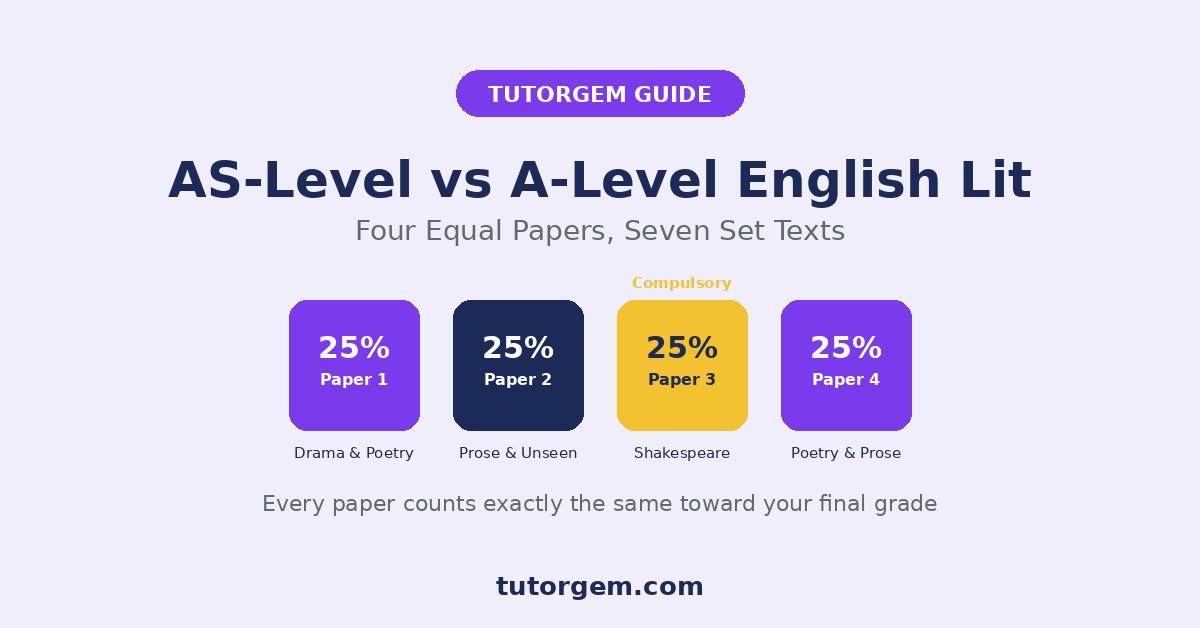
AS Level vs A Level English Literature comparison comes down to something refreshingly simple compared to other subjects. Unlike Economics, where paper weighting shifts dramatically between AS and the second half, every English Literature paper carries exactly equal weight.
This guide breaks down exactly what AS-Level covers, what full A-Level adds, and why the even weighting across all four papers changes how you should approach revision. Read this before choosing your set texts, since that choice shapes your entire two years.
How Cambridge Structures AS Level vs A Level English Literature (9695)
Cambridge International Literature in English, syllabus code 9695, assesses students entirely through four externally marked written papers. There is no coursework component at all, which surprises students moving from subjects that include practical or project-based assessment.
What AS-Level English Literature Actually Covers
AS-Level requires:
- Three set texts, studied across drama, poetry, and prose
- Preparation for one unseen extract, tested without prior knowledge of the specific passage
Students take two papers at this stage:
- Paper 1: Drama and Poetry, 50 marks, one drama question plus one poetry question
- Paper 2: Prose and Unseen, 50 marks, one prose question plus one unseen question
What Full A-Level Adds on Top of the AS Foundation
Full A-Level adds four further set texts, bringing the total to seven across the full two years. One of those four is always a Shakespeare play, which Cambridge treats as compulsory rather than optional.
Two additional papers cover this new content:
- Paper 3: Shakespeare and Drama, 50 marks, one Shakespeare question plus one drama question
- Paper 4: Pre- and Post-1900 Poetry and Prose, 50 marks, one poetry question plus one prose question
Paper Structure and Weighting Table
| Paper | Level | Content | Marks | Weight at Full A-Level |
|---|---|---|---|---|
| Paper 1 | AS | Drama and Poetry | 50 | 25% |
| Paper 2 | AS | Prose and Unseen | 50 | 25% |
| Paper 3 | Second half | Shakespeare and Drama | 50 | 25% |
| Paper 4 | Second half | Pre- and Post-1900 Poetry and Prose | 50 | 25% |
This even weighting is the core of the AS Level vs A Level English Literature comparison. In subjects like Economics, one paper can decide a third of the final grade. In English Literature, every paper genuinely counts the same, which means weak preparation on any single paper carries real, proportional cost.
Why Seven Set Texts Changes How You Should Plan
Most competitor guides describe the paper structure without connecting it to workload. Seven set texts is a real number that deserves real planning. AS-Level’s three texts arrive first, giving students a full year before Shakespeare and three more texts join the workload in the second half.
Students who leave Shakespeare preparation late, assuming it’s “just another drama text,” often underestimate how much contextual knowledge Cambridge examiners expect for that specific paper. This is a point most guides on AS Level vs A Level English Literature never properly explain.
Topic Comparison Table: AS vs Full A-Level Skills Focus
| Skill Area | AS-Level Focus | Full A-Level Additional Focus |
|---|---|---|
| Close Reading | Core skill introduced across all texts | Applied to more demanding, often older, texts |
| Contextual Understanding | Basic historical and social context | Deeper period-specific context, especially for Shakespeare |
| Unseen Analysis | Practised through Paper 2 | Not directly retested, though the skill underpins Paper 4 |
| Comparative Writing | Introductory comparison within single texts | Expected across pre-1900 and post-1900 works in Paper 4 |
A Realistic Example From TutorGem Sessions
One TutorGem student handled AS-Level confidently, strong on close reading across all three set texts. In the second half, the same student found Shakespeare specifically challenging, not from unfamiliarity with the play, but from underestimating how much historical and linguistic context Paper 3 actually rewards.
Building that contextual layer early, rather than relying purely on plot and character analysis, closed the gap well before the exam.
Common Mistakes Students Make Across the Two Stages
- Treating all four papers as equally easy to prepare for, without accounting for Shakespeare’s extra contextual demands
- Leaving Paper 4’s comparative writing skill until too late, since comparing pre and post 1900 texts needs sustained practice
- Assuming AS-Level unseen practice fully prepares students for later texts, when the second half’s set texts are typically more linguistically demanding
How TutorGem Supports Students Through the English Literature Transition
TutorGem’s English tutors build a set text preparation timeline from day one, ensuring Shakespeare and the additional set texts get the contextual depth Cambridge examiners specifically look for, rather than being rushed in the final term. This is exactly where a clear plan for AS Level vs A Level English Literature pays off most.
Frequently Asked Questions
What is the main AS Level vs A Level English Literature difference in content?
AS-Level covers three set texts and unseen extract preparation across two papers. Full A-Level adds four further set texts, including a compulsory Shakespeare play, across two additional papers, for seven texts total.
Do all four English Literature papers carry the same weight?
Yes. Each of the four papers, Drama and Poetry, Prose and Unseen, Shakespeare and Drama, and Pre- and Post-1900 Poetry and Prose, carries exactly 25% of the final A-Level grade.
Is Shakespeare compulsory at A-Level?
Yes. Cambridge treats Shakespeare as a compulsory element of Paper 3, Shakespeare and Drama, rather than an optional text choice.
Does English Literature include any coursework?
No. All four papers are externally examined written exams under timed conditions, with no coursework component at all.
How many set texts do students study across AS and full A-Level?
Students study three set texts at AS-Level and four further texts in the second half, bringing the total to seven set texts across the full two-year A-Level.
Understanding AS Level vs A Level English Literature means understanding the even weighting across all four papers, and the real workload behind seven set texts. If you want a set text timeline built around Cambridge’s specific expectations for each paper, TutorGem’s English tutors can map that out with you.