AS Level and A Level Mathematics: Curriculum and Content Compared
Maths works differently from every other AS and A-Level subject, and almost nobody explains why. Chemistry, Physics, and Biology all follow a fixed five-paper AS-then-full-A-Level split. Maths does not.
AS Level and A Level Mathematics difference actually comes down to choice. Cambridge lets students pick which applied papers, Mechanics or Statistics, they want to combine with Pure Maths. That flexibility changes how you should plan this subject entirely.
This guide breaks down exactly how the modular Cambridge 9709 structure works, what AS-Level covers, and what full A-Level adds on top. Read this before choosing your paper combination, since the choice affects your whole two years.
How Cambridge Structures AS Level and A Level Mathematics (9709)?
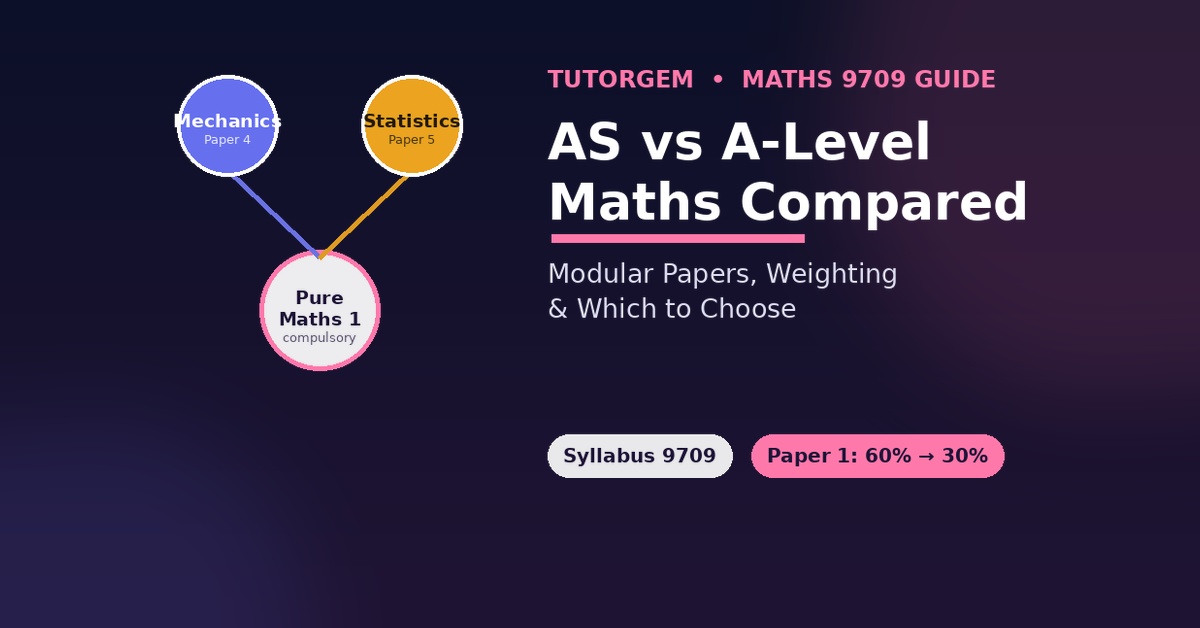
Cambridge International Mathematics, syllabus code 9709, offers six possible papers. Students combine these papers differently depending on whether they want AS-Level, full A-Level Mathematics, or even A-Level Further Mathematics.
The six papers are:
- Paper 1: Pure Mathematics 1 (compulsory for everyone)
- Paper 2: Pure Mathematics 2
- Paper 3: Pure Mathematics 3 (A-Level only, not available at AS)
- Paper 4: Mechanics
- Paper 5: Probability and Statistics 1
- Paper 6: Probability and Statistics 2
What AS-Level Mathematics Actually Requires:
AS-Level Mathematics needs just two papers:
- Paper 1, Pure Mathematics 1, which is compulsory
- One applied paper of your choice, either Paper 2, Paper 4, or Paper 5
This is the part most competitor guides skip entirely when discussing the AS Level and A Level Mathematics structure. You genuinely get to choose whether your AS-Level leans toward more pure maths, mechanics, or statistics.
What Full A-Level Mathematics Requires:
Full A-Level Mathematics needs four papers:
- Paper 1, Pure Mathematics 1
- Paper 3, Pure Mathematics 3
- Two applied papers, typically Mechanics and Probability and Statistics 1
Students aiming for engineering or physics-heavy degrees often lean toward Mechanics. Students heading into economics, psychology, or data-focused fields often lean toward Statistics instead.
Topic Comparison Table:
The following is the comprehensive comparison table for AS level and A level mathematics:
| Paper | Content | AS-Level Weighting | Full A-Level Weighting |
| Paper 1: Pure Mathematics 1 | Algebra, functions, trigonometry, coordinate geometry | 60% of AS Level | 30% of full A-Level |
| Paper 2: Pure Mathematics 2 | Logarithms, differentiation, integration (AS applied option) | Optional AS choice | Not used at full A-Level |
| Paper 3: Pure Mathematics 3 | Advanced calculus, vectors, differential equations | Not available at AS | Compulsory, roughly 30% |
| Paper 4: Mechanics | Kinematics, forces, energy, momentum | Optional AS choice | Optional applied paper |
| Paper 5: Probability & Statistics 1 | Data representation, probability, discrete distributions | Optional AS choice | Optional applied paper |
| Paper 6: Probability & Statistics 2 | Hypothesis testing, advanced distributions | Not available at AS | Optional applied paper |
Why Paper 1’s Weighting Changes So Much
This single number tells the whole story of the AS Level and A Level Mathematics split. Paper 1 makes up 60% of a standalone AS-Level award. Once you continue to full A-Level, that same paper drops to just 30% of your final grade.
Why does this matter? Because it means:
- AS-Level Mathematics leans heavily on Pure Mathematics 1 alone.
- Full A-Level spreads the weighting far more evenly across Pure 1, Pure 3, and your two applied papers.
A student who finds Pure Mathematics 1 genuinely difficult faces a tougher AS-Level year than someone who finds it manageable, simply because of how much that one paper counts for within the AS-Level structure.
Mechanics or Statistics: Which Applied Route Should You Choose
This is the decision most AS and A-Level Maths guides never properly address, and it’s genuinely important to the AS Level and A Level Mathematics choice you make.
Choose Mechanics if:
- You’re planning engineering, physics, or a maths-heavy degree
- You enjoy applying calculus to real physical systems, forces, and motion
Choose Statistics if:
- You’re planning economics, psychology, biology, or a data-driven degree
- You prefer working with probability, distributions, and real-world data sets
Choose both, where your school allows it, if you want maximum flexibility for university applications that haven’t fully narrowed down yet.
A Realistic Example From TutorGem Sessions
One TutorGem student started AS-Level Mathematics confident in Pure Maths but unsure whether to pick Mechanics or Statistics. After a short diagnostic session, it became clear the student’s target degree, economics, made Statistics the far more natural fit.
That single decision, made early and correctly, meant the student’s AS-Level Paper 5 content connected directly and usefully into university-level statistics later. Choosing Mechanics instead would have added workload with far less relevance to the student’s actual goals.
Common Mistakes Students Make With This Subject
- Picking Mechanics or Statistics based on what a friend chose, rather than personal strengths or degree plans
- Underestimating how much Paper 1 counts at the AS-Level stage specifically
- Assuming AS-Level Pure Mathematics 2 content transfers directly to A-Level, when in fact Pure Mathematics 3 at full A-Level covers different, more advanced ground
How TutorGem Supports Students?
TutorGem’s maths tutors help students choose between Mechanics and Statistics based on genuine strengths and real degree goals, not guesswork. Once that choice is made, your tutor builds a revision plan around the specific paper combination you’re actually sitting, rather than a generic maths study plan that assumes the wrong papers.
Frequently Asked Questions
What is the main AS Level and A Level Mathematics difference in structure?
AS-Level Mathematics needs two papers, Pure Mathematics 1 plus one applied paper of choice. Full A-Level needs four papers, adding Pure Mathematics 3 and a second applied paper on top.
Should I choose Mechanics or Statistics for AS-Level Maths?
This depends on your future degree plans. Mechanics suits engineering and physics-focused students, while Statistics suits economics, psychology, and data-driven fields.
Why does Paper 1 matter more at AS-Level than at full A-Level?
Paper 1 makes up 60% of a standalone AS-Level award, but only 30% once Pure Mathematics 3 and a second applied paper are added at full A-Level, spreading the weighting more evenly.
Can I switch from Mechanics to Statistics between AS-Level and A-Level?
Availability depends on your school or exam centre, but many students do adjust their applied paper choice between AS and full A-Level as their degree plans become clearer.
Is Pure Mathematics 2 the same content as Pure Mathematics 3?
No. Pure Mathematics 2 is an AS-Level applied option, while Pure Mathematics 3 is a separate, more advanced paper only available at full A-Level, covering different ground rather than repeating Paper 2.
Understanding the modular structure behind AS Level and A Level Mathematics makes choosing your papers a genuine strategic decision, not a guess. If you want help picking the right applied papers for your goals, TutorGem’s maths tutors can walk through that choice with you.