A Level or AS Level or IGCSE Which Is Right for My Child
Parents are mostly confused with A Level or AS Level or IGCSE which is right for my child. The real decision is smaller and more specific than it first appears, and most guides make it sound bigger than it actually is.
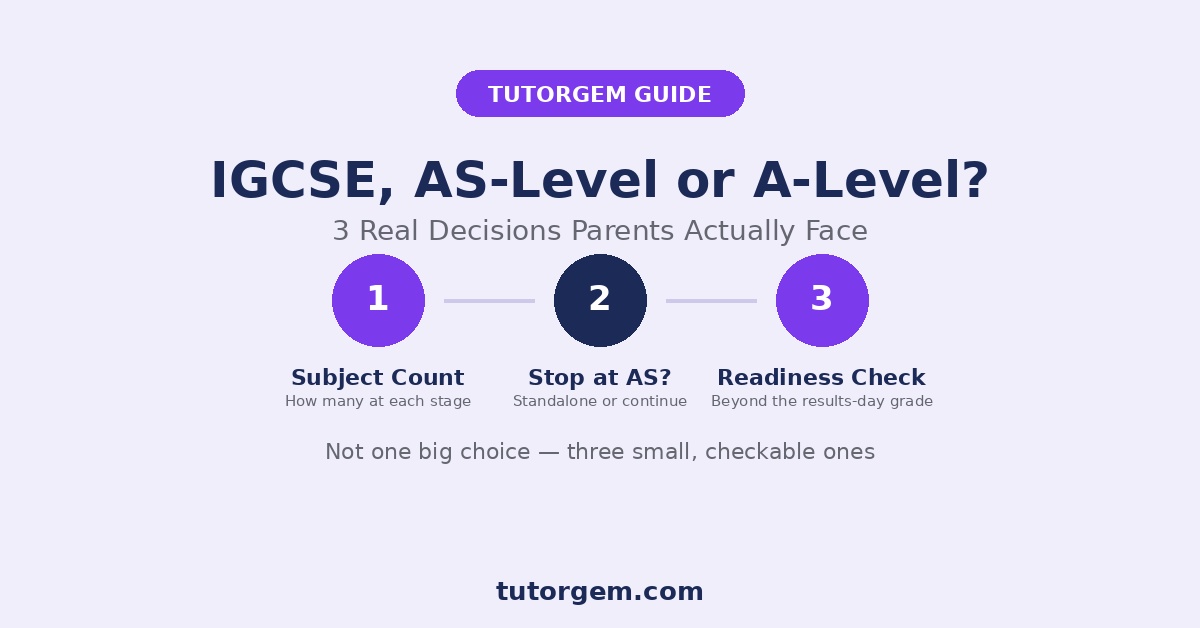
A Level or AS Level or IGCSE which is right for my child usually comes down to just a few real decision points: subject count, whether to stop at AS-Level in a subject, and how ready your child genuinely is for the next stage, not which qualification sounds more impressive.
This guide breaks down the actual decision points parents face at each transition, with the specific checks that matter more than a results-day grade alone. Read this before the subject selection conversation, not after.
Why This Isn’t Really a Three-Way Choice
For the vast majority of students, IGCSE, AS-Level, and A-Level aren’t competing options. They’re sequential stages in the same British curriculum pathway, and your child moves through all three in order.
The real decisions parents face are narrower and more specific:
- How many subjects to take at each stage
- Whether to stop a subject at AS-Level rather than continuing to full A-Level
- Whether your child is genuinely ready to move to the next stage, beyond just their grade
The IGCSE Stage: Building the Foundation
Most students take seven to ten subjects at IGCSE, covering English, Mathematics, Sciences, and a broad spread of humanities or language options. This breadth is intentional. IGCSE exists to give students a wide academic foundation before they narrow their focus.
What Parents Should Actually Watch For at This Stage
Grades matter more than many families realise. Universities and even future employers look back at IGCSE results, and strong grades open the door to the right AS-Level choices later. If your child already has a career direction in mind, checking typical university entry requirements early saves painful surprises down the line.
The AS-Level Decision: Subject Count and the Standalone Option
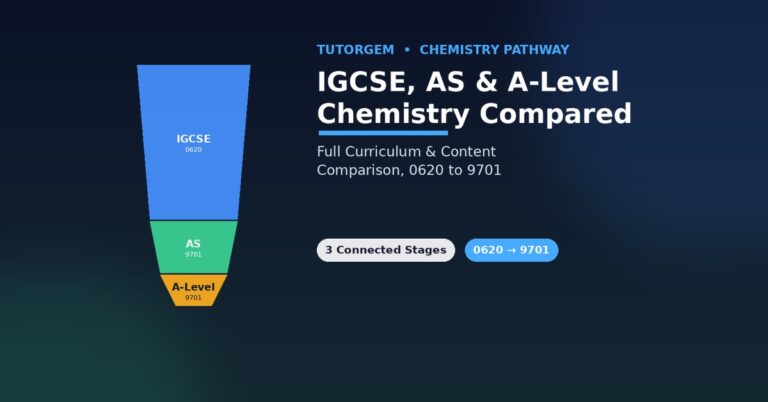
Most students narrow from up to ten IGCSE subjects down to three or four at AS-Level, often beginning with four and continuing the strongest three into full A-Level.
The Standalone AS-Level Option Most Parents Don’t Know About
AS-Level can stand alone as a complete qualification, not just the first half of A-Level. This matters for a fourth subject your child enjoys but doesn’t want to carry through two full years, since it adds breadth to an application without doubling the workload.
The Hidden Readiness Gap Most Parents Never Check
This is the single most useful thing in this guide, and it’s rarely mentioned anywhere else. An IGCSE grade tells you how your child performed on a finished syllabus, in a specific format, on a specific day. It does not guarantee every individual skill the next stage assumes is already solid.
For example, Cambridge’s own AS-Level Mathematics syllabus assumes IGCSE Extended Mathematics content, plus specific skills like manipulating surds and recognising the shapes of graphs. A child can hold an A* in IGCSE Mathematics and still hesitate on surds specifically, and that thirty-second hesitation is the difference between following a Week 3 AS-Level lesson and spending it catching up.
A Practical Readiness Check Parents Can Actually Do
Before assuming a strong IGCSE grade means full AS-Level readiness, it helps to:
- Look at the specific prerequisite skills the next syllabus names, not just the overall subject
- Ask your child to work through a handful of transition-level questions before term starts
- Treat October, not June results day, as the real test of readiness
When a Subject Choice Looks Wrong: Fixable Gap or Genuine Mismatch
If your child says in the first term that a subject feels wrong, that’s the cheapest possible moment to test the claim. The distinction worth drawing is between a fixable skills gap, which targeted support can close quickly, and a genuine mismatch in interest or aptitude, which no amount of extra tutoring resolves comfortably.
A Realistic Example From TutorGem Sessions
One TutorGem student held an A grade in IGCSE Mathematics but struggled noticeably in the first weeks of AS-Level Pure Mathematics, specifically with manipulating surds, a skill that had featured only lightly on the IGCSE paper itself. A short, targeted diagnostic session identified the exact gap within a single lesson, rather than letting it compound silently over several weeks.
Common Mistakes Parents Make Across This Decision
- Comparing an A-Level mark directly against an IGCSE grade, when the two are assessed against entirely different, finished standards
- Assuming a strong overall grade rules out specific skill gaps, when individual prerequisite skills can still be shaky
- Waiting until results day to judge readiness, rather than checking named prerequisite skills before the next stage begins
How TutorGem Supports Families Through Each Transition
TutorGem’s tutors run specific readiness checks at each transition point, IGCSE to AS-Level and AS-Level to full A-Level, rather than assuming a results-day grade tells the whole story. This catches the kind of narrow, specific gaps that a strong overall grade can easily hide.
Frequently Asked Questions
Do I need to choose between IGCSE, AS-Level, and A-Level?
No. For most students these are sequential stages, not competing choices. The real decisions are how many subjects to take, whether to stop a subject at AS-Level, and whether your child is genuinely ready for the next stage.
Can my child take AS-Level as a standalone qualification?
Yes. AS-Level doesn’t have to lead into full A-Level. It works well as a fourth subject that adds breadth to an application without committing to two full years of study.
Does a strong IGCSE grade guarantee readiness for AS-Level?
Not entirely. A grade reflects performance on a finished syllabus in a specific format. Individual prerequisite skills, like specific mathematical techniques, can still be shaky even within a strong overall grade.
When should I worry if my child says a subject feels wrong?
The first term is the cheapest time to test the claim. Early on, it’s worth checking whether the issue is a fixable skills gap or a genuine mismatch in interest before assuming either one.
How many subjects should my child take at AS-Level?
Most students begin with four AS-Level subjects and continue with the strongest three into full A-Level, though this varies based on individual workload and university plans.
Choosing the right path through A Level or AS Level or IGCSE which is right for my child comes down to specific, checkable decisions rather than one big qualification choice. If you want a direct consultation to decide among these, contact our support team at TutorGem.