
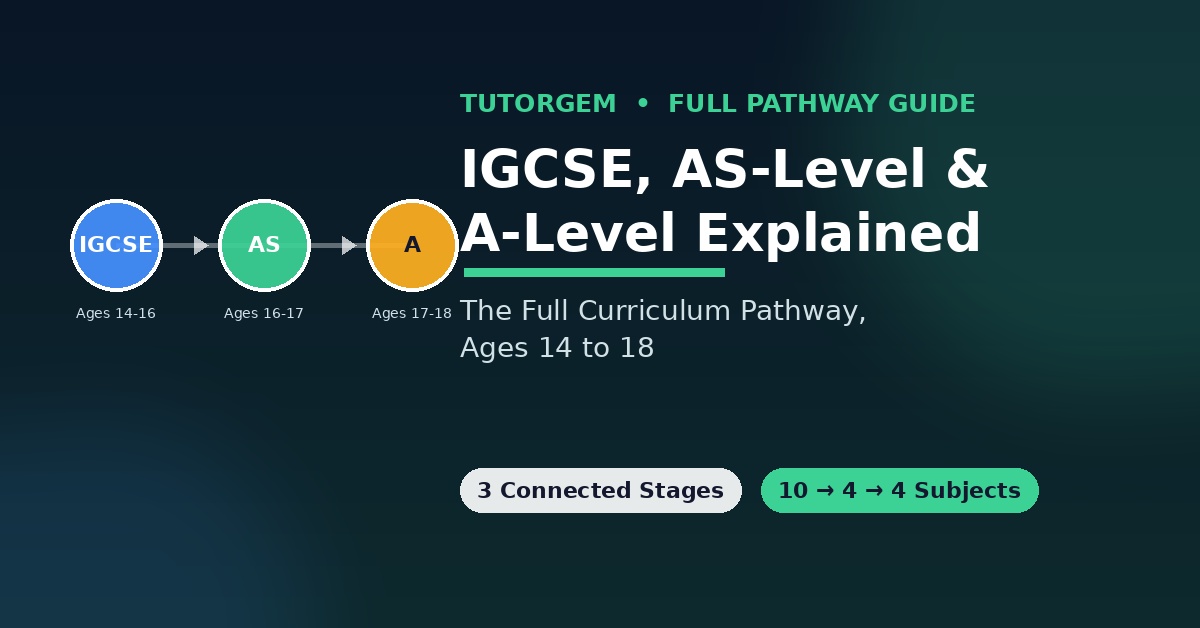
IGCSE, AS-Level and A-Level: Full Curriculum Comparison Guide
Parents researching the British curriculum pathway often hit the same wall. They understand IGCSE, they’ve heard of A-Level, but nobody explains where AS-Level actually fits between the two.
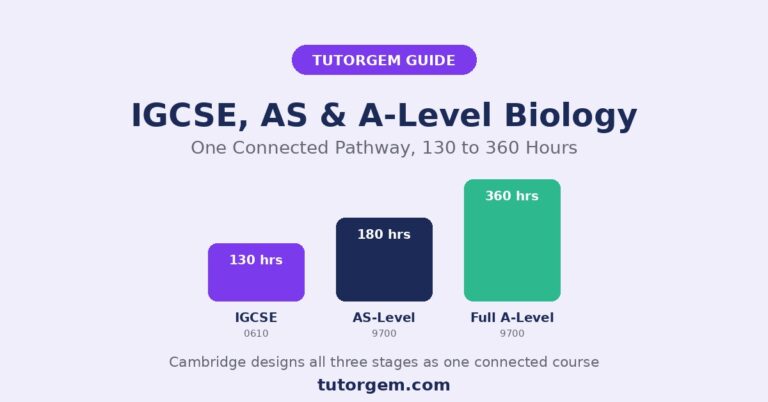
IGCSE, AS-Level and A-Level confusion usually comes down to one missing piece, the pathway is not two stages, it’s three, and each one changes in age, subject load, and depth in a specific, predictable way.
This guide lays out the full progression clearly, from the first IGCSE subject choice through to a completed A-Level, so you can plan the whole journey instead of one stage at a time.
The Three-Stage British Curriculum Pathway at a Glance
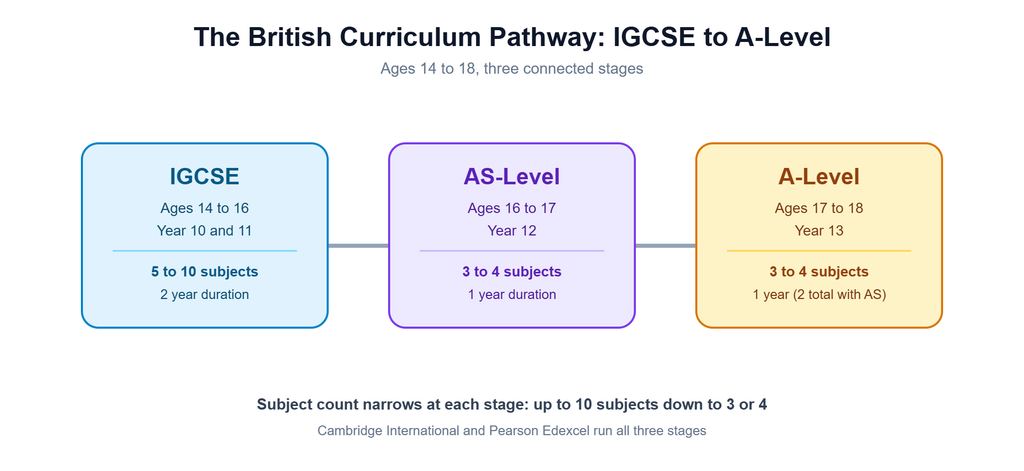
Before comparing details, it helps to see all three stages side by side, since most confusion comes from viewing them in isolation rather than as one connected journey.
| Stage | Typical Age | Typical Year Group | Subjects Studied | Duration |
|---|---|---|---|---|
| IGCSE | 14 to 16 | Year 10 and 11 | 5 to 10 subjects | 2 years |
| AS-Level | 16 to 17 | Year 12 | 3 to 4 subjects | 1 year |
| A-Level | 17 to 18 | Year 13 | 3 to 4 subjects | 1 year (2 total with AS) |
IGCSE: The Foundation Stage
IGCSE is the world’s most widely taken international qualification for 14 to 16 year olds, run primarily by Cambridge International and Pearson Edexcel. Students typically choose between five and ten subjects, covering English, Mathematics, Sciences, and a broad spread of humanities or language options.
Why IGCSE Choices Affect Everything That Follows
The subjects and grades a student achieves at IGCSE often determine which AS and A-Level subjects they can realistically take next. A student who struggled with IGCSE Physics, for example, may find AS-Level Physics considerably harder without that foundation in place.
AS-Level: The Bridge Year
AS-Level marks the first real narrowing of focus, typically dropping from up to ten IGCSE subjects down to three or four. It is studied over one year, usually Year 12, and represents roughly half the depth of a full A-Level in the same subject.
Where AS-Level Fits Between IGCSE and A-Level
Students moving from IGCSE into AS-Level face a genuine step up in independent thinking and depth, even though the subject count drops. This is the year where study habits from IGCSE either scale up successfully or need real adjustment.
A-Level: The University Entry Stage
A-Level is the final and most demanding stage, typically completed over Year 13 following on from AS-Level, covering the full depth of the syllabus in three to four chosen subjects. Universities build their entry offers primarily around final A-Level grades, making this the single most consequential stage of the three.
How A-Level Content Builds on AS-Level Foundations
A-Level does not simply repeat AS-Level content at a higher difficulty, it builds directly on it, assuming AS-level concepts are already solid. This is why students who treat AS-Level as a throwaway year often struggle disproportionately once A-Level begins.
Similarities Across All Three Stages
Despite the differences in age, subject count, and depth, all three stages share a few consistent features that make the pathway coherent rather than three disconnected exams.
- All three are externally set and marked by the same major exam boards, primarily Cambridge International and Pearson Edexcel
- All three are internationally recognised and portable across countries, which matters for TutorGem’s students across the UK, Pakistan, and UAE
- All three combine written examinations with, in some subjects, coursework or practical components
A Realistic Example: One Student’s Path Through All Three Stages
One TutorGem student began IGCSE with nine subjects across sciences, humanities, and languages. By AS-Level, that narrowed to four, Mathematics, Physics, Chemistry, and Economics, based on strong IGCSE results in those specific areas.
At A-Level, the student dropped Economics to focus deeply on the three sciences needed for a engineering university application. The IGCSE grades directly shaped the AS-Level choices, and the AS-Level results shaped the final A-Level combination, showing exactly how each stage feeds into the next rather than standing alone.
Common Mistakes Families Make Across the Pathway
Treating each stage as a separate decision, made in isolation, is the most frequent mistake families make. Choosing IGCSE subjects without any thought toward likely AS and A-Level combinations often forces harder adjustments later than necessary.
Another common error is underestimating the AS-Level year specifically, since it carries less public attention than IGCSE results day or final A-Level results, despite directly shaping A-Level success.
How TutorGem Supports Students Across the Full Pathway
TutorGem’s tutors work with students continuously across IGCSE, AS-Level, and A-Level, which means subject choices at each stage get made with the next stage already in mind. This continuity, rather than switching tutors at every transition, is what keeps the whole three-stage pathway coherent instead of three separate scrambles.
Frequently Asked Questions
What is the correct order of IGCSE, AS-Level and A-Level?
IGCSE comes first, typically ages 14 to 16, followed by AS-Level around age 16 to 17, and finally A-Level around age 17 to 18. Each stage builds directly on the one before it.
Do IGCSE grades affect which AS-Level subjects I can take?
Yes. Many schools and exam centres expect a minimum IGCSE grade in a subject before allowing AS-Level study in that same subject, since AS-Level assumes that foundation is already in place.
How many subjects do students typically study at each stage?
IGCSE students often take five to ten subjects, narrowing to three or four at AS-Level, and generally staying at three or four through to full A-Level.
Is AS-Level a separate qualification from A-Level?
AS-Level can stand alone as its own qualification or, under Cambridge International’s staged assessment, count toward a full A-Level if completed within 13 months, depending on the exam system followed.
Which exam boards run IGCSE, AS-Level and A-Level?
Cambridge International and Pearson Edexcel are the two main exam boards running all three qualifications internationally, including across the UK, Pakistan, and UAE.
Understanding the IGCSE, AS-Level, and A-Level pathway as one connected journey, rather than three separate exams, makes every subject decision along the way easier to get right the first time. If you want help planning subject choices that carry smoothly from IGCSE through to a strong final A-Level result, TutorGem’s tutors can build that plan with you across all three stages.
4 Comments