IGCSE AS Level A Level Biology: Full Curriculum and Content Comparison
Biology students often experience IGCSE as one long list of topics, cells, nutrition, reproduction, ecology, without ever seeing how it connects to what comes next. Then AS-Level Biology begins, and the same topics reappear at a completely different depth.
IGCSE AS Level A Level Biology comparison reveals a deliberately built progression. Cambridge’s own syllabus documentation confirms this directly, not as marketing language, but as an official recognition and progression statement.
This guide compares all three stages side by side, showing exactly which IGCSE topics carry forward, what changes at AS-Level, and what the second half of A-Level adds on top. Read this before you plan your revision across all three stages.
The Full Biology Pathway: IGCSE to A-Level at a Glance
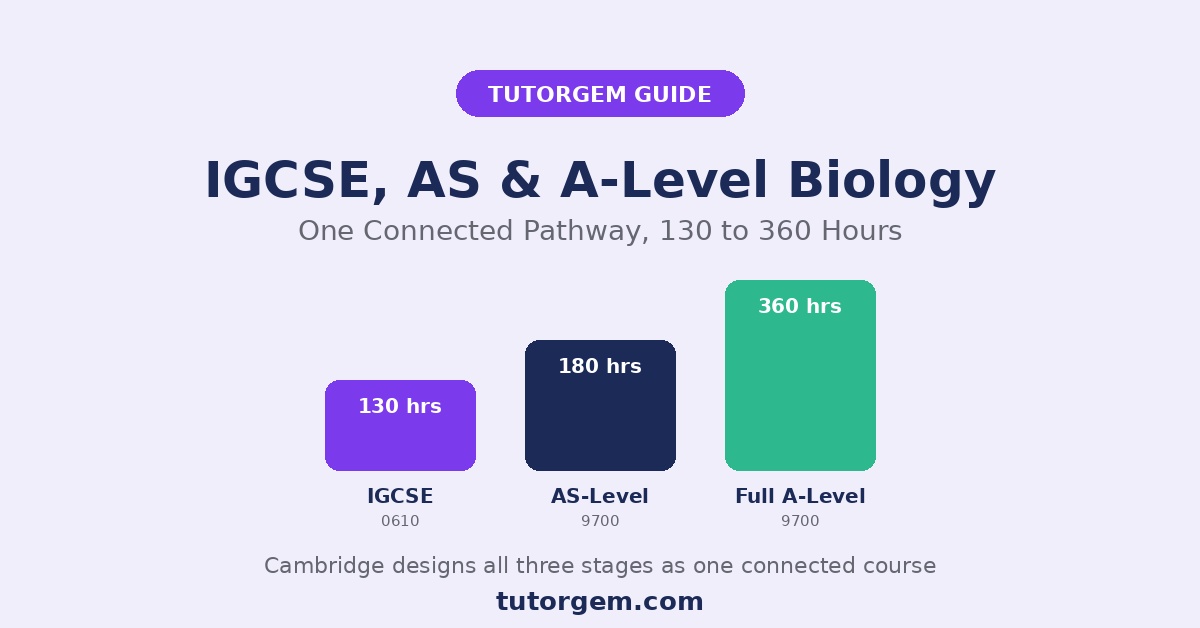
Seeing all three Cambridge biology syllabuses side by side makes the IGCSE AS Level A Level Biology progression far easier to follow than reading about each one separately.
| Stage | Syllabus Code | Guided Learning Hours | Entry Expectation |
|---|---|---|---|
| IGCSE | 0610 | Around 130 hours | No formal prerequisite, broad science foundation |
| AS-Level | 9700 (AS component) | Around 180 hours | IGCSE grade A*, A, or B in Biology recommended |
| Full A-Level | 9700 (full) | Around 360 hours | Solid AS-Level foundation |
Cambridge’s own syllabus documentation states plainly that candidates who achieve grades A* to C in IGCSE Biology are well prepared to follow Cambridge International AS and A Level Biology. This is an official recognition and progression statement, not a general recommendation.
What IGCSE Biology Actually Builds
IGCSE Biology 0610 covers a genuinely wide survey of the subject, including:
- Characteristics and classification of living organisms
- Cell structure and organisation
- Movement in and out of cells
- Biological molecules and enzymes
- Plant and human nutrition
- Transport in plants and animals
- Gas exchange and respiration
- Coordination, response, and reproduction
- Inheritance and variation
- Ecology and human influence on ecosystems
Why IGCSE Grade Matters for AS-Level Readiness
Most schools and centres expect a grade of A*, A, or B in IGCSE Biology before recommending AS-Level. This threshold exists because AS-Level assumes several IGCSE topics as settled knowledge, particularly cell structure, biological molecules, and enzyme function, rather than teaching them again from scratch.
How AS-Level Biology Builds Directly on IGCSE Foundations
AS-Level Biology takes IGCSE’s introductory treatment of cells and molecules and extends it into full cell structure and organisation, detailed biological molecules, and formal enzyme kinetics. The transport topics that started broadly at IGCSE narrow into specific, detailed treatment of transport in plants and mammals at AS-Level.
The Topics That Carry Forward Without Being Retaught
Several foundational concepts don’t get relearned at AS-Level, they get assumed:
- Basic cell structure and function
- Core understanding of enzymes
- Fundamental transport and gas exchange concepts
This is precisely why weak IGCSE foundations in these specific areas cause disproportionate struggle once AS-Level begins.
What the Second Half of A-Level Adds That IGCSE Barely Touches
The second half of A-Level introduces content that IGCSE only brushes against at a very surface level, if at all, including:
- Detailed respiration, covering ATP, glycolysis, and the Krebs cycle
- Photosynthesis, both light-dependent and light-independent reactions
- Homeostasis, covering thermoregulation and osmoregulation in mechanistic detail
- Genetics, gene expression, and gene technology
This is the stage where biology shifts from descriptive knowledge toward genuine systems-level understanding.
Three-Way Topic Comparison Table
| Biology Topic | IGCSE Level | AS-Level | Full A-Level |
|---|---|---|---|
| Cell Biology | Basic cell structure | Full cell structure and organisation | Not directly extended |
| Enzymes | Introductory enzyme function | Detailed enzyme kinetics | Applied within metabolic pathways |
| Transport | Broad plant and animal transport | Detailed transport in plants and mammals | Not directly extended |
| Energy Systems | Basic respiration mention | Introductory only | Full respiration and photosynthesis |
| Genetics | Basic inheritance and variation | Nucleic acids basics | Gene expression, gene technology, evolution |
A Realistic Progression Example
One TutorGem student scored a grade B in IGCSE Biology, solid on ecology and human biology but weaker on enzyme-related questions. That specific gap resurfaced within the first term of AS-Level, where enzyme kinetics became a core, heavily examined topic rather than a minor IGCSE subtopic.
Addressing the enzyme gap before AS-Level began meant the student wasn’t relearning fundamentals under exam pressure later.
Common Mistakes Students Make Across the Three Stages
- Assuming AS-Level Biology repeats IGCSE content, when it actually narrows focus and adds real depth to a smaller set of topics
- Underestimating how much an IGCSE grade below A to B signals real readiness gaps*, particularly in cells and enzymes
- Treating the second half of A-Level as familiar territory, when respiration and photosynthesis barely exist in IGCSE content at all
How TutorGem Supports Students Across the Biology Pathway
TutorGem’s biology tutors work with students continuously from IGCSE through to full A-Level, which means specific gaps in enzymes, cell structure, or transport get identified and fixed before they resurface as AS-Level or later struggles. This continuity across all three stages is what keeps the whole IGCSE AS Level A Level Biology pathway coherent, rather than three disconnected scrambles.
Frequently Asked Questions
Does IGCSE Biology prepare students for AS-Level Biology?
Yes. Cambridge’s own syllabus documentation confirms that candidates achieving grades A* to C in IGCSE Biology are well prepared to follow Cambridge International AS and A Level Biology.
What IGCSE grade do I need for AS-Level Biology?
Most schools and centres recommend a grade of A*, A, or B in IGCSE Biology before progressing to AS-Level, since AS-Level assumes core cell and enzyme knowledge is already solid.
What is the IGCSE AS Level A Level Biology comparison in terms of guided learning hours?
IGCSE Biology uses around 130 guided learning hours, AS-Level adds roughly 180 more hours, and full A-Level totals around 360 hours across both years combined.
What biology topics appear only in the second half of A-Level?
Detailed respiration, photosynthesis, homeostasis, gene expression, and gene technology all appear in real depth for the first time in the second half of A-Level, with only a surface-level IGCSE equivalent at best.
Are IGCSE, AS-Level, and A-Level Biology assessed by the same exam board?
Cambridge International runs all three under this pathway, IGCSE Biology as syllabus 0610 and AS-Level and A-Level Biology as syllabus 9700, ensuring continuity in how the subject is structured and assessed.
Seeing IGCSE, AS-Level, and full A-Level biology as one connected subject, rather than three separate courses, changes how students should actually prepare at each stage. If you want a biology plan that carries your IGCSE foundations all the way through to a strong final A-Level result, TutorGem’s tutors can build that continuity with you.