Resitting AS-Level or A-Level Exams: Full Guide
A disappointing grade feels final on the day you see it. It isn’t, and most students resitting AS-Level or A-Level exams don’t realise how much flexibility they actually have.
Resitting AS-Level or A-Level exams comes with far fewer restrictions than most students assume, but one specific Cambridge rule catches international students off guard more than any other factor in this process.
This guide breaks down exactly how resits work, what the 13-month carry-forward rule actually means, and which subjects you genuinely cannot resit as a private candidate. Read this before registering for a resit, since the timing decision matters more than most guides admit.
There’s No Official Limit on How Many Times You Can Resit
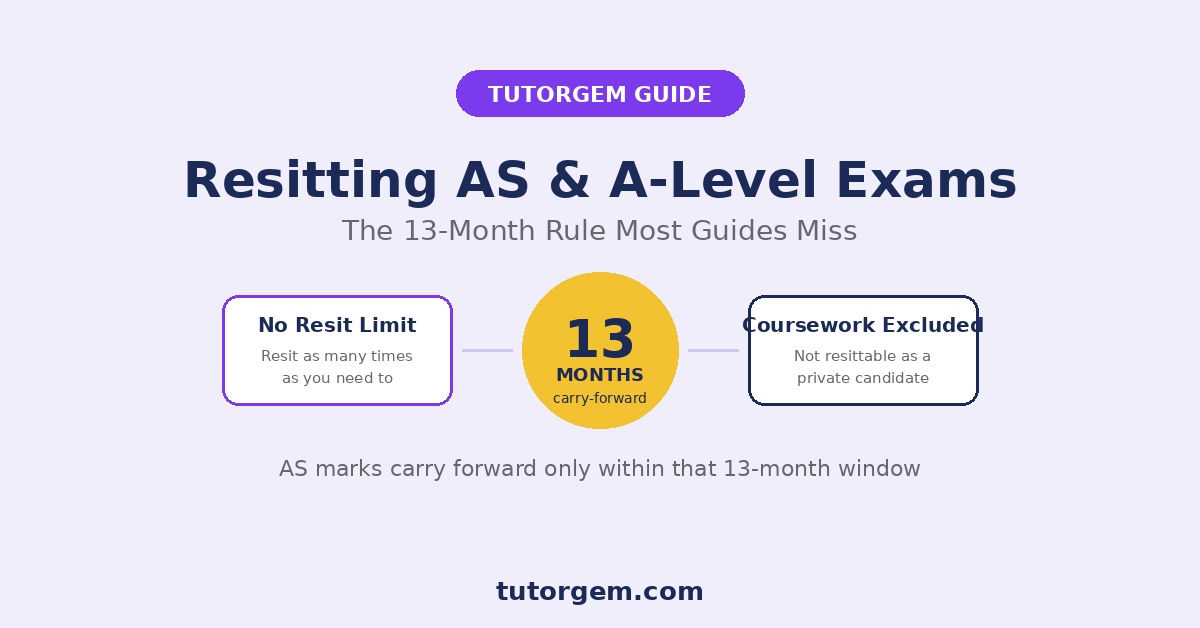
You can resit an AS-Level or A-Level exam as many times as you want. There’s no formal cap on attempts, whether you’re resitting through your current school, a new centre, or as a private candidate.
Most students resit for one of a few clear reasons:
- Missing a specific university offer by one grade
- A single poor exam day that didn’t reflect genuine ability
- Wanting to strengthen an application before a later deadline
The Cambridge-Specific Rule Most Resit Guides Never Mention
This is where resitting AS-Level or A-Level exams gets genuinely complicated for Cambridge International students, and almost every resit guide online only covers UK domestic boards like AQA and Pearson, missing this entirely.
Why the 13-Month Carry-Forward Rule Exists
Cambridge’s own carry-forward regulations state the reasoning plainly. A final qualification grade reflects a candidate’s demonstrated ability on a syllabus that was current at the time of assessment. Because syllabus content changes over time, marks can’t be carried forward indefinitely, specifically for 13 months from the original AS-Level sitting.
This means if a student sits AS-Level Chemistry in June and wants that mark to count toward a full A-Level award, the second half must be completed within that same 13-month window. Miss it, and the AS-Level marks can no longer be carried forward into the full qualification.
When Marks Cannot Be Carried Forward At All
A few specific situations block carry-forward entirely:
- The syllabus code has changed between the original sitting and the resit
- The candidate was withdrawn from the syllabus in the original series
- The candidate received a U grade (ungraded) in the original sitting
Which Subjects You Cannot Resit Privately
This catches many private candidates completely off guard. Cambridge International rules out resitting any syllabus that carries a coursework or internally assessed component as a private candidate.
This exclusion exists for a practical reason, not an arbitrary one. Coursework needs ongoing supervision and internal assessment by a centre, something an external private candidate, studying independently, simply cannot access. Before planning a resit, always confirm your specific subject doesn’t include this kind of component.
How to Register for a Resit
Resitting Through Your Current School
If you’re still enrolled, your school handles resit registration the same way it handles standard entries, as part of its group submission to the exam board.
Resitting as a Private Candidate
If you’ve left school or want to resit independently, you’ll need to:
- Find an approved exam centre that accepts private candidates for your specific subject
- Confirm your subject doesn’t carry a coursework component that blocks private resits
- Submit your registration, identification documents, and payment before the centre’s deadline
What Happens to Your Grade After a Resit
Your new result replaces the previous one for that specific sitting, it isn’t averaged with your earlier attempt. Most universities and employers consider your highest achieved grade when reviewing an application, and resitting is a widely accepted, unremarkable part of many students’ academic journeys.
A Realistic Example From TutorGem Sessions
One TutorGem student missed a university offer by a single grade in A-Level Chemistry and wanted to resit as a private candidate within the same year. A quick check confirmed the student’s specific syllabus variant didn’t carry a coursework component, clearing the path to register independently and resit without needing to re-enrol at a school.
Common Mistakes Students Make When Planning a Resit
- Missing the 13-month carry-forward window for AS-Level marks, not realising the deadline applies until it’s already passed
- Assuming every subject can be resat privately, without checking for a coursework component first
- Waiting too long to register, since private candidate resit spaces can fill up well before the centre’s own deadline
How TutorGem Supports Students Through the Resit Process
TutorGem’s tutors help students confirm their resit eligibility, check the 13-month carry-forward window where it applies, and build a focused revision plan targeting the specific paper or topic that cost marks the first time.
Frequently Asked Questions
How many times can I resit an AS-Level or A-Level exam?
There’s no official limit. You can resit as many times as you want, whether through your school, a new centre, or as a private candidate.
What is the 13-month carry-forward rule for AS-Level marks?
Cambridge allows an AS-Level grade to count toward a full A-Level award only if the second half is completed within 13 months of the original AS-Level sitting. After that window closes, the marks can no longer be carried forward.
Can I resit any subject as a private candidate?
No. Subjects with coursework or internally assessed components generally cannot be resat privately, since that work needs ongoing centre supervision that an external candidate can’t access.
Does resitting an exam replace my old grade or average with it?
Your new result replaces the previous one for that specific sitting. It isn’t averaged, and most universities consider your highest achieved grade.
Do universities look unfavourably on resits?
Generally not. Resitting is a common, widely accepted part of many students’ academic paths, and most universities focus on the final grade achieved rather than the number of attempts.
Understanding the real rules behind resitting AS-Level or A-Level exams, especially the 13-month carry-forward window most guides never mention, helps you plan a resit with confidence instead of guesswork. If you want a focused revision plan built around exactly where you lost marks the first time, TutorGem’s tutors can put that together with you.