AS Level And A Level Chemistry: Curriculum, Content and Difficulty Compared
Chemistry students moving from AS into the second year often feel the jump before they can explain it. The topics sound familiar, yet the exam questions suddenly demand far more.
AS level and A level chemistry comes down to a specific, well-documented shift in both content and assessment weight, not just a vague sense that things got harder. Cambridge’s own syllabus structure makes that shift visible once you know where to look.
This guide breaks down exactly what AS-Level chemistry covers, what A2 adds on top, and how the exam papers themselves reflect that growing depth. Read this before you plan your A2 revision schedule.
How Cambridge Structures AS level and A level chemistry (9701)
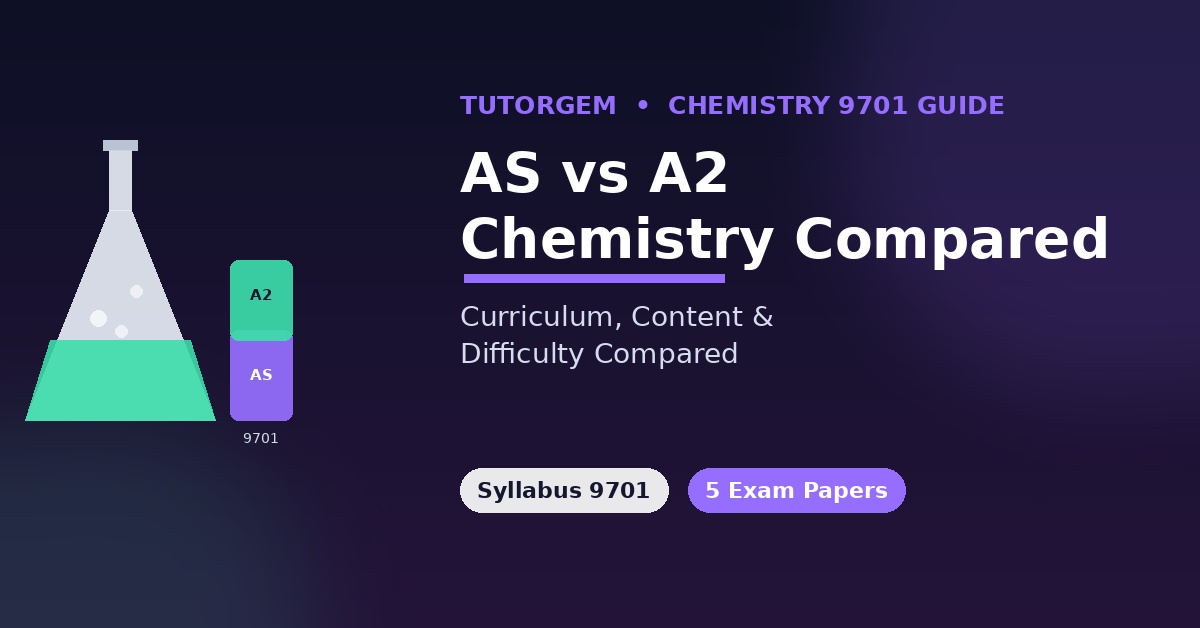
Cambridge International AS and A Level Chemistry, syllabus code 9701, splits content across physical, inorganic, and organic chemistry. AS forms the first stage, and A2 extends each area in greater depth.
What AS-Level Chemistry Actually Covers
AS content includes:
- Physical chemistry: atomic structure, bonding, energetics, kinetics, and equilibria
- Inorganic chemistry: periodicity, Group 2, and Group 17
- Organic chemistry: hydrocarbons, halogenoalkanes, alcohols, and carbonyl compounds
What A2 Adds on Top of the AS Foundation
A2 extends physical chemistry into more advanced territory, introduces transition elements as an entirely new inorganic topic, and expands organic chemistry to include:
- Aromatic compounds
- Carboxylic acids
- Nitrogen chemistry
- Dedicated analytical techniques
Topic Comparison Table: AS vs A2 Content
| Chemistry Branch | AS-Level Content | A2 Additional Content |
| Physical Chemistry | Atomic structure, bonding, energetics, kinetics, equilibria | Advanced energetics, rate equations, electrochemistry in depth |
| Inorganic Chemistry | Periodicity, Group 2, Group 17 | Transition elements |
| Organic Chemistry | Hydrocarbons, halogenoalkanes, alcohols, carbonyls | Aromatic chemistry, carboxylic acids, nitrogen compounds |
| Analytical Skills | Foundational practical skills | Dedicated analytical techniques |
How the Exam Papers Reflect the AS level and A level chemistry Split
The assessment structure itself confirms how much weight shifts toward A2. Cambridge Chemistry runs a five-paper structure, including two dedicated practical-skills papers. The AS-only Paper 1 multiple-choice component carries a noticeably different weighting depending on which qualification you’re working toward.
Paper 1, the multiple-choice paper testing AS content, is worth 40 marks. It makes up roughly 31% of a standalone AS-Level award, but only around 15.5% of a full A-Level once A2 papers are added in.
That single number captures the whole AS level and A level chemistry story. AS content doesn’t disappear at A-Level. It simply becomes a smaller share of a much bigger picture.
Why A* Never Appears at the AS Stage
Cambridge grade threshold documents confirm that Grade A* does not exist at the level of an individual component. AS-only results are capped without a starred grade.
The numbers make this concrete:
- Full A-Level maximum weighted mark: 260
- AS-only maximum weighted mark: 130
- A2-only maximum weighted mark: 130
This is a direct numerical reflection of A-Level representing double the content depth of AS alone.
Is A2 Chemistry Genuinely Harder Than AS Chemistry
A2 chemistry is not simply AS chemistry repeated at a higher difficulty. It introduces entirely new topics, transition elements and nitrogen organic chemistry among them, while also demanding that students connect ideas across physical, inorganic, and organic chemistry simultaneously.
Exam questions increasingly expect students to link a calculation from physical chemistry to a mechanism from organic chemistry, within the same answer. This connective skill is what genuinely separates A2 from AS.
Practical Skills Run Through Both Stages
Unlike some subjects where practical assessment sits apart from theory, Cambridge Chemistry weaves practical skills through both AS and A2 via two dedicated practical papers. Students who treat practical technique as a separate, lower-priority skill often lose marks disproportionately, since it’s assessed continuously rather than as an isolated unit.
A Realistic Example From TutorGem Sessions
One TutorGem student scored comfortably at AS-Level, strong on physical chemistry calculations but weaker on organic mechanisms. That specific gap resurfaced within the first month of A2, when aromatic chemistry questions began demanding the same mechanism-writing skill at a noticeably higher standard.
Fixing the AS-level organic foundation first made the A Level topic click far faster than trying to teach aromatic chemistry from scratch.
Common Mistakes Students Make Across the Two Stages
- Assuming A Level is just “more of the same,” rather than genuinely new topics layered on an AS foundation
- Treating practical skills as separate from theory, when Cambridge assesses them continuously across both stages
- Underestimating how much Paper 1’s weighting drops, from 31% at AS to 15.5% at full A-Level, which changes how revision time should be allocated
How TutorGem Supports Students Through Chemistry
TutorGem’s chemistry tutors map revision directly to the 9701 syllabus structure, identifying exactly which AS foundations need reinforcing before a student tackles A Level topics like transition elements or aromatic chemistry. This targeted approach matters more in chemistry than in most subjects, since A Level genuinely depends on AS content rather than replacing it.
Frequently Asked Questions
What is the main AS level and A level chemistry content difference?
AS-Level Chemistry covers atomic structure, bonding, energetics, kinetics, equilibria, periodicity, Groups 2 and 17, and core organic chemistry. A2 adds transition elements, aromatic chemistry, carboxylic acids, nitrogen compounds, and dedicated analytical techniques on top of that foundation.
Is A Level chemistry harder than AS chemistry?
Yes, generally. A Level introduces new topics while also requiring students to connect concepts across physical, inorganic, and organic chemistry within single exam questions, which demands more than simply learning additional content.
Can I get an A Level in AS-Level Chemistry alone?
No. Cambridge’s grading confirms that A Level does not exist at the AS-only stage, since it reflects achievement across the complete two-year A-Level content rather than the AS foundation alone.
How many exam papers does Cambridge Chemistry 9701 have?
Cambridge Chemistry 9701 uses a five-paper structure, including two dedicated practical-skills papers, spread across the AS and A2 stages.
Does AS Chemistry content still matter once I reach A2?
Yes, significantly. A2 topics build directly on AS foundations like bonding and energetics, so gaps in AS understanding tend to resurface as difficulty at A2 rather than disappearing.
Understanding exactly how AS level and A level chemistry content connects makes the transition between the two stages far less overwhelming than it first appears.
If you want a revision plan built around the specific AS foundations your A2 topics depend on, TutorGem’s chemistry tutors can map that out with you.