IGCSE Chemistry vs GCSE Chemistry: Key Differences Explained
Moving countries or choosing between an international school and a UK curriculum, and unsure if IGCSE chemistry and GCSE chemistry are actually the same thing? This confusion is more common than most parents realize.
The honest answer is that IGCSE vs GCSE chemistry differs less in academic level and more in exam board structure, assessment style, and where the qualification is taught. Both prepare students equally well for further study.
This guide breaks down exactly how the two qualifications compare, which one might suit your child better, and what to expect if you are moving between systems partway through secondary school.
What IGCSE and GCSE Chemistry Actually Are
GCSE chemistry is the standard qualification taken by students aged 14 to 16 in England, Wales, and Northern Ireland, regulated by Ofqual and offered through boards like AQA, Edexcel, and OCR. IGCSE chemistry, by contrast, is the internationally focused version of the same qualification, developed originally by Cambridge International and now also offered by Pearson Edexcel.
Both qualifications sit at the same academic level and cover comparable core chemistry content, despite common assumptions that one is significantly harder than the other.
Who Sits Which Qualification
IGCSE chemistry is taken across roughly 10,000 schools in more than 150 countries, making it the default choice for international schools outside the UK, along with many UK independent schools and homeschooling families. Students following a domestic UK curriculum, meanwhile, typically sit standard GCSE chemistry through their state or independent school.
This distinction matters most for families relocating internationally, since choosing the right qualification early avoids awkward transfers partway through the two year course.
IGCSE vs GCSE Chemistry: The Core Differences
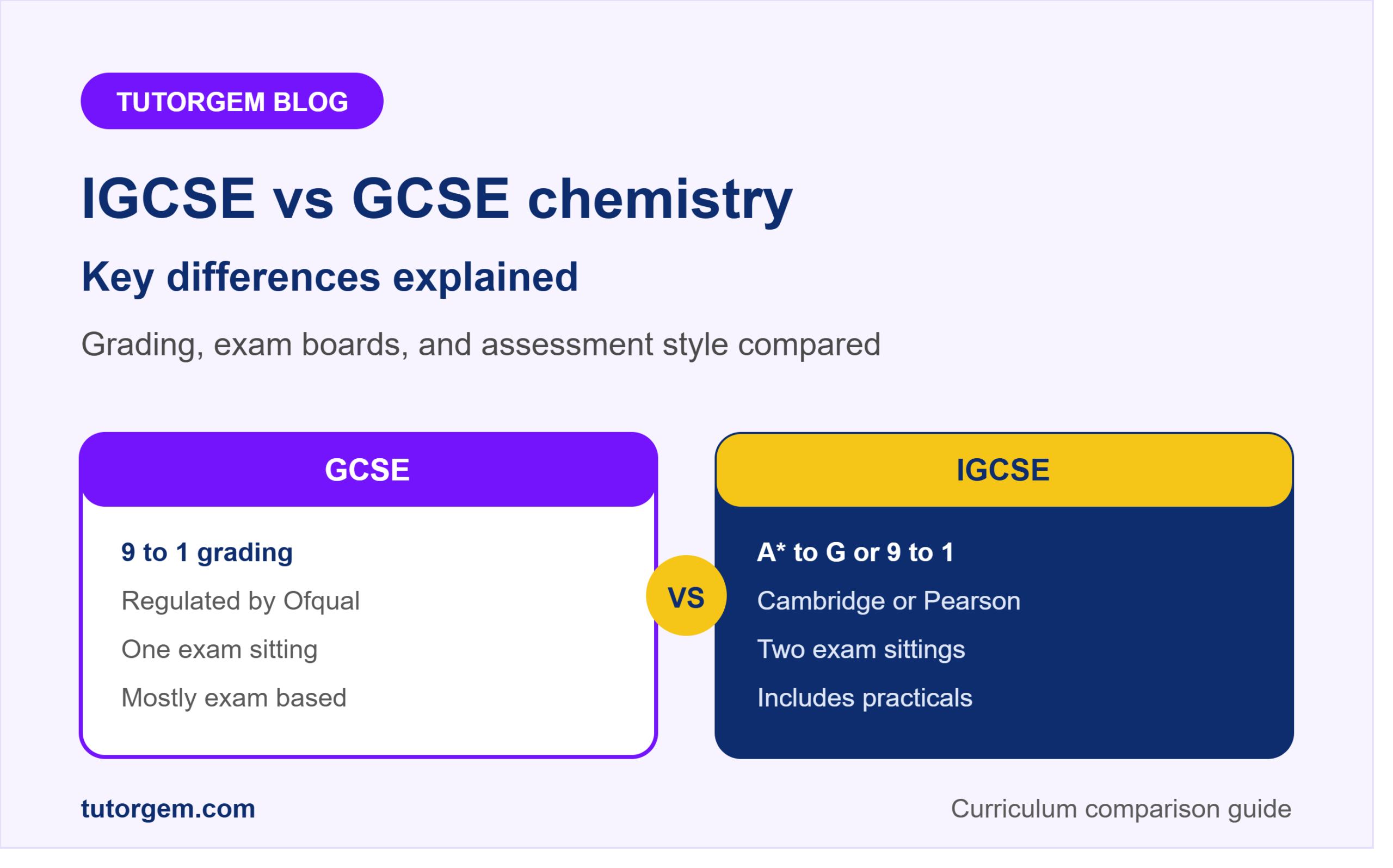
The two qualifications share similar core content, but differ meaningfully in grading, assessment format, and exam scheduling.
Grading Systems Compared
GCSE chemistry in England has used the 9 to 1 grading scale since the 2017 reforms, with grade 9 representing the highest achievable result. Cambridge IGCSE chemistry traditionally uses the A* to G scale, though some subjects now also offer a numerical 9 to 1 option following recent updates. Edexcel International GCSE chemistry typically follows the same 9 to 1 system as domestic GCSEs.
| Feature | GCSE Chemistry | IGCSE Chemistry |
|---|---|---|
| Regulator | Ofqual | Cambridge International or Pearson |
| Grading scale | 9 to 1 | A* to G, or 9 to 1 (Edexcel) |
| Exam sittings | May and June only | May and June, plus October and November |
| Coursework or practical | Mostly exam based | Some boards include practical assessment |
| Tier structure | Foundation and Higher | Core and Extended |
Coursework, Practicals, and Exam Sittings
Cambridge IGCSE chemistry often includes practical assessment components alongside written exams, while reformed UK GCSEs since 2015 emphasize final written exams almost exclusively. IGCSE exams also run twice yearly in most cases, giving international students and those retaking a subject more flexibility than the single UK exam window each summer.
This flexibility particularly benefits students who transfer schools mid-year or need to resit a subject without losing an entire academic year.
Is IGCSE Chemistry Harder Than GCSE Chemistry?
Neither qualification is inherently harder in terms of academic content, though structural differences can make one feel more demanding depending on a student’s strengths.
What the Entry Data Shows
Recent Edexcel International GCSE entry data shows chemistry attracting over 21,000 entries globally, alongside similarly strong entry numbers for physics and biology among international candidates. This scale confirms IGCSE chemistry is a well established, rigorously assessed qualification rather than a simplified alternative to standard GCSE.
Students who struggle with coursework style practical assessments sometimes find Cambridge IGCSE chemistry more demanding, while those who prefer flexible resit options often find IGCSE better suited to their learning pace.
A Real Case: Moving Between Systems Mid-Course
One TutorGem student relocated from a UK school partway through Year 10 to an international school following the Cambridge IGCSE syllabus. Despite strong GCSE predicted grades beforehand, she found the practical assessment component and different terminology genuinely confusing at first.
Her tutor mapped the overlap between her previous GCSE chemistry topics and the new IGCSE specification, focusing extra time on the practical skills paper she had not previously encountered. Within one term, she matched her original predicted grade under the new system.
This case shows that strong chemistry understanding transfers well between IGCSE and GCSE. The main adjustment is usually structural, not academic, and targeted support closes that gap quickly.
Which Qualification Suits Your Child Better
Families rarely choose freely between IGCSE and GCSE chemistry, since the decision usually depends on which school a child attends rather than personal preference.
Questions to Ask Your Child’s School
Ask which exam board your school follows for chemistry, since Cambridge and Edexcel IGCSE specifications differ meaningfully in content emphasis and assessment style. Also confirm whether practical assessment forms part of the final grade, since this affects how revision time should be allocated.
How a Tutor Supports Students Across Both Systems
A tutor experienced in both curricula can bridge gaps quickly when students move between IGCSE and GCSE chemistry, since the underlying scientific content overlaps significantly even when terminology and assessment structure differ.
TutorGem’s chemistry tutoring programs support students across IGCSE, GCSE, and A-level curricula, which matters particularly for international families in the UAE, Pakistan, and beyond navigating multiple exam systems. For families managing chemistry alongside other GCSE subjects, TutorGem’s GCSE tutoring support covers the full science curriculum under one consistent study plan.
Frequently Asked Questions
Do UK universities accept IGCSE chemistry the same as GCSE chemistry?
Yes. Both qualifications are widely accepted by UK universities, since admissions teams generally recognize the qualification type rather than favoring one exam board over another.
Is Cambridge IGCSE chemistry different from Edexcel IGCSE chemistry?
Yes. Cambridge IGCSE is the older, more globally distributed qualification, while Edexcel International GCSE follows a structure closer to standard UK GCSE specifications with different tier names and content emphasis.
Can my child switch from IGCSE to GCSE chemistry partway through the course?
Switching is possible, though the amount of catch up needed depends on how much the two syllabuses have already diverged by the point of transfer.
Why do IGCSE exams run twice a year while GCSE only runs once?
IGCSE boards serve international students across different school calendars, so multiple exam sittings accommodate resits and mid-year transfers more easily than the single UK exam window.
Is IGCSE chemistry recognized outside the country where it is taken?
Yes. IGCSE chemistry is accepted globally, including by UK, US, and other international university admissions systems, since it is designed specifically for an internationally mobile student population.
Understanding IGCSE vs GCSE chemistry before choosing a school or planning a move removes unnecessary stress later in your child’s academic journey. If your family is navigating a curriculum change or simply wants confidence heading into exams, TutorGem’s experienced chemistry tutors support students across both systems and can build a clear plan starting this week.