HSC vs VCE Chemistry: A Complete Guide for Australian Students
Moving between New South Wales and Victoria partway through senior school and confused about how your chemistry marks will even translate? This uncertainty causes more stress than the actual content usually does.
The honest answer is that HSC vs VCE chemistry differs mainly in structure, assessment weighting, and scaling, not in the underlying scientific content itself. Both systems ultimately feed into the same ATAR used for university admission nationwide.
This guide breaks down exactly how NESA’s HSC chemistry syllabus compares to VCAA’s VCE chemistry curriculum, how scaling actually affects your result, and what genuinely helps students succeed in either system.
What HSC and VCE Chemistry Actually Involve
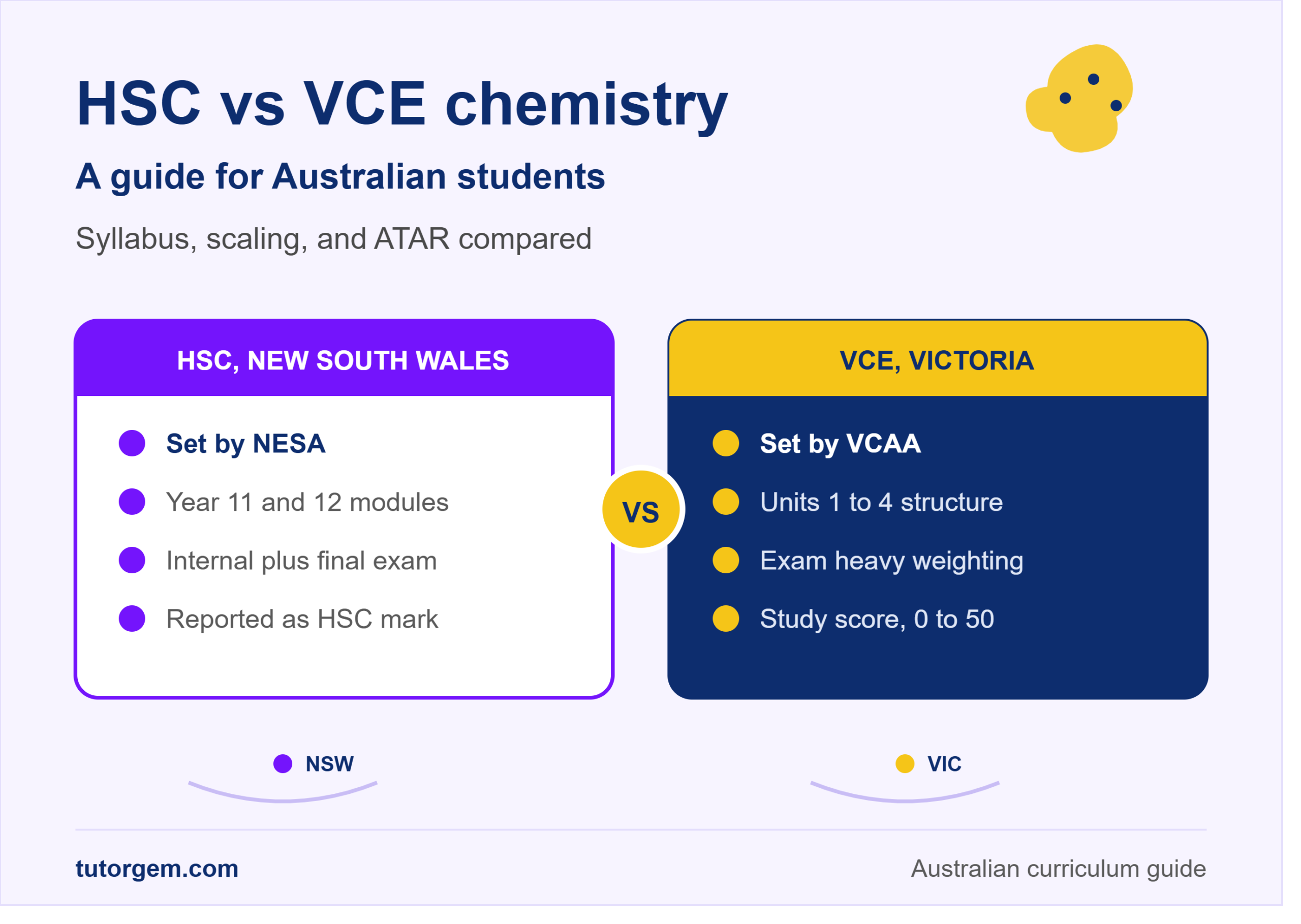
HSC chemistry, set by NESA in New South Wales, is organized into Year 11 and Year 12 modules covering properties of matter, chemical reactions, acid base equilibria, and organic chemistry. VCE chemistry, set by VCAA in Victoria, follows a similar structure but is organized into Units 1 through 4, with Units 3 and 4 forming the assessable Year 12 component that counts toward your final study score.
Both curricula teach students to understand chemistry at three levels simultaneously, the macroscopic level of observable reactions, the submicroscopic level of atoms and molecules, and the symbolic level of formulas and equations.
Syllabus Structure: Modules vs Units
HSC chemistry covers topics including equilibrium, acid reactions, redox reactions, organic chemical pathways, and applied chemistry across its Year 12 modules. VCE chemistry structures similar content across Units 3 and 4, titled around chemical analysis, chemical processes, and organic compound categorization.
Despite different naming conventions, both syllabuses require depth studies or practical investigations, along with internal school based assessment that contributes alongside the final external exam.
HSC vs VCE Chemistry: The Core Differences
While the scientific content overlaps significantly, the two systems calculate and weight results in genuinely different ways.
Assessment Format and Weighting
HSC chemistry blends internal school based assessment throughout Year 12 with a single external exam at the end of the year, contributing to your final HSC mark. VCE chemistry weights the external exam more heavily overall, though School Assessed Coursework still contributes to your final study score, which is reported on a 0 to 50 scale.
| Feature | HSC Chemistry | VCE Chemistry |
|---|---|---|
| Curriculum authority | NESA | VCAA |
| Structure | Year 11 and Year 12 modules | Units 1 to 4 |
| Assessed component | Units 3 and 4 equivalent modules | Units 3 and 4 |
| Result reported as | HSC mark, contributes to ATAR | Study score, 0 to 50 scale |
| Assessment weighting | Internal plus external exam | Exam heavy with internal SAC component |
How Scaling Affects Your Final ATAR
Both systems scale subjects, meaning your raw mark or study score adjusts based on the overall ability of the cohort studying that subject that year. Chemistry typically scales up moderately in both HSC and VCE, generally by around three to six points, reflecting the strong academic cohort that tends to choose the subject.
Since scaling recalculates annually based on actual cohort performance, checking your state’s current official scaling report through UAC or VTAC before finalizing subject choices gives a far more accurate picture than relying on outdated assumptions about which subjects scale well.
Is HSC Chemistry Harder Than VCE Chemistry
Neither syllabus is inherently more difficult, since both cover comparable depth in stoichiometry, chemical equilibrium, organic reaction pathways, and quantitative analysis. Both exams also provide students with a periodic table, meaning success depends on understanding relationships between elements rather than memorizing raw data.
What Scaling Data Actually Shows
Published scaling reports consistently show chemistry as one of the more competitively scaled subjects in both the HSC and VCE systems, since students who choose it tend to perform strongly across their other subjects too. This means a genuinely elite ATAR from either state generally reflects comparable underlying achievement, even though the raw mark or study score that produced it looks different on paper.
This scaling pattern also explains why comparing chemistry results directly between the two systems without accounting for cohort strength can give a misleading impression of relative difficulty.
A Real Case: Interstate Move Mid-Way Through Year 11
One TutorGem student relocated from Sydney to Melbourne partway through Year 11, moving from the HSC chemistry syllabus to VCE chemistry Units 1 and 2 without any real overlap period to adjust.
Her tutor mapped the topic sequencing differences between the two curricula, identifying that her previous HSC organic chemistry content had actually been covered earlier than the VCE equivalent, while VCE’s equilibrium unit came sooner than she expected based on her NSW timeline. This targeted realignment prevented her from either repeating content unnecessarily or missing gaps before her Unit 3 and 4 year began.
By the start of Year 12, she was fully aligned with her VCE cohort, with her tutor’s early intervention preventing what could have become a significant content gap heading into her most important assessment year.
How to Study Chemistry Effectively in Either System
Chemistry rewards consistent method over last minute cramming in both HSC and VCE, since both systems test applied understanding rather than pure recall through their external exams.
Building a Reaction Type Index
Creating a personal index of every reaction type covered in your syllabus, such as neutralization, precipitation, redox, esterification, and polymerization, along with one worked example for each, builds the kind of pattern recognition both HSC and VCE examiners consistently reward. Reviewing past HSC papers or past VCE papers against official VCAA and NESA exam reports also reveals exactly where students commonly lose marks.
How a Tutor Supports HSC and VCE Chemistry Students
A tutor experienced across both the HSC and VCE systems understands the structural differences well enough to prevent exactly the kind of content gap that interstate movers often face. This matters particularly for chemistry, given how heavily both systems weight the subject within ATAR scaling calculations.
TutorGem’s chemistry tutoring programs support students preparing for both HSC and VCE chemistry, alongside broader science tutoring for students managing biology and physics within either senior secondary system.
Frequently Asked Questions
Does a 90 ATAR from NSW mean the same as a 90 ATAR from Victoria?
Yes. Universities across Australia treat the ATAR as a national percentile ranking, so a 90 ATAR from either state generally meets the same course entry cutoffs, even though the underlying subject combinations differ.
Is VCE chemistry easier to score well in than HSC chemistry?
Neither system is inherently easier, since both scale chemistry upward based on a consistently strong academic cohort, meaning genuine top performance requires similar effort in either state.
How many chemistry modules or units do I need to complete for Year 12?
HSC students complete Year 12 chemistry modules that form the assessable component of the course, while VCE students complete Units 3 and 4, both structured to align with their respective final external exams.
Can I switch from HSC chemistry to VCE chemistry if I move states?
Yes, though topic sequencing differs between NESA and VCAA syllabuses, so identifying content gaps early with a tutor familiar with both systems prevents falling behind your new cohort.
Does chemistry scale well in both HSC and VCE?
Chemistry typically scales up moderately in both systems, generally by three to six points, reflecting the strong academic cohort that tends to choose the subject each year.
Understanding HSC vs VCE chemistry before an interstate move or subject selection decision removes unnecessary confusion from an already demanding senior year. If your child is navigating either system or facing a mid-course transfer, TutorGem’s experienced chemistry tutors can map their exact content gaps this week and build a plan aligned to their specific syllabus.