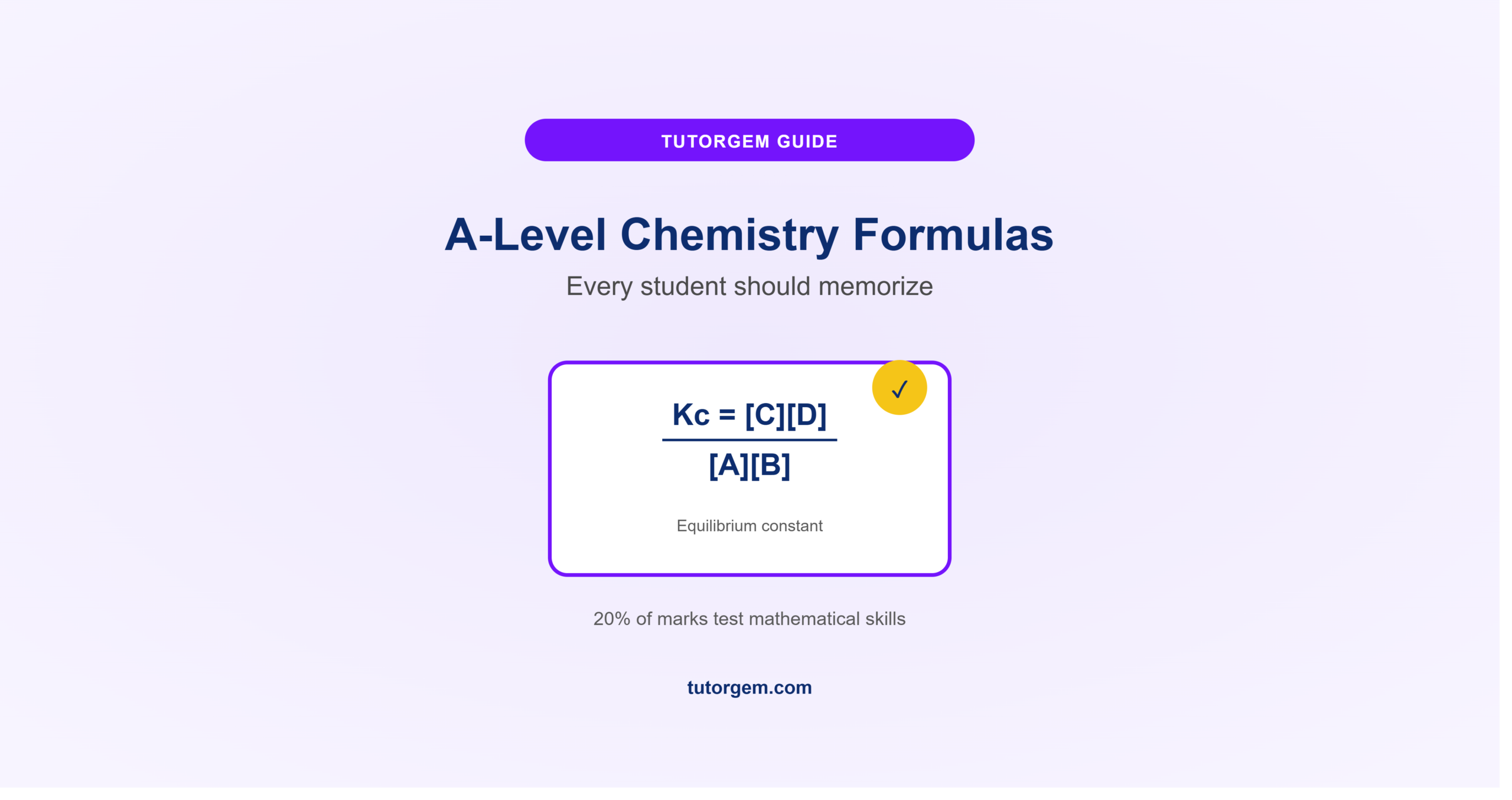
Chemistry Formulas Every A-Level Student Should Memorize
You are expert in theory portion of chemistry but stuck with the A-level chemistry formulas. This happens more often with students of A-level.
Chemistry rewards students who can recall the right formula instantly, not just understand the concept behind it. That gap between knowing and recalling costs real marks.
This guide lists the chemistry formulas every A-level student should memorize first, and shows exactly how to make them stick before exam day.
Why Formulas Matter More Than Students Expect
A-level chemistry blends conceptual understanding with real mathematical demand. Students who focus only on theory often struggle the moment a calculation question appears.
The Real Percentage Behind Maths Marks
According to official AQA guidance, at least 20 percent of the marks across A-level chemistry papers require mathematical skills at GCSE higher tier standard or above. This requirement applies across every major exam board, not just one specification.
This number matters. It means formula recall alone can decide the difference between a B and an A grade, regardless of how well a student understands the surrounding theory.
The A-Level Chemistry Formulas Worth Memorizing First
Some formulas appear across almost every paper, regardless of topic. Learning these first builds a strong foundation for the rest of the course.
Physical Chemistry Formulas
Moles, concentration, and equilibrium constant formulas form the backbone of physical chemistry questions. These appear constantly across titration, rate of reaction, and equilibrium topics throughout both years.
| Formula Area | What It Calculates | Common Exam Context |
|---|---|---|
| Moles | Amount of substance | Titrations, yield questions |
| Concentration | Amount per volume | Solution and dilution problems |
| Equilibrium constant | Balance of reactants and products | Le Chatelier’s principle questions |
| Rate equation | Speed of a reaction | Kinetics and order of reaction |
| Enthalpy change | Energy released or absorbed | Hess cycle calculations |
Organic and Practical Formulas
Percentage yield and percentage atom economy calculations appear consistently in organic chemistry questions, testing both formula recall and careful arithmetic under time pressure.
Practical based formulas, like uncertainty calculations, also carry real exam weight, since required practicals feed directly into written exam questions across every board.
Formulas on the Sheet vs Formulas You Must Know
Exam boards print some formulas directly on the paper, while others must be memorized entirely from scratch. Confusing the two creates unnecessary panic in the exam hall.
Why Confusing the Two Costs Easy Marks
Students who assume every formula appears on the sheet often freeze when a memorized formula, like the ideal gas equation rearrangement, is actually expected from memory.
Checking your specific exam board’s official formula sheet early in the course removes this confusion completely, since the list rarely changes once published.
A Real Case: One Missing Formula, Three Lost Marks
One TutorGem student understood equilibrium theory well but consistently lost marks on Kc calculation questions. His tutor found the exact issue during a past paper review.
He had never fully memorized the equilibrium constant expression itself, relying instead on vaguely recalling the shape of the formula under pressure. This guesswork cost him marks on nearly every equilibrium question he attempted.
His tutor built short, daily formula recall drills into his revision. Within three weeks, equilibrium questions became one of his strongest topics, purely from confident, accurate formula recall.
A Simple Way to Memorize Formulas That Actually Sticks
Write each formula from memory daily, rather than simply reading it repeatedly from notes. Active recall builds far stronger memory than passive review.
Questions to Ask While You Practice
Ask if you can write the formula without looking, then check it against your notes afterward. Ask if you understand what each symbol in the formula actually represents, not just its position in the equation.
How a Tutor Turns Formulas Into Exam Confidence
A tutor identifies exactly which formulas a student confuses or forgets under pressure, building targeted practice around those specific gaps instead of generic revision.
TutorGem’s chemistry tutoring programmes build formula recall directly into every session, alongside broader A-level tutoring support across other subjects. This turns shaky formula recall into one of a student’s strongest exam skills.
Frequently Asked Questions
How many chemistry formulas do I need to memorize for A-level?
Around 15 to 20 core formulas cover most calculation questions across physical, organic, and practical chemistry topics, though the exact number varies slightly by exam board.
Are chemistry formulas provided on the A-level exam paper?
Some are, such as basic constants, but many core formulas, including moles and equilibrium expressions, must be memorized entirely from scratch.
What is the best way to memorize chemistry formulas?
Writing each formula from memory daily builds stronger recall than repeatedly reading it, since active recall trains the brain to retrieve information under real exam pressure.
Do all exam boards require the same chemistry formulas?
Core physical chemistry formulas remain largely consistent across AQA, Edexcel, and OCR, though the official formula sheet provided in the exam can vary slightly between boards.
Can a tutor help with formula recall specifically?
Yes. A tutor can identify exactly which formulas a student consistently forgets or confuses, then build short, targeted recall practice around those specific gaps.
Mastering the chemistry formulas every A-level student needs turns shaky calculation questions into reliable, confident marks. If formula recall keeps costing you points despite solid theory knowledge, TutorGem’s experienced chemistry tutors can pinpoint your exact gaps this week and build lasting recall before your next exam.