AS Level and A Level Economics: Curriculum and Content Compared
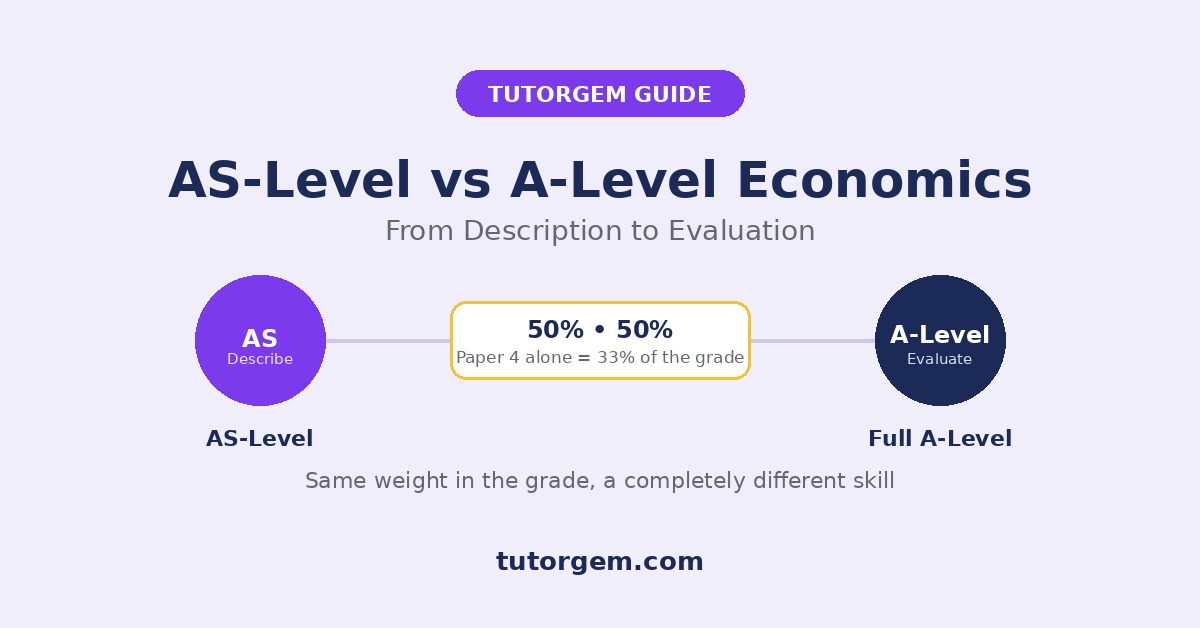
AS-Level Economics teaches you to describe how markets work. The second half of A-Level teaches you to argue about whether they work well. That shift, from description to evaluation, is the real story behind this subject’s difficulty jump.
AS Level and A Level Economics difference shows up clearly once you compare the actual topic lists side by side. AS builds the foundation. The second half adds market failure, labour markets, and macroeconomic policy debate on top of it.
This guide breaks down exactly what each stage covers, how the four Cambridge papers are weighted, and why later essays demand a completely different skill than AS ones. Read this before your first evaluative essay, since the expectations genuinely change.
How Cambridge Structures AS Level and A Level Economics (9708)
Cambridge International Economics, syllabus code 9708, assesses AS and full A-Level content through four papers, using a mix of multiple choice, data response, and essay questions.
What AS-Level Economics Actually Covers
AS content includes:
- Basic economic ideas and resource allocation
- The price system and the microeconomy
- Government microeconomic intervention
- The macroeconomy
- International economic issues
What the Second Half of A-Level Adds on Top of the AS Foundation
The second half of A-Level extends into genuinely new territory:
- Utility, costs, and revenues
- Market structures, including monopoly and oligopoly
- Market failure, in far greater depth than AS
- Labour markets
- Macroeconomic policy
- Exchange rates
- Economic growth and development
Paper Structure and Weighting Table
| Paper | Level | Format | Marks | Weight at AS | Weight at Full A-Level |
| Paper 1 | AS | Multiple Choice | 30 | 33% | 17% |
| Paper 2 | AS | Data Response & Essay | 40 | 67% | 33% |
| Paper 3 | Second half | Multiple Choice | 30 | Not applicable | 17% |
| Paper 4 | Second half | Data Response & Essay | 70 | Not applicable | 33% |
Notice something important here about the AS Level and A Level Economics split. AS and second-half content each contribute exactly half of the final A-Level grade. Neither stage outweighs the other numerically, even though the second half feels harder to most students.
Why the Second Half of A-Level Economics Feels Like a Different Subject
This is the part most competitor guides skip when covering AS Level and A Level Economics. AS-Level economics is mostly descriptive. You explain how supply and demand shift, or how a government intervention affects a market.
The second half is evaluative. Every major topic at this stage, market failure, macroeconomic policy, economic growth, ends in essay questions asking you to weigh up competing arguments and reach a justified conclusion.
Students who scored well at AS by memorising diagrams and definitions often struggle once evaluation is required, since strong recall alone no longer earns top marks. Evaluation, not memory, becomes the deciding skill.
Topic Comparison Table: AS vs Full A-Level Content
| Economics Area | AS-Level Focus | Full A-Level Additional Focus |
| Microeconomics | Price system, basic resource allocation | Market structures, utility, market failure |
| Macroeconomics | Basic macroeconomy concepts | Macroeconomic policy, growth and development |
| International Economics | International economic issues | Exchange rates in depth |
| Government Intervention | Microeconomic intervention | Labour market intervention, policy trade-offs |
A Realistic Example From TutorGem Sessions
One TutorGem student scored an A at AS-Level Economics, confident with diagrams and definitions across microeconomics and macroeconomics. In the second half of A-Level, the same student initially struggled with market failure essays specifically.
The issue wasn’t knowledge. It was structure. The student knew the theory but hadn’t practised building a balanced argument that weighed government intervention against market-based solutions. A few focused essay-technique sessions closed that gap within weeks.
Common Mistakes Students Make Across the Two Stages
- Treating later essays like longer AS answers, rather than genuinely evaluative arguments
- Assuming strong AS diagram knowledge automatically transfers to market structure analysis later on
- Underestimating how much weight Paper 4 carries, since it makes up a third of the entire A-Level grade on its own
Practical Skills That Matter More Later On
Data response questions appear at both AS and the second half, but later data sets tend to involve real-world statistics requiring interpretation, not just calculation. Reading between the lines of a data set becomes a genuine exam skill at this stage, not an optional extra.
How TutorGem Supports Students Through the Economics Transition
TutorGem’s economics tutors specifically target the shift from description to evaluation, since that shift, not raw content volume, is what actually separates AS and full A-Level performance. Your tutor builds essay technique practice around the exact command words Cambridge uses at this stage, discuss, evaluate, assess, so students walk into Paper 4 already comfortable with what’s being asked.
Frequently Asked Questions
What is the main AS Level and A Level Economics difference in content?
AS-Level covers basic economic ideas, the price system, government microeconomic intervention, the macroeconomy, and international trade. The second half of A-Level adds market structures, market failure, labour markets, macroeconomic policy, and economic growth.
Is the second half of A-Level economics harder than AS economics?
Most students find it harder, not because there’s more content, but because the essays demand evaluation and balanced argument rather than description and recall.
How many exam papers does Cambridge Economics 9708 have?
Cambridge Economics 9708 uses four papers. Papers 1 and 2 assess AS content, while Papers 3 and 4 assess the second half of A-Level content.
Do AS and full A-Level content carry equal weight in the final grade?
Yes. AS and second-half content each contribute exactly 50% of the final A-Level grade, split evenly across the four papers.
What skill matters most for later Economics essays?
Evaluation matters most. Cambridge’s later essays consistently reward students who weigh competing arguments and reach a justified conclusion, rather than simply describing economic theory.
Understanding that AS and full A-Level economics differ in skill, not just content, changes how students should actually prepare for each stage. If you want help building the evaluative essay technique that later Economics work demands, TutorGem’s tutors can work through that with you.