How to Prepare for IELTS: A Step-by-Step Study Guide
All international university offer, visa, or your job depends heavily on your IELTS score. Are you sure you are ready to fulfill the primary requirement.
Most students are ready on content. They lose marks on timing, task rules, and format. Knowing how to prepare for IELTS fixes exactly these gaps.
This guide covers the four sections, realistic band score targets, and a weekly plan you can follow. If you want expert feedback along the way, TutorGem’s English tutoring can help.
What the IELTS Test Actually Measures
IELTS tests how well you use English in real situations. It scores you from 0 to 9, in half-band steps.
Your overall band score is the average of four section scores. Each section matters equally.
The Four Sections at a Glance
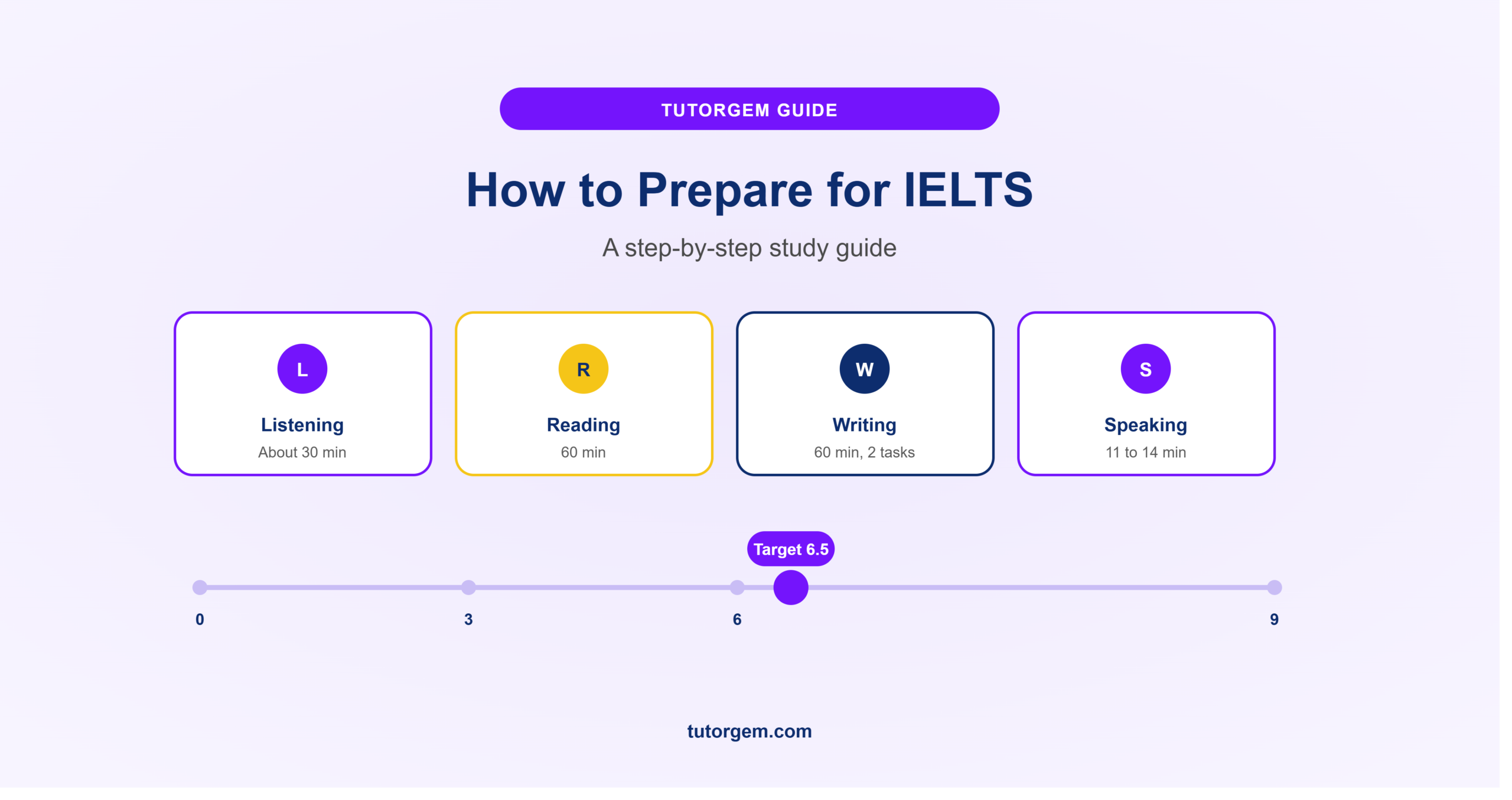
The whole test takes about two hours and forty-five minutes. Speaking happens face to face with an examiner, often on a separate day.
| Section | Time | What You Do |
|---|---|---|
| Listening | About 30 minutes | Answer questions on four recordings |
| Reading | 60 minutes | Answer 40 questions on long texts |
| Writing | 60 minutes | Two tasks, at least 150 and 250 words |
| Speaking | 11 to 14 minutes | Three-part conversation with an examiner |
Academic vs General Training
Listening and Speaking are the same for both versions. Reading and Writing differ.
Choose Academic for university study. Choose General Training for migration or work, unless your employer says otherwise.
What Band Score Do You Actually Need
Your target score decides how hard you must study. Check your institution’s exact requirement before you plan anything.
Typical UK University Requirements
Most UK universities ask for an overall band score of 6.0 to 7.0, usually with no section below 5.5. Undergraduate courses often sit near 6.0, while master’s courses often ask for 6.5.
Competitive subjects like law and medicine often ask for more. IELTS results stay valid for two years, so time your test with your application dates.
How to Prepare for IELTS Without Wasting Weeks
Random practice feels busy but rarely lifts your score. A clear order of steps works far better.
Start With a Diagnostic Test
Take one full, timed practice test before studying anything. This shows your real starting score in each section.
Your weakest section becomes your first priority. Most students find Writing or Speaking needs the most work.
A Simple Weekly Study Plan
Spread your practice across the week instead of cramming. Short, daily sessions build habits faster than one long weekend.
| Day | Focus |
|---|---|
| Monday | Listening practice and review |
| Tuesday | Reading with strict timing |
| Wednesday | Writing Task 2 essay |
| Thursday | Speaking practice, recorded on your phone |
| Friday | Vocabulary and grammar review |
| Saturday | One full section under real timing |
| Sunday | Rest and light review of mistakes |
A Real Case: Lifting Writing From 6.0 to 7.0
One TutorGem student in Lahore needed an overall 6.5 for a UK master’s degree. Her Listening and Reading were strong, but her Writing stayed at 6.0 across three practice tests.
Her tutor found two clear problems. She wrote good ideas but ended Task 2 without a real conclusion, and she repeated the same words often.
After six weeks of focused feedback, her practice Writing score reached 7.0. Her English did not change much. Her task structure did.
Common Mistakes That Cost Band Points
Many students study hard but repeat the same errors in every practice test. These patterns cost the most points.
Writing under the minimum word count lowers your score. Memorizing a template answer also hurts, since examiners mark memorized responses down.
Practicing Speaking only in your head is another common trap. Your mouth needs practice, not just your mind.
Questions to Ask After Every Practice Test
Which questions did I run out of time on? Did I answer the exact question, or a similar one I felt more comfortable with?
These two checks reveal more than your raw score ever will.
How an IELTS Tutor Speeds Up Your Progress
An IELTS tutor marks your Writing and Speaking against the official band descriptors. This gives you specific feedback, not general advice like “write better.”
Working with an IELTS tutor online also fits busy schedules, especially for students in Pakistan and the UAE preparing from home. TutorGem’s online tutoring connects you with experienced English tutors for this exact purpose.
Frequently Asked Questions
How long does it take to prepare for IELTS?
Most students need six to twelve weeks, depending on their starting level and target band score.
Which IELTS section is hardest for most students?
Many students find Writing hardest, since it needs both good ideas and strict structure under time pressure.
Can I improve my IELTS score quickly?
Yes, if you fix specific task habits. A diagnostic test shows where small changes bring the biggest score gains.
Should I take IELTS Academic or General Training?
Take Academic for university study. Take General Training for work or migration, unless your institution says otherwise.
Do I need an IELTS tutor to pass?
Not always, but expert feedback on Writing and Speaking helps most students improve faster than studying alone.
Learning how to prepare for IELTS properly saves weeks of unfocused studying and protects your target score. If your practice results have stopped improving, TutorGem’s experienced English tutors can review your work this week and show you exactly what to fix next.