GCSE Physics: Everything Students Need to Know Before the Exam
Do equations, units, and circuit diagrams all blur together the night before your mock exam? You are not the only student who feels this way about GCSE Physics Past Papers.
The subject feels overwhelming because it mixes maths, memory, and logic into one paper. Once you understand exactly what each exam board tests and how marks are actually awarded, physics becomes far more manageable than it first appears.
This guide breaks down the full GCSE physics syllabus, explains why students lose marks, and shows a proven revision method using physics past papers that consistently raises grades within weeks.
What GCSE Physics Past Papers Actually Covers
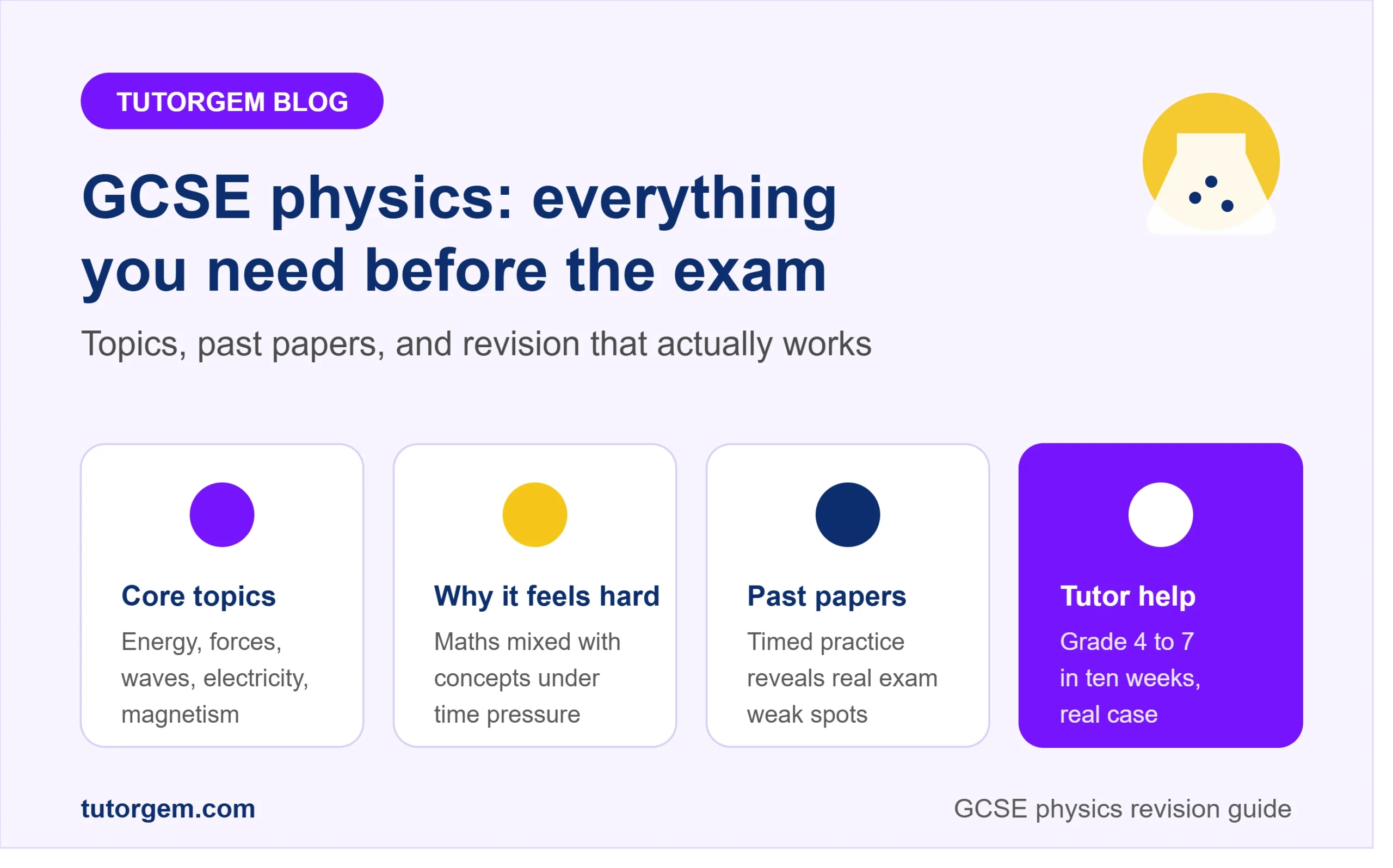
GCSE physics tests your understanding of energy, forces, waves, electricity, magnetism, and the structure of matter. Every major exam board, including AQA, Edexcel, and OCR, follows a similar core structure with small variations in wording.
Students sit either Combined Science, which covers physics alongside biology and chemistry, or Triple Science, which treats physics as a separate full GCSE. Triple Science goes deeper into topics like nuclear physics and space.
The Core Topics Every Exam Board Tests
Energy transfers, forces and motion, waves, electricity, magnetism, and particle model of matter form the backbone of every physics specification. Each topic links directly to the next, so gaps early in the course create confusion later.
| Topic Area | What It Tests | Common Student Difficulty |
| Energy | Transfers, conservation, efficiency | Confusing energy stores with transfers |
| Forces | Motion, momentum, Newton’s laws | Weak algebra skills |
| Waves | Sound, light, electromagnetic spectrum | Wave equation calculations |
| Electricity | Circuits, resistance, current | Series versus parallel confusion |
| Magnetism | Fields, electromagnets, motors | Visualizing field direction |
| Particle model | States of matter, pressure | Abstract, hard to picture |
Why GCSE Physics Feels Harder Than Other Sciences?
Physics demands constant switching between conceptual understanding and mathematical calculation. Biology and chemistry rely more on recall, while physics requires you to apply formulas correctly under time pressure.
This dual demand explains why many students who do well in biology still struggle with physics. The subject punishes memorization without understanding far more severely than other sciences. Many students ask this exact question on forums like Quora, where the most common answer points to the same issue, weak conceptual grip rather than lack of effort.
The Maths Inside Physics
Roughly a third of GCSE physics marks depend on mathematical skills such as rearranging equations, using standard form, and reading graphs accurately. A small maths error often costs marks even when the physics concept is fully understood.
Students who practice equation rearrangement separately from physics content tend to perform noticeably better on calculation heavy questions.
Too Many Formulas, Too Little Time
Exam boards expect students to memorize around 21 key equations, while another set is provided on the exam paper. Confusing which equations must be memorized creates unnecessary panic in the exam hall.
Building a single formula sheet early in the course, then testing recall weekly, removes this last minute stress entirely.
How GCSE Physics Grading Works
GCSE physics uses the 9 to 1 grading scale, with grade 4 counting as a standard pass and grade 7 considered a strong pass equivalent to the old grade A.
What the Latest Results Show
According to 2025 data from the Joint Council for Qualifications, 90.8 percent of physics students achieved a grade 4 or above, while 45.1 percent reached the top grades of 7 or higher. These figures show physics has one of the higher top grade rates among GCSE subjects, meaning strong preparation genuinely pays off.
Interestingly, exam board data also shows boys have historically outperformed girls at both grade 4 and grade 7 in physics, one of only a handful of subjects showing this pattern.
A Real Case: Turning a Grade 4 Into a Grade 7
One TutorGem student entered Year 11 mock exams with a borderline grade 4 in physics. His main weakness was not understanding concepts but applying them under exam conditions.
His tutor restructured his revision around timed physics past papers combined with equation drills twice a week. Within ten weeks, his predicted grade rose to a 7, driven almost entirely by improved exam technique rather than new content.
This pattern shows up repeatedly. Students rarely fail physics because the content is impossible. They fail because they never practiced applying it under real exam pressure.
The Best Way to Revise GCSE Physics Past Papers
Active recall consistently outperforms passive reading. Testing yourself on definitions, equations, and diagrams forces your brain to retrieve information the same way an exam demands.
Spaced repetition also matters more than long single sessions. Revisiting a topic every few days for twenty minutes beats one exhausting four hour session the week before the exam.
Using GCSE Physics Past Papers the Right Way
Physics past papers reveal exactly how examiners phrase questions and where marks are commonly lost. Completing them under timed conditions builds both speed and confidence.
After each paper, review your mistakes carefully instead of just checking the final score. Understanding why an answer was wrong prevents the same error from repeating in the real exam.
Common Mistakes Students Make Before the Exam
Many students revise topics they already understand while avoiding weaker areas. This creates a false sense of readiness that collapses under real exam pressure.
Skipping unit checks on calculation answers also costs easy marks. Examiners specifically look for correct units, and missing them is one of the most common reasons strong students lose points.
How a Tutor Helps You Prepare for GCSE Physics
A dedicated physics tutor identifies exactly which topics need more attention instead of forcing you through a generic revision plan built for the whole class. Personalized feedback on past paper answers speeds up improvement significantly.
Working through physics with a tutor also removes the fear of asking basic questions, something many students hesitate to do during a busy classroom lesson. This one on one attention is usually the biggest difference between a borderline pass and a confident grade 7.
Frequently Asked Questions
How many equations do I need to memorize for GCSE physics?
Most exam boards require around 21 equations to be memorized, while additional equations are printed on the exam paper itself.
Is GCSE physics harder than GCSE biology?
Physics generally demands stronger mathematical skills, while biology relies more heavily on memory and recall, making the two subjects challenging in different ways.
How many physics past papers should I complete before the exam?
Most students benefit from completing at least eight to ten full past papers under timed conditions before their final exam.
What grade counts as a pass in GCSE physics?
Grade 4 is considered a standard pass, while grade 5 is often required for progression onto A-level science subjects.
Can online tutoring improve GCSE physics grades?
Yes. Regular one on one sessions focused on weak topics and past paper technique consistently help students move up one or two full grades within a term.
GCSE physics rewards preparation over talent, and the data proves it. Students who combine consistent practice with timed physics past papers and targeted feedback move from borderline passes to strong grades within a single term. If exam season is approaching and your child needs a clearer, more structured plan, TutorGem’s experienced physics tutors are ready to help turn confusion into confidence before results day arrives.