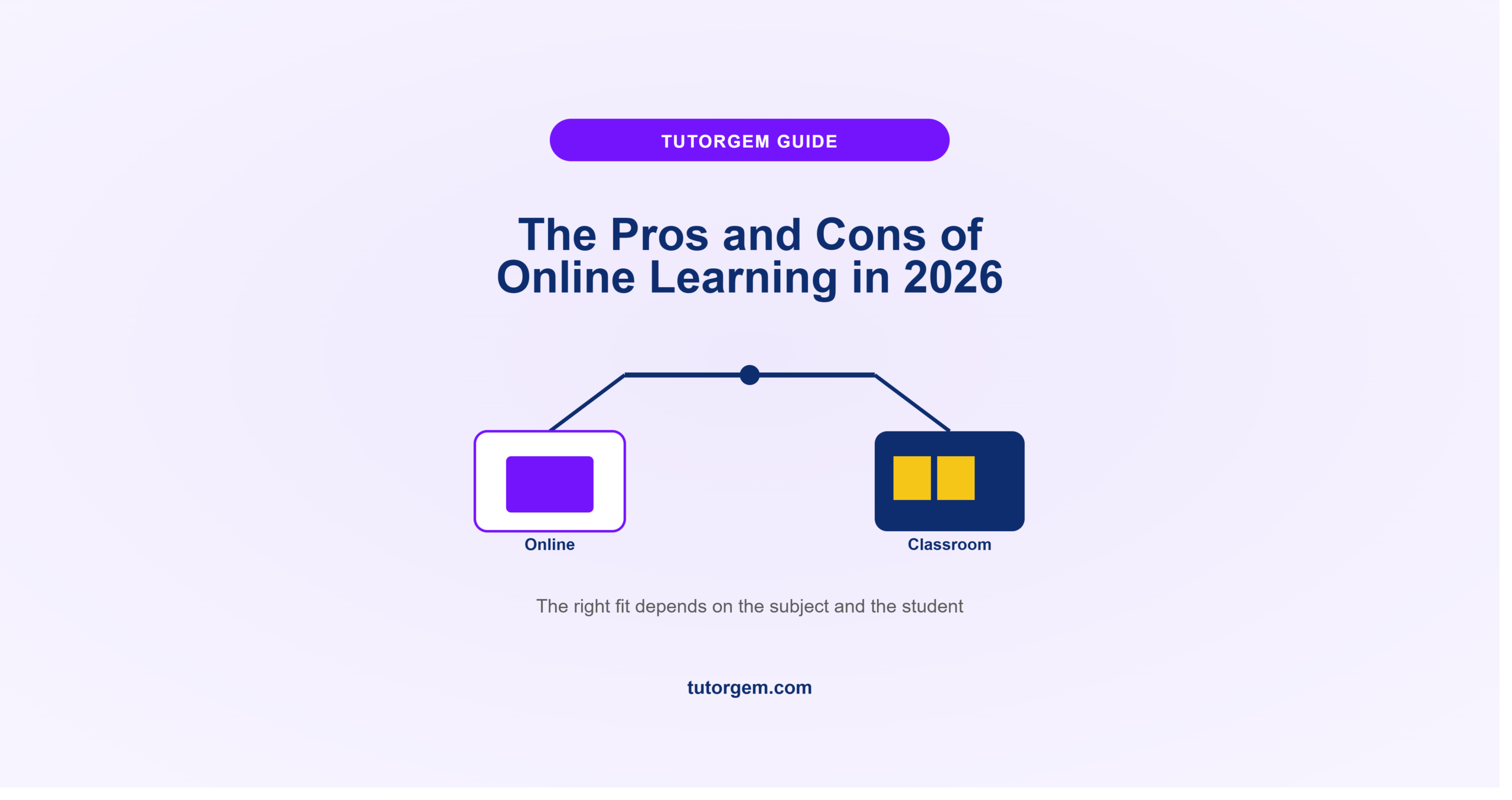
The Pros and Cons of Learning Online in 2026
Screens everywhere. Classrooms not going anywhere either. Choosing between the two feels more confusing than it should.
The honest answer is that the pros and cons of online learning depend heavily on the subject, the student’s age, and how disciplined that student already is with independent work.
This guide breaks down what genuinely works well online, where the traditional classroom still holds a real edge, and how to judge which format actually fits your specific situation.
Why This Decision Feels Harder Than It Used To
Online learning stopped being a niche alternative years ago. It now sits alongside classroom teaching as a completely normal, mainstream option across nearly every stage of education.
How Much Online Learning Has Actually Grown
More than half of US college students took at least one online course in 2023, according to federal IPEDS data, while global online education revenue is projected to reach roughly 199 billion dollars in 2026. Participation has climbed steadily across Europe too, with online learning use rising from 21.4 percent in 2019 to nearly 35 percent by 2025.
This scale confirms the pros and cons of online learning now matter to almost every family, not just a small group choosing an unconventional path.
The Real Pros and Cons of Online Learning
Neither format wins universally. Each genuinely suits different subjects, ages, and learning styles better than the other.
Where Online Learning Genuinely Outperforms the Classroom
Online learning removes geographic barriers entirely, opening access to specialist teachers regardless of where a student lives. Self-paced material also lets students revisit difficult concepts as many times as needed, something a live classroom moving at a fixed pace cannot easily offer.
| Factor | Online Learning | Traditional Classroom |
|---|---|---|
| Access to specialists | Wide, not limited by location | Limited to local teachers |
| Pacing | Self-paced, revisit anytime | Fixed pace for the whole group |
| Social interaction | Limited, requires effort | Built in naturally |
| Discipline required | High, self-management needed | Lower, structure provided externally |
| Best suited for | Motivated, independent learners | Younger students, hands-on subjects |
Where the Classroom Still Wins
A 2020 study of Hong Kong primary school students found that only 49.6 percent considered online learning effective, while 67.2 percent still preferred in-person schooling overall. Younger children in particular benefit from the structure, social interaction, and physical presence that a classroom provides naturally.
What the Research Says About Learning Outcomes
Outcome data on the pros and cons of online learning paints a genuinely mixed picture, depending heavily on subject and student profile.
A Surprising Finding From the 2020 School Shutdowns
A peer-reviewed study analyzing over 124,000 maths problem sets from more than 2,500 K-12 students found that academic performance actually improved during the 2020 school shutdown compared to the previous year, with lower-achieving students showing the greatest gains. This finding suggests that for some subjects and some students, the self-paced, low-pressure structure of online learning genuinely helps rather than hinders progress.
This research shows the pros and cons of online learning cannot be reduced to one universal verdict. Results depend heavily on the subject tested and the individual student’s existing habits.
A Real Case: Matching Format to the Actual Need
One TutorGem family had enrolled their younger child in a fully online primary curriculum, assuming flexibility alone would suit her well. She struggled significantly with the lack of structure and missed the social interaction of a physical classroom.
Switching her core subjects back to in-person schooling while keeping specialist online tutoring for maths, where she needed a level of pacing her local school could not offer, solved both problems at once. This blended approach matched each need to the format that actually suited it.
How to Decide What Fits Your Situation
Consider the subject itself before the format. Hands-on or highly social subjects often suit a classroom better, while structured, sequential subjects like maths or coding often translate well to self-paced online formats.
Questions to Ask Before Choosing a Format
Ask whether your child manages independent tasks well without close supervision. Ask whether the subject in question benefits more from social interaction or from flexible, repeatable practice.
How TutorGem Blends the Best of Both Worlds
TutorGem’s online tutoring combines the access and flexibility of online learning with the structure and accountability a live, one-on-one tutor provides, addressing many of the discipline concerns that pure self-paced online learning can struggle with.
Frequently Asked Questions
Is online learning as effective as traditional classroom learning?
Research shows mixed results depending on subject and student profile, with some structured subjects like maths performing comparably or even better online, while younger students often still prefer in-person settings overall.
What are the biggest drawbacks of online learning?
Reduced social interaction and the need for strong self-discipline rank among the most consistently reported drawbacks, particularly for younger or less independent learners.
Does online learning work better for older students than younger ones?
Generally, yes. Older, more independent students tend to manage the self-paced structure of online learning more successfully than younger children who benefit more from classroom structure.
Can online learning and traditional schooling be combined?
Yes. Many families successfully blend both, using in-person schooling for core social and hands-on subjects while adding online, specialist tutoring for subjects needing more flexible pacing.
How has online learning changed since the pandemic era?
Participation has continued rising steadily well beyond the pandemic, with 2026 data showing online education as a mainstream, permanent part of the education landscape rather than a temporary shift.
Weighing the pros and cons of online learning honestly means matching the format to the actual subject and student, not choosing one option for everything. If your family is trying to find the right balance, TutorGem’s experienced tutors can help identify exactly where online support adds the most value for your child’s specific needs.