GCSE Chemistry: Everything Students Need to Know Before the Exam
Do word equations, mole calculations, and required practicals all blur together the week before your exam? You are not the only student who feels overwhelmed by GCSE chemistry.
The subject feels harder than expected because it mixes abstract theory with precise mathematical calculation, often within the same question. Once you understand exactly what each exam board tests and how marks get awarded, chemistry becomes far more manageable than it first appears.
This guide breaks down the full GCSE chemistry syllabus, explains why students lose marks, and shows a proven revision method using GCSE chemistry past papers that consistently raises grades within weeks.
What GCSE Chemistry Actually Covers
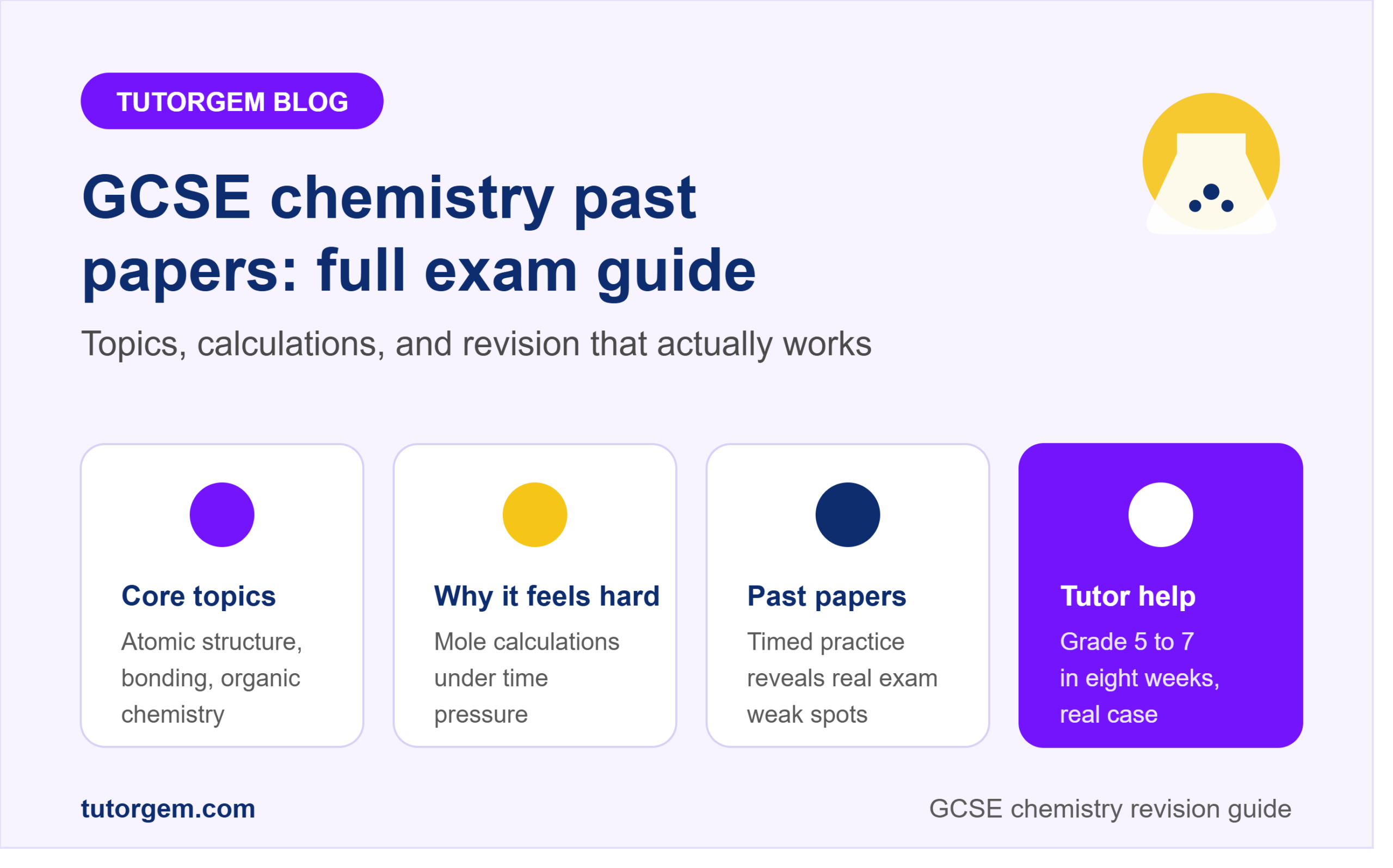
GCSE chemistry tests your understanding of atomic structure, bonding, chemical reactions, rates of reaction, and organic chemistry basics. Every major exam board, including AQA, Edexcel, and OCR, follows a similar core structure with small variations in required practicals and wording.
Students sit either Combined Science, which covers chemistry alongside biology and physics, or Triple Science, which treats chemistry as a separate full GCSE. Triple Science goes deeper into topics like quantitative chemistry and chemical analysis.
The Core Topics Every Exam Board Tests
Atomic structure, bonding, chemical changes, energy changes, rates of reaction, and organic chemistry form the backbone of every chemistry specification. Each topic links directly to the next, so gaps early in the course create confusion later.
| Topic Area | What It Tests | Common Student Difficulty |
|---|---|---|
| Atomic structure | Protons, neutrons, electron configuration | Confusing mass number with atomic number |
| Bonding | Ionic, covalent, metallic bonds | Drawing dot and cross diagrams |
| Chemical changes | Reactivity series, electrolysis | Predicting reaction outcomes |
| Quantitative chemistry | Moles, concentration, yield | Weak arithmetic under time pressure |
| Rates of reaction | Collision theory, catalysts | Explaining graphs accurately |
| Organic chemistry | Hydrocarbons, polymers | New vocabulary overload |
Why GCSE Chemistry Feels Harder Than Expected
Chemistry demands constant switching between recalling facts and applying mathematical reasoning. Biology relies more heavily on description and memory, while chemistry requires accurate calculation alongside conceptual understanding.
This dual demand explains why many students who do well in biology still find chemistry difficult. The subject punishes memorization without understanding, particularly in exam questions that combine two topics at once.
The Calculation Side of Chemistry
Mole calculations, percentage yield, and concentration questions carry significant marks across every exam board specification. A single unit error or misplaced decimal point often costs marks even when the underlying chemistry concept is fully understood.
Students who practice calculation questions separately from theory content tend to perform noticeably better on the higher tier papers.
Too Many Equations to Balance and Remember
Balancing chemical equations, writing word equations, and memorizing key definitions all demand precision. Confusing similar looking equations creates unnecessary panic during timed conditions.
Building a personal glossary of key terms and practicing equation balancing daily removes most of this last minute confusion.
How GCSE Chemistry Grading Works
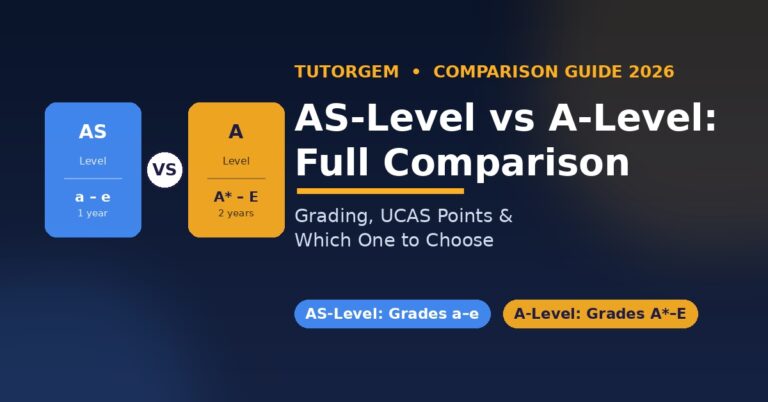
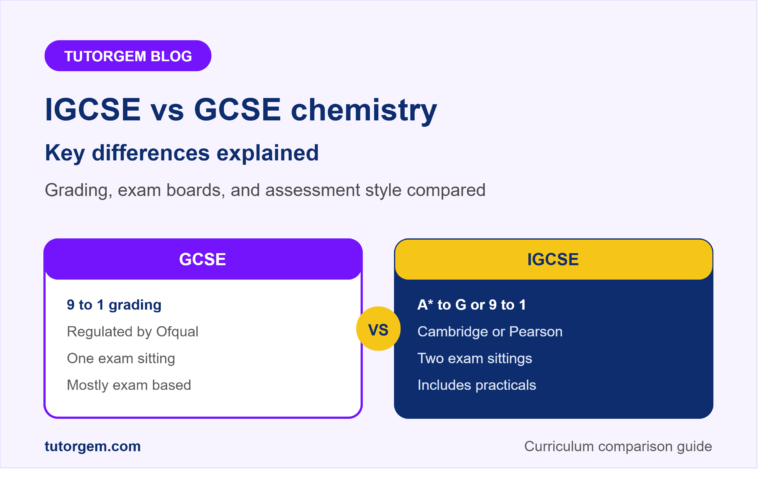
GCSE chemistry uses the 9 to 1 grading scale, with grade 4 counting as a standard pass and grade 7 considered a strong pass equivalent to the old grade A.
What the Latest Results Show
According to 2025 data analysis of national GCSE results, around 45 percent of chemistry entries achieved grades 7 to 9, while less than 10 percent of students scored below grade 4. These figures place chemistry among the stronger performing sciences at GCSE level, showing that focused preparation genuinely pays off.
Ofqual’s own results guidance also confirms that grading standards remain consistent year on year, meaning steady improvement through structured practice reliably translates into better final grades.
A Real Case: Turning Weak Practicals Into Strong Marks
One TutorGem student struggled specifically with required practical questions in chemistry, often losing marks on method evaluation and error analysis despite understanding the core theory well.
Her tutor introduced a structured review of all ten required practicals, paired with past paper questions focused only on practical based marks. Within eight weeks, her practical question accuracy rose from around 40 percent to over 80 percent, lifting her overall predicted grade from a 5 to a 7.
This pattern repeats often. Students frequently understand chemistry theory well but lose easy marks on practical and evaluation questions simply through lack of targeted practice.
The Best Way to Revise GCSE Chemistry
Active recall consistently outperforms passive reading, especially for equations, definitions, and required practical methods. Testing yourself regularly forces retrieval in the same way an exam demands.
Spaced repetition also matters more than long single sessions. Revisiting calculation methods every few days for twenty minutes builds stronger recall than one long session the week before the exam.
Using GCSE Chemistry Past Papers the Right Way
GCSE chemistry past papers reveal exactly how examiners phrase questions and where marks are commonly lost, particularly around practical evaluation and calculation method marks. Completing them under timed conditions builds both speed and confidence.
After each paper, review incorrect answers carefully rather than only checking the final score. Understanding why an answer was marked wrong prevents the same mistake from repeating in the real exam.
Common Mistakes Students Make Before the Exam
Many students revise definitions and theory while avoiding calculation heavy topics entirely. This creates a false sense of readiness that collapses when a calculation question appears on the exam paper.
Ignoring required practical questions is another common error, since these questions appear consistently across every exam board and often carry more marks than students expect.
How a Tutor Helps You Prepare for GCSE Chemistry
A dedicated chemistry tutor identifies exactly which topics need more attention instead of forcing you through a generic revision plan built for the whole class. Personalized feedback on past paper answers speeds up improvement significantly.
Working through chemistry with a tutor also removes the fear of asking basic questions, something many students hesitate to do during a busy classroom lesson. If your child is preparing for GCSEs across multiple subjects, TutorGem’s GCSE tutoring support covers chemistry alongside physics, maths, and biology under one consistent study plan.
Frequently Asked Questions
How many required practicals are there in GCSE chemistry?
Most exam boards require students to complete around ten required practicals, and exam questions frequently test understanding of these methods and results.
Is GCSE chemistry harder than GCSE biology?
Chemistry generally demands stronger mathematical and calculation skills, while biology relies more heavily on memory and description, making the two subjects challenging in different ways.
How many GCSE chemistry past papers should I complete before the exam?
Most students benefit from completing at least eight to ten full past papers under timed conditions before their final exam.
What grade counts as a pass in GCSE chemistry?
Grade 4 is considered a standard pass, while grade 5 is often required for progression onto A-level science subjects.
Can online tutoring improve GCSE chemistry grades?
Yes. Regular one on one sessions focused on weak topics and past paper technique consistently help students move up one or two full grades within a term.
GCSE chemistry rewards preparation over talent, and the results data proves it every year. Students who combine consistent practice with timed GCSE chemistry past papers and targeted feedback move from borderline passes to strong grades within a single term. If exam season is approaching and your child needs a clearer, more structured plan, TutorGem’s experienced chemistry tutors are ready to help turn confusion into confidence before results day arrives.