How Learning Quran Online Works: A Beginner’s Guide
Booking a first Quran lesson online feels like a leap into the unknown when you have no idea what actually happens once you log in.
Understanding how learning Quran online works removes most of that uncertainty, since the process follows a clear, structured path regardless of a student’s starting level.
This guide walks through exactly what to expect, from the very first lesson through the typical progression toward fluent recitation and beyond.
What a First Online Quran Lesson Actually Looks Like
A typical first session starts with a short assessment, letting the tutor understand a student’s current reading level before building any formal lesson plan.
The Tools and Platform Behind a Typical Session
Most online Quran lessons run through a simple video call platform, often with a shared digital Mushaf or text on screen so both tutor and student can follow along together in real time. This setup lets a tutor point directly to specific words or letters while listening and correcting pronunciation as the student reads aloud.
How Learning Quran Online Works, Step by Step
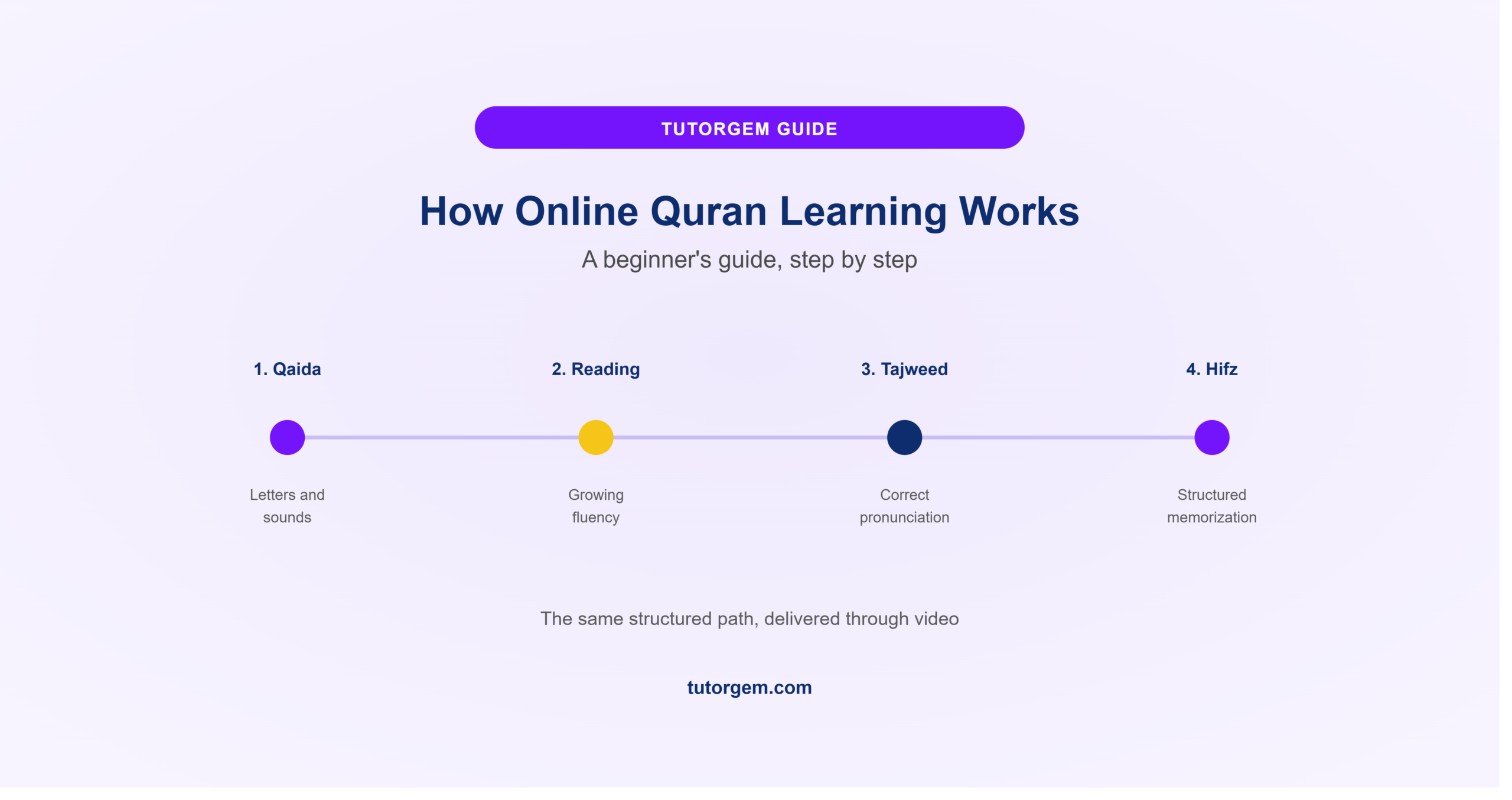
The overall structure of online Quran learning mirrors traditional in-person teaching closely, simply delivered through video rather than a shared physical room.
Starting With Noorani Qaida for True Beginners
Complete beginners typically start with Noorani Qaida, a foundational course covering Arabic letters, their sounds, and how they join together to form words. This foundation matters significantly, since skipping ahead to full Quran reading without it often creates pronunciation gaps that become harder to fix later.
| Stage | What It Covers | Typical Starting Point |
|---|---|---|
| Noorani Qaida | Arabic letters and basic sounds | Complete beginners, including young children |
| Quran reading | Reading full text with growing fluency | After completing Qaida foundation |
| Tajweed | Correct pronunciation rules | Alongside or after basic reading fluency |
| Hifz | Structured memorization | Once reading and Tajweed feel solid |
| Tafsir | Understanding meaning | Any stage, often alongside memorization |
Moving Into Recitation and Tajweed Correction
Once basic reading fluency develops, lessons shift toward Tajweed, the rules governing correct pronunciation and articulation of each letter. A tutor listens to recitation in real time during each session, correcting mistakes immediately rather than letting them repeat unnoticed.
What Comes After the Basics
Students who reach a comfortable reading level often continue toward memorization, though this step is entirely optional and depends on individual goals.
Hifz and Ongoing Revision Explained Simply
Hifz, or memorization, follows a structured daily cycle balancing new memorization with revision of previously learned material, since memory naturally fades without consistent review. Online sessions manage this balance directly, checking new memorization accuracy while also revisiting earlier sections regularly.
A Real Case: A Beginner’s First Few Months Online
One TutorGem family enrolled their eight-year-old daughter with no prior Arabic reading experience, unsure how a young child would manage lessons through a screen.
Her first month focused entirely on Noorani Qaida, moving letter by letter at a pace suited to her age and attention span. By her third month, she had progressed to reading short verses independently, with her tutor correcting pronunciation gently along the way.
This case reflects how learning Quran online works in practice. Structured pacing, not speed, produces genuine, lasting progress, especially for younger beginners.
What to Expect in Terms of Schedule and Pace
Most students attend two to three sessions weekly, each lasting thirty to forty-five minutes, though this varies based on age and specific learning goals.
Questions to Ask Before Your First Lesson
Ask how the tutor will assess your current level during that very first session. Ask what the typical weekly schedule looks like, and how progress gets tracked and communicated over time.
How TutorGem Structures Online Quran Learning
TutorGem’s Quran tutoring programme follows this exact structured path, starting with an honest assessment of a student’s current level before building a personalized plan through Qaida, reading, Tajweed, and memorization as appropriate.
Frequently Asked Questions
Do I need any prior Arabic knowledge before starting online Quran lessons?
No. Complete beginners typically start with Noorani Qaida, which teaches Arabic letters and sounds from the very beginning, requiring no prior knowledge at all.
How long does a typical online Quran lesson last?
Most sessions run thirty to forty-five minutes, though length can vary based on a student’s age and how many sessions they attend each week.
Can young children genuinely learn effectively through online Quran lessons?
Yes. Many online tutors specifically adjust pacing and teaching style for younger children, using shorter segments and simpler explanations suited to their attention span.
What happens during the very first online Quran lesson?
Most tutors begin with a short assessment of current reading ability, using this to build a personalized starting point rather than assuming a fixed level for every student.
Is memorization required as part of learning Quran online?
No. Memorization, or Hifz, is optional and depends entirely on individual goals, with many students focusing purely on reading fluency and correct Tajweed instead.
Understanding how learning Quran online works removes the uncertainty that often holds families back from starting. If you are ready to begin but unsure where your current level fits, TutorGem’s qualified Quran tutors can assess your starting point this week and build a clear, structured plan from there.