IGCSE & AS Level and A Level Chemistry: Full Curriculum and Content Comparison
Chemistry students rarely get a clear picture of how IGCSE content actually connects to what comes next. They finish two years of IGCSE topics, then AS-Level Chemistry begins as if starting fresh.
IGCSE & AS level and A level chemistry comparison actually reveals a tightly connected progression, where IGCSE builds the exact foundation that AS-Level and A-Level chemistry depend on directly. Cambridge designs it this way on purpose, not by coincidence.
This guide compares all three stages side by side, showing exactly which IGCSE topics carry forward, what changes at AS-Level, and what A-Level adds on top. Read this before planning your revision timeline across all three stages.
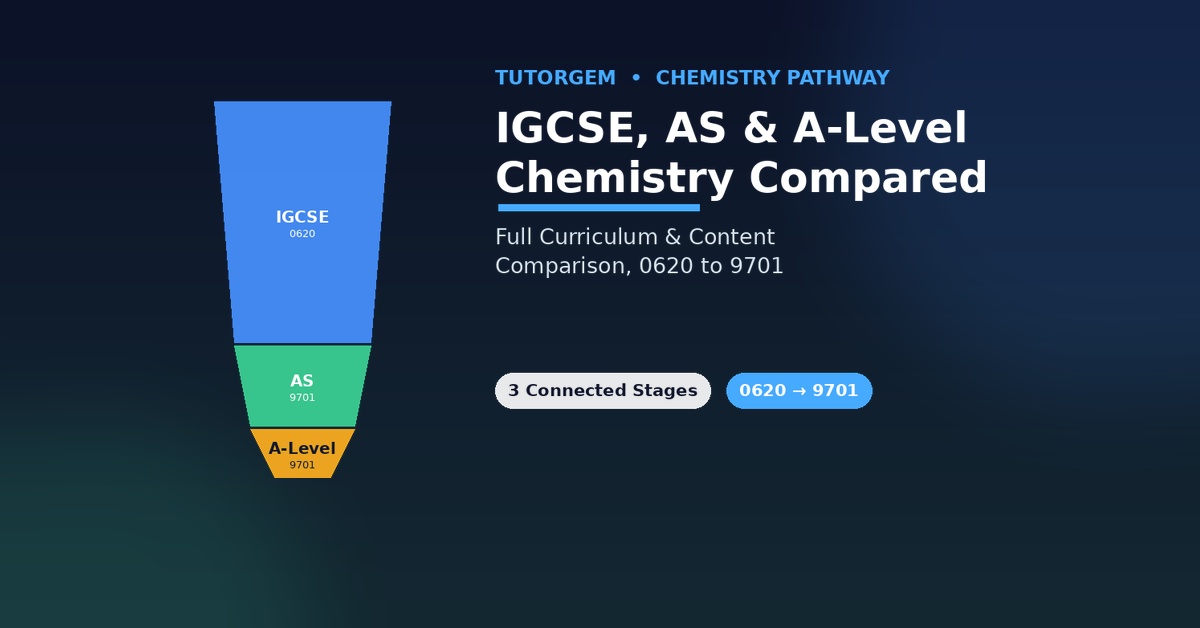
The Full Chemistry Pathway: IGCSE, AS level and A level chemistry at a Glance
Seeing all three Cambridge chemistry syllabuses side by side makes the progression far easier to follow than reading about each one separately.
| Stage | Syllabus Code | Topic Areas | Tiers | Papers |
|---|---|---|---|---|
| IGCSE | 0620 | 12 to 14 topic areas | Core (grades C to G) and Extended (grades A* to E) | 3 papers, no coursework |
| AS-Level | 9701 (AS component) | Physical, inorganic, organic foundations | Single tier | Part of 5-paper structure |
| A-Level | 9701 (full) | Physical, inorganic, organic in depth | Single tier | 5 papers total, including 2 practical papers |
What IGCSE Chemistry Actually Builds
IGCSE Chemistry 0620 covers foundational ground including:
- Atomic structure
- The mole and stoichiometry
- Acids and bases
- Electrolysis
- The reactivity series
- Introductory organic chemistry, covering alkanes and alkenes
Cambridge’s own syllabus documentation confirms that candidates achieving grades A* to C are well prepared to progress directly into AS-Level and A-Level Chemistry.
Why the Core and Extended Tiers Matter for Progression
Students sitting the Core tier are capped at grade C, while Extended tier students can reach A*. This tier choice has real consequences for AS-Level readiness. A student aiming for AS-Level Chemistry needs the deeper content only the Extended tier actually covers, since Core tier alone often leaves genuine gaps.
How AS-Level Chemistry Builds Directly on IGCSE Foundations
AS-Level chemistry takes IGCSE’s introductory mole calculations and stoichiometry and extends them into full atomic structure, bonding theory, and energetics. The organic chemistry that started with simple alkanes and alkenes at IGCSE grows into hydrocarbons, halogenoalkanes, alcohols, and carbonyl compounds at AS-Level.
The Topics That Carry Forward Without Change
Fundamental skills don’t get relearned at AS-Level, they get assumed. This includes:
- Balancing equations
- Mole calculations
- Understanding the periodic table
This is precisely why weak IGCSE foundations in these specific areas cause disproportionate struggle once AS-Level begins.
What A-Level Adds That IGCSE Never Touches
The second half of A-Level introduces content with no real IGCSE equivalent at all, including:
- Transition elements
- Aromatic chemistry
- Nitrogen-containing organic compounds
This is the stage where chemistry becomes genuinely new material, rather than a deeper version of something already familiar.
Three-Way Topic Comparison Table
| Chemistry Topic | IGCSE Level | AS-Level | Full A-Level |
|---|---|---|---|
| Mole calculations | Introduced | Extended into gas volumes and complex stoichiometry | Applied within advanced calculations |
| Organic chemistry | Alkanes, alkenes basics | Hydrocarbons, halogenoalkanes, alcohols, carbonyls | Aromatic compounds, carboxylic acids, nitrogen chemistry |
| Periodic table | Basic trends | Periodicity, Groups 2 and 17 | Transition elements |
| Practical skills | Practical or alternative-to-practical paper | Woven through theory papers | Two dedicated practical-skills papers |
A Realistic Progression Example
One TutorGem student scored a grade B in IGCSE Extended Chemistry, comfortable with mole calculations but shaky on organic naming conventions. That specific gap, left unaddressed, showed up again within the first month of AS-Level organic chemistry, confirming exactly how directly these stages connect rather than starting over.
Common Mistakes Students Make Across the Three Stages
- Assuming AS-Level chemistry starts from zero, which leads students to skip revisiting IGCSE organic naming and mole calculation skills that AS-Level assumes are already solid
- Choosing the Core tier at IGCSE without realising it limits AS-Level readiness, a frequent error that surfaces too late to fix easily
- Treating the jump into A-Level as more of the same, when it introduces genuinely new topics with no IGCSE foundation at all
How TutorGem Supports Students Across the Chemistry Pathway
TutorGem’s chemistry tutors work with students continuously from IGCSE through to A-Level, which means gaps from Core tier choices or shaky IGCSE organic chemistry get identified and fixed before they resurface as AS-Level or A-Level struggles. This continuity across all three stages is what keeps the whole chemistry pathway coherent.
Frequently Asked Questions
Does IGCSE Chemistry prepare students for AS-Level Chemistry?
Yes. Cambridge’s own syllabus confirms that students achieving grades A to C in IGCSE Chemistry, particularly at Extended tier, are well prepared to progress into AS-Level and A-Level Chemistry.
What is the IGCSE & AS level and A level chemistry comparison in terms of topic count?
IGCSE Chemistry 0620 covers 12 to 14 topic areas at a foundational level, while AS-Level and A-Level combined build those same core concepts, atomic structure, organic chemistry, and periodicity, into significantly greater depth across the 9701 syllabus.
Should I take Extended tier at IGCSE if I want to study AS Chemistry?
Yes, generally. Extended tier covers the deeper content that AS-Level assumes as a foundation, while Core tier alone often leaves gaps that surface once AS-Level chemistry begins.
What chemistry topics does A-Level introduce that IGCSE never covers?
A-Level introduces transition elements, aromatic chemistry, carboxylic acids, and nitrogen-containing organic compounds, none of which appear at IGCSE level at all.
Are IGCSE & AS Level and A Level Chemistry assessed by the same exam board?
Cambridge International runs all three under this pathway, IGCSE Chemistry as syllabus 0620 and AS-Level and A-Level Chemistry as syllabus 9701, ensuring continuity in how the subject is structured and assessed.
Seeing IGCSE & AS Level and A Level chemistry as one connected subject, rather than three separate courses, changes how students should actually prepare at each stage. If you want a chemistry plan that carries your IGCSE foundations all the way through to a strong final A-Level result, TutorGem’s tutors can build that continuity with you.