IGCSE AS Level A Level Physics: Full Curriculum and Content Comparison
Physics students rarely see how their IGCSE work actually connects to what comes next. They finish two years of forces, energy, and waves, then AS-Level Physics begins as if none of that came before it.
IGCSE AS Level A Level Physics comparison actually reveals a deliberately built progression. Cambridge designs IGCSE Physics specifically as preparation for AS and full A-Level Physics, not as a separate, disconnected course.
This guide compares all three stages side by side, showing exactly which IGCSE topics carry forward, what changes at AS-Level, and what the second half of A-Level adds on top. Read this before mapping out your revision across all three stages.
The Full Physics Pathway: IGCSE to A-Level at a Glance
Seeing all three Cambridge physics syllabuses side by side makes the IGCSE AS Level A Level Physics progression far easier to follow than reading about each one separately.
| Stage | Syllabus Code | Guided Learning Hours | Entry Expectation |
|---|---|---|---|
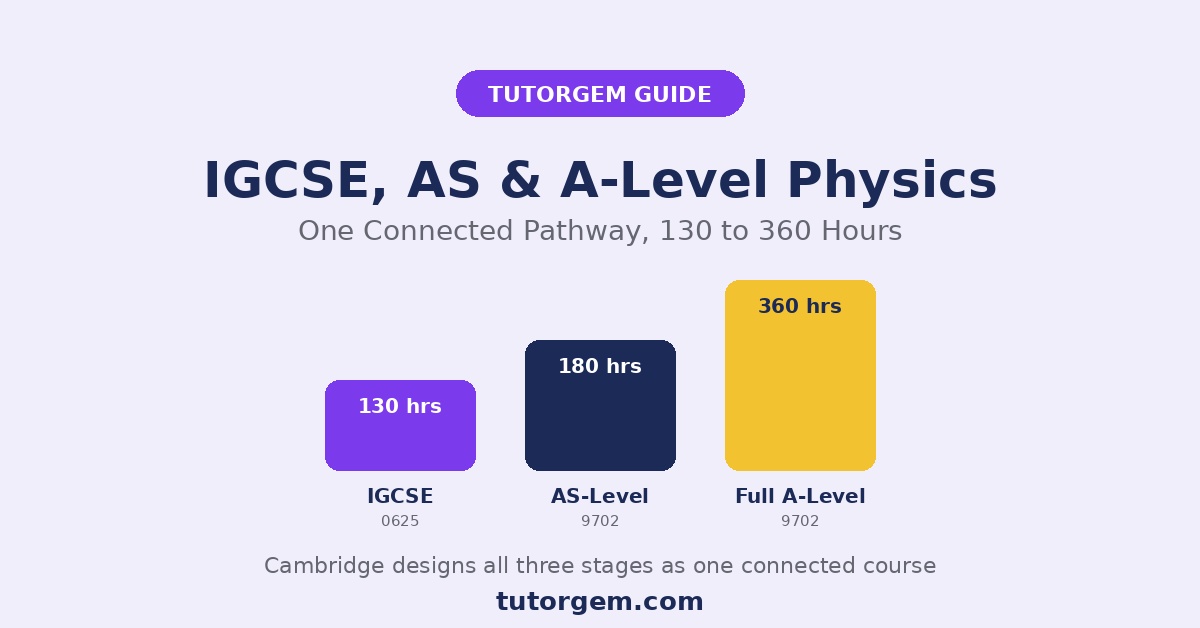
| IGCSE | 0625 | 130 hours | Prior Cambridge Lower Secondary science, or equivalent |
| AS-Level | 9702 (AS component) | Around 180 hours | IGCSE grade A*, A, or B in Physics and Mathematics recommended |
| Full A-Level | 9702 (full) | Around 360 hours | Solid AS-Level foundation |
What IGCSE Physics Actually Builds
IGCSE Physics 0625 covers foundational ground including:
- General physics, covering motion, forces, mass, and density
- Thermal physics
- Properties of waves, including light and sound
- Electricity and magnetism
- Atomic physics
- Space physics, in the current syllabus version
Cambridge’s own documentation explicitly recommends this course as previous study for Cambridge International AS and A Level Physics 9702. This is not a coincidence. It’s a deliberately built pathway.
Why the Recommended IGCSE Grade Matters
Schools and centres commonly expect a grade of A*, A, or B in IGCSE Physics and Mathematics before recommending a student move on to AS-Level Physics. This isn’t arbitrary. AS-Level assumes the mathematical and conceptual foundation IGCSE builds, particularly around forces, energy, and basic wave behaviour.
How AS-Level Physics Builds Directly on IGCSE Foundations
AS-Level Physics takes IGCSE’s introductory treatment of motion and forces and extends it into full kinematics, dynamics, and measurement technique, including formal uncertainty analysis. The wave content that started with light and sound at IGCSE grows into waves and superposition as a dedicated AS-Level topic.
The Skills That Carry Forward Without Being Retaught
Several foundational skills don’t get relearned at AS-Level, they get assumed:
- Basic understanding of forces, mass, and motion
- Core electrical circuit concepts
- Fundamental wave properties
This is precisely why weak IGCSE foundations in these specific areas cause disproportionate struggle once AS-Level begins.
What the Second Half of A-Level Adds That IGCSE Never Touches
The second half of A-Level introduces content with no real IGCSE equivalent at all, including:
- Gravitational, electric, and magnetic fields
- Capacitance
- Thermodynamics and ideal gases
- Quantum physics
This is the stage where physics becomes genuinely new material, not simply a deeper version of something already familiar from IGCSE or AS-Level.
Three-Way Topic Comparison Table
| Physics Topic | IGCSE Level | AS-Level | Full A-Level |
|---|---|---|---|
| Mechanics | Basic motion, forces, mass, density | Full kinematics, dynamics, work, energy, power | Circular motion added |
| Waves | Light and sound basics | Waves and superposition | Oscillations in depth |
| Electricity | Basic circuits | D.C. circuits in depth | Fields, capacitance |
| Thermal and Modern Physics | Thermal physics basics | Introductory particle and nuclear physics | Thermodynamics, ideal gases, quantum physics |
A Realistic Progression Example
One TutorGem student scored a grade B in IGCSE Physics, comfortable with basic mechanics but shaky on formal uncertainty analysis in practical work. That specific gap resurfaced almost immediately in AS-Level, where measurement technique carries real, assessed weight from the very first practical paper.
Addressing that gap before AS-Level began meant the student wasn’t learning a brand new skill under exam pressure.
Common Mistakes Students Make Across the Three Stages
- Assuming AS-Level Physics starts from zero, when it actually assumes solid IGCSE mechanics and basic circuit knowledge
- Underestimating how much IGCSE grade matters for AS-Level readiness, since a grade below the recommended A* to B range often signals real gaps
- Treating the second half of A-Level as more of the same, when fields and quantum physics have no direct foundation in either IGCSE or AS-Level content
How TutorGem Supports Students Across the Physics Pathway?
TutorGem’s physics tutors work with students continuously from IGCSE through to full A-Level, which means gaps in mechanics or measurement technique get identified and fixed before they resurface as AS-Level or later struggles. This continuity across all three stages is what keeps the whole IGCSE AS Level A Level Physics pathway coherent, rather than three disconnected scrambles.
Frequently Asked Questions
Does IGCSE Physics prepare students for AS-Level Physics?
Yes. Cambridge’s own syllabus documentation explicitly recommends IGCSE Physics as previous study for Cambridge International AS and A Level Physics, confirming the two are designed as a connected pathway.
What IGCSE grade do I need for AS-Level Physics?
Most schools and centres recommend a grade of A*, A, or B in both IGCSE Physics and Mathematics before progressing to AS-Level Physics, since AS-Level assumes that foundation is already solid.
What is the IGCSE AS Level A Level Physics comparison in terms of guided learning hours?
IGCSE Physics uses around 130 guided learning hours, AS-Level adds roughly 180 more hours, and full A-Level totals around 360 hours across both years combined.
What physics topics appear only in the second half of A-Level?
Gravitational, electric, and magnetic fields, capacitance, thermodynamics, ideal gases, and quantum physics all appear for the first time in the second half of A-Level, with no direct IGCSE or AS-Level equivalent.
Are IGCSE, AS-Level, and A-Level Physics assessed by the same exam board?
Cambridge International runs all three under this pathway, IGCSE Physics as syllabus 0625 and AS-Level and A-Level Physics as syllabus 9702, ensuring continuity in how the subject is structured and assessed.
Seeing IGCSE, AS-Level, and full A-Level physics as one connected subject, rather than three separate courses, changes how students should actually prepare at each stage. If you want a physics plan that carries your IGCSE foundations all the way through to a strong final A-Level result, TutorGem’s tutors can build that continuity with you.