Can AI Help Preparation of A Level Chemistry?
AI help preparation of A Level Chemistry is sometimes a risky practice, because whether that explanation is actually correct is a completely different question, and the research on this is more mixed than the hype suggests.
AI help preparation of A Level Chemistry genuinely works for some tasks and commonly fails at others, and the failures tend to show up in exactly the areas where students already lose the most marks. That overlap matters more than most AI hype articles ever mention.
This guide covers what AI tools are actually reliable for, where the published research shows real accuracy problems, and how to use AI without letting it quietly teach you something wrong. Read this before trusting on AI help preparation of A Level Chemistry for especially exams content.
What the Research Actually Shows
Accuracy on chemistry questions varies enormously depending on the model, the question type, and the chemistry topic itself. This isn’t marketing spin, it’s a consistent pattern across multiple published studies.
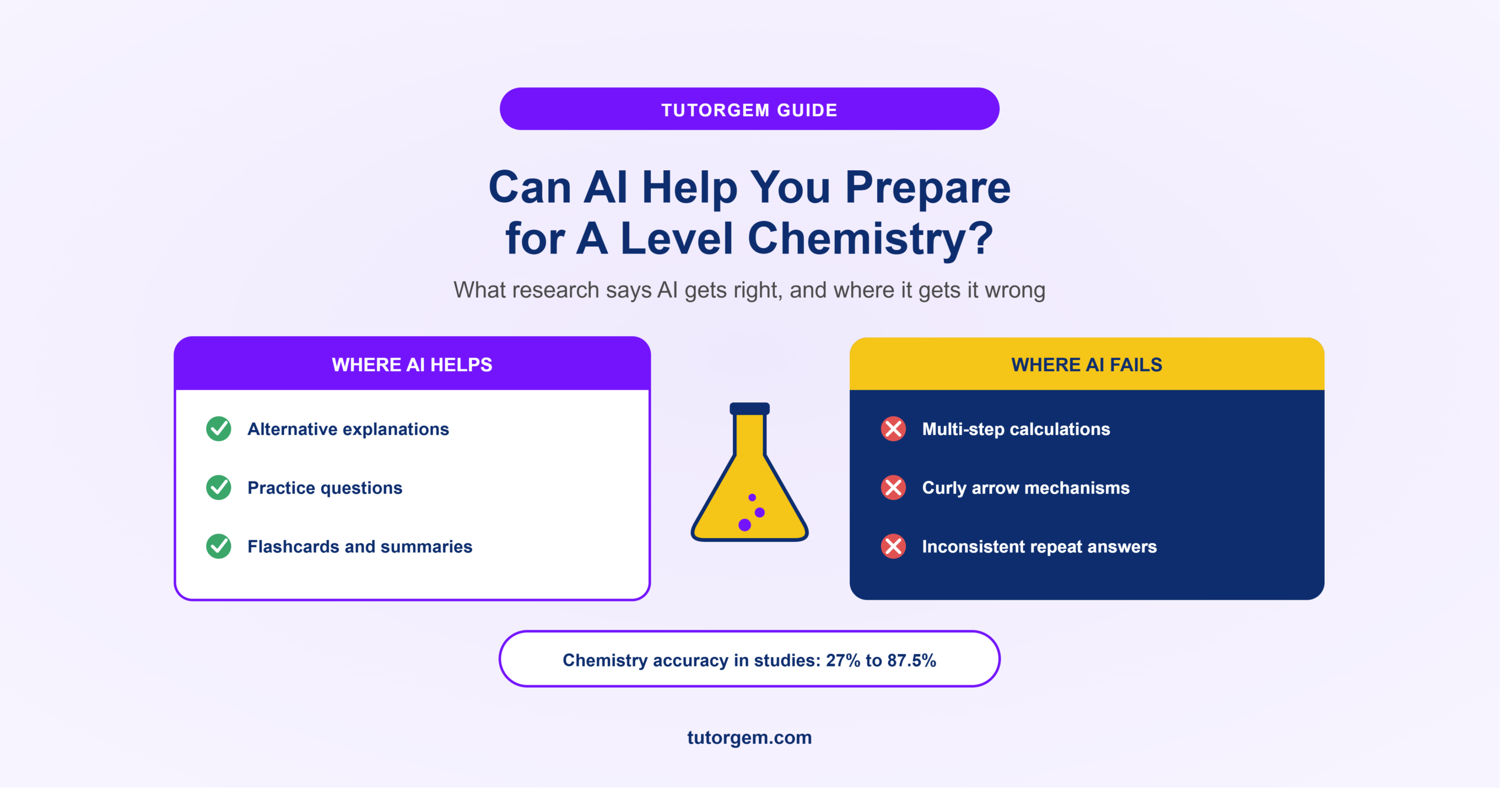
- One study found ChatGPT-3.5 scored a mean of just 27% on multiple-choice and free response general chemistry questions
- A separate evaluation found 47% accuracy on non-numeric chemistry questions
- A more recent comparison using newer models found Gemini AI scoring 87.5% and GPT-4o scoring 85.3% on a 120-question multiple-choice set, a huge jump from earlier results
- Across nearly every study, accuracy dropped noticeably for calculation-based questions specifically, regardless of which model was tested
The pattern is clear: newer models perform far better than older ones, but calculation-heavy and mechanism-heavy chemistry remains a consistent weak spot.
Where Genuinely AI Help Preparation of A Level Chemistry?
The following information help you understand where AI help preparation of A Level Chemistry:
Explaining Concepts in Different Ways
If a textbook explanation of equilibrium or bonding isn’t clicking, asking AI to explain it differently, or at a simpler reading level, genuinely works well. This is one of the more reliably useful applications, since it draws on well-established, frequently repeated chemistry concepts that appear extensively in AI training data.
Generating Practice Questions and Flashcards
AI tools are genuinely useful for quickly generating flashcards, outline summaries, and practice question sets around a topic you’ve already studied. This saves real time compared to building these resources manually, and the risk of a factual error here is lower than in open-ended mechanism or calculation questions.
Textbook-Level Organic Chemistry Explanations
Research specifically testing ChatGPT on organic chemistry found it performs at “university textbook-level knowledge” on well-established, frequently taught reactions. For standard, commonly covered organic chemistry, AI explanations tend to be reasonably reliable.
Where AI Help Preparation of A Level Chemistry AI Genuinely Failed?
In the following perspectives AI help preparation of A Level Chemistry is a failed practice:
Multi-Step Numerical Calculations
This is the single most consistent weak spot across every study reviewed. Accuracy drops noticeably whenever a question requires multiple calculation steps, precise data handling, or careful unit tracking, exactly the skills A-Level Chemistry calculation questions demand.
Reaction Mechanisms Under Pressure
Research evaluating ChatGPT’s organic mechanism explanations found that while responses often sound sophisticated and confident, a significant portion contain minor inaccuracies that can genuinely mislead a learner. This matters enormously for A-Level Chemistry specifically, since examiner reports consistently flag curly arrow direction and missing lone pairs as common student errors. An AI tool confidently getting these same details wrong teaches the exact mistake examiners already penalise.
Inconsistent Answers to the Same Question
One study specifically noted ChatGPT gave inconsistent answers when asked the identical question twice, sometimes correct, sometimes not. This unpredictability makes AI a poor sole source for verifying whether your own understanding of a tricky concept is actually correct.
Niche or Advanced Subtopics
Research testing ChatGPT across different chemistry subfields found it performed well on established, well-documented areas but either gave confidently wrong answers or refused to answer entirely when prompted on more specialised topics like polymer chemistry or reaction kinetics specifics.
A Practical Rule: Use AI to Generate, Not to Verify
The safest way to use AI help preparation of A Level Chemistry is to let it generate a first draft explanation or practice question, then verify the content yourself against your syllabus, textbook, or a tutor. Treating AI output as a final, trusted answer on anything calculation-heavy or mechanism-heavy is where the real risk sits.
This mirrors exactly how the strongest Chemistry students already work, cross-checking their own understanding against a reliable source rather than trusting a single pass through material.
A Realistic Example From TutorGend Sessions
As per our experience, our one student used ChatGPT to check a nucleophilic substitution mechanism answer before a mock exam. The AI’s explanation looked confident and well-structured, but got the direction of one curly arrow wrong, the exact error examiner reports flag as one of the most common mistakes in this topic. Catching it required a tutor session, not another AI query.
Common Mistakes Students Make When Using AI for Chemistry
- Trusting AI-generated calculations without checking the working, since accuracy drops specifically on multi-step numerical questions
- Accepting a confident-sounding mechanism explanation without verifying curly arrow direction, exactly where research shows AI tools make frequent, subtle errors
- Asking the same question twice and assuming consistency, when studies show answers can genuinely vary between identical prompts
How TutorGem Supports Students Using AI Responsibly?
TutorGem offers Tutor AI as a genuinely useful starting point, generating practice questions and alternative explanations, while verifying the specific calculation and mechanism content where research shows AI accuracy consistently drops.
The Tutor AI is designed by our expert tutors and they all have put their subject related expertise in it. The tool mostly answer from the data shared by our our teachers and less probably answer from the Ai support.
Frequently Asked Questions
AI help preparation of A Level Chemistry calculations?
Not consistently. Research across multiple studies shows accuracy drops noticeably on multi-step numerical questions compared to conceptual, text-based questions, so calculation answers should always be checked.
Can AI explain organic chemistry mechanisms correctly?
Often, but not always. Research found AI explanations can sound sophisticated while containing minor but genuine inaccuracies, particularly around curly arrow direction, a common source of real student errors too.
Which AI tasks are safest for A-Level Chemistry revision?
Generating practice questions, flashcards, and alternative explanations of well-established concepts tend to be the more reliable uses, since these draw on frequently repeated, well-documented chemistry content.
Does AI give the same answer every time to the same chemistry question?
Not necessarily. At least one study found inconsistent answers when the identical question was asked twice, which is worth knowing before relying on AI to confirm your own understanding.
Are newer AI models more accurate for chemistry than older ones?
Yes, generally. Studies show a significant accuracy jump between older models and newer ones on multiple-choice chemistry questions, though calculation-heavy questions remain a weak spot across most models tested.
Understanding exactly where AI help preparation of A Level Chemistry support genuinely helps, and where published research shows it still gets things wrong, means you can use these tools without letting them quietly teach you an examiner-penalised mistake. If you want a tutor to verify the tricky mechanisms and calculations AI tends to get wrong, TutorGem’s chemistry tutors are ready to help.