AS Level and A Level Biology: Curriculum and Content Compared
Biology students often hit a wall in Year 13. AS-Level felt manageable. Then the second half of A-Level arrives, and suddenly photosynthesis, respiration, and genetics all demand a level of detail nobody warned them about.
AS Level and A Level biology difference is not just a feeling. It is written directly into Cambridge’s own syllabus structure and paper weighting. Once you see the real numbers, the jump makes sense.
This guide breaks down exactly what AS-Level Biology covers, what full A-Level adds, and how the five Cambridge papers reflect that growing depth. Read this before you plan your revision schedule, not after.
How Cambridge Structures AS Level and A Level Biology (9700)
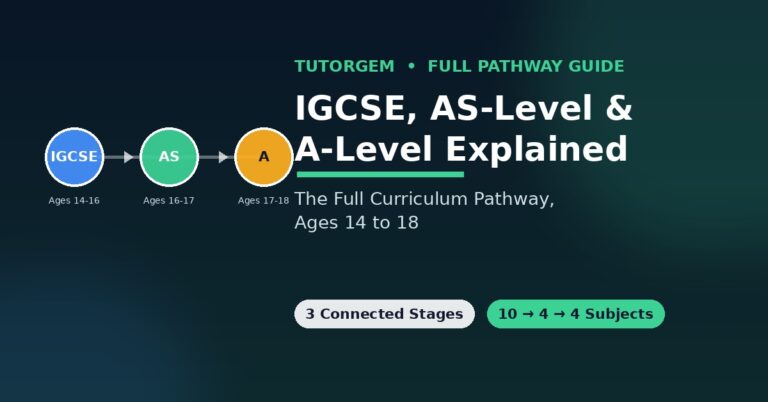
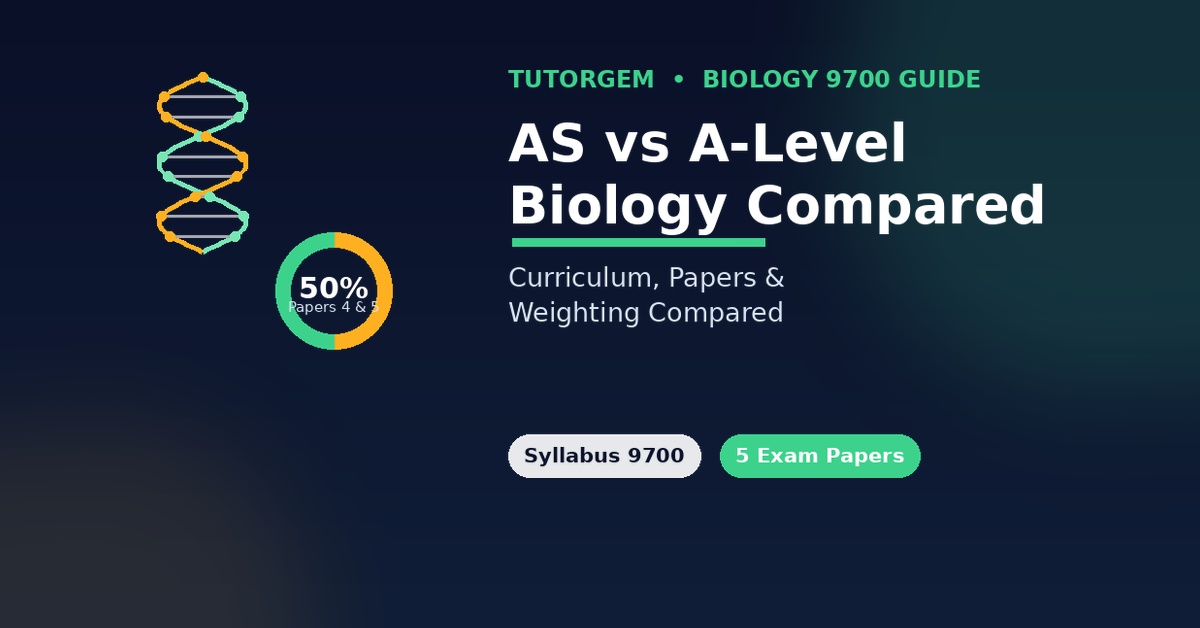
Cambridge International AS Level and A Level Biology, syllabus code 9700, splits its five-paper assessment between AS content in Papers 1 to 3, and the second half of A-Level content in Papers 4 and 5.
What AS-Level Biology Actually Covers
AS content focuses on the building blocks of the subject. It includes:
- Cell structure and organisation
- Biological molecules, including carbohydrates, lipids, proteins, and nucleic acids
- Enzymes
- Cell membranes and transport
- The mitotic cell cycle
- Nucleic acids and protein synthesis
- Transport in plants and mammals
- Gas exchange
- Infectious diseases and immunity
What Full A-Level Adds on Top of the AS Foundation
The second half of A-Level shifts from structure toward process and system-level biology. New topics include:
- Energy and respiration, including ATP, glycolysis, and the Krebs cycle
- Photosynthesis, both light-dependent and light-independent reactions
- Homeostasis, covering thermoregulation, blood glucose control, and osmoregulation
- Control and coordination, including nervous and hormonal communication
- Inherited change, covering genetics, gene expression, and gene technology
- Selection and evolution
Topic Comparison Table:
The following table highlights the difference between AS Level and A Level biology on the basis of their content:
| Biology Branch | AS-Level Content | A-Level Additional Content |
| Cell Biology | Cell structure, membranes, mitotic cycle | Not directly extended |
| Molecular Biology | Biological molecules, enzymes, protein synthesis | Gene technology, gene expression |
| Physiology | Transport in plants and mammals, gas exchange | Homeostasis, control and coordination |
| Energy Systems | Not covered | Respiration, photosynthesis |
| Genetics and Evolution | Nucleic acids basics | Inheritance, selection, evolution |
| Immunity | Infectious disease, immunity | Not directly extended |
How the Five Exam Papers Reflect the AS Level and A Level Biology Split?
The paper structure confirms exactly how the weighting shifts once the second half of A-Level content enters.
| Paper | Content Tested | Weight at AS-Level | Weight at Full A-Level |
| Paper 1: Multiple Choice | AS content | 31% | 15.5% |
| Paper 2: AS Structured Questions | AS content | 46% | 23% |
| Paper 3: Advanced Practical Skills | AS content | 23% | 11.5% |
| Paper 4: A Level Structured Questions | Second-half content | Not applicable | 38.5% |
| Paper 5: Planning, Analysis and Evaluation | Second-half content | Not applicable | 11.5% |
Papers 4 and 5 together make up exactly half of the full A-Level grade. That single fact explains why students who coast through AS often struggle once the second half begins. Half of the final mark rests entirely on content they have not seen yet.
Why A level Never Appears at the AS Stage?
Cambridge’s own grade threshold documents confirm something many students never realise. Grade A does not exist at the level of an individual component. It only applies once AS and full A-Level marks are combined into one final award.
The numbers back this up:
- Full A-Level maximum weighted mark: 260
- AS-only maximum weighted mark: 130
- Second-half-only maximum weighted mark: 130
A standalone AS-Level result simply cannot reach an A, no matter how strong the performance.
Is the Second Half of A-Level Biology Genuinely Harder Than AS Biology?
It is not AS biology repeated at a harder level. It introduces entirely new systems, respiration and photosynthesis chief among them, that AS never touches directly. Students also need to connect ideas across topics, linking cell membrane structure from AS to osmoregulation later on, for example.
This is where many students get caught out. They assume it’s just “more of the same.” It is not.
A Realistic Example From TutorGem Sessions
One TutorGem student scored a B grade in AS Biology, strong on cell structure but shaky on enzyme kinetics. That specific gap resurfaced within weeks of starting the respiration topic, where enzyme-controlled reaction rates suddenly mattered again, this time at a much higher level of detail.
Our biology tutors fix the AS level gap first made the new topic click far faster than trying to teach respiration from scratch.
Common Mistakes Students Make Across the Two Stages
The below are some common mistakes students make in both AS Level and A Level biology:
- Assuming strong AS results guarantee an easy transition, when half the final grade depends on genuinely new content
- Treating practical skills as separate from theory, when Cambridge assesses them continuously through Papers 3 and 5
- Underestimating how disconnected respiration and photosynthesis feel from AS content, since neither topic has a direct AS-level equivalent
Practical Skills Across Both Stages
AS-Level assesses practical skills through Paper 3, worth 23% of the AS award. At full A-Level, that continues through Paper 5, which shifts focus toward planning, analysing, and evaluating experiments rather than just carrying them out.
Students who treat practical work as a side skill, separate from theory, tend to lose marks disproportionately here.
How TutorGem Supports Students Through the Biology Transition
TutorGem’s biology tutors map revision directly onto the 9700 paper structure. This means specific AS weaknesses, whether in enzymes, cell transport, or molecular biology, get identified and fixed before they resurface as bigger problems later.
Since Papers 4 and 5 alone decide half of the final grade, getting that preparation right matters just as much as AS ever did.
Frequently Asked Questions
What is the main AS Level and A Level biology difference in content?
AS-Level Biology covers cell structure, biological molecules, enzymes, and transport systems. The second half of A-Level adds respiration, photosynthesis, homeostasis, genetics, and evolution, tested through Papers 4 and 5, which together make up half of the full A-Level weighting.
Is the second half of A-Level biology harder than AS biology?
Many students find it genuinely harder. It introduces new systems like respiration and photosynthesis rather than simply extending AS content at greater difficulty.
How many exam papers does Cambridge Biology 9700 have?
Cambridge Biology 9700 uses five papers. Papers 1 to 3 assess AS content, while Papers 4 and 5 assess the second half of A-Level content exclusively.
Does AS Biology content still matter once I reach the second half of A-Level?
Yes, significantly. Topics like homeostasis build directly on AS concepts such as cell membranes and transport, so weak AS foundations tend to resurface as difficulty later.
What new topics appear only in the second half of A-Level Biology?
The second half introduces energy and respiration, photosynthesis, homeostasis, inherited change, and selection and evolution, none of which appear in the AS content.
Understanding exactly how AS and full A-Level biology content and paper weighting connect makes the transition between them far less overwhelming. If you want a revision plan built around the specific AS foundations your later topics depend on, TutorGem’s biology tutors can map that out with you.